Refined Products, Crude Oil
July 28, 2025
US-EU trade deal could struggle to transform transatlantic oil trade: analysts
By Kelly Norways, Max Lin, and Binish Azhar
HIGHLIGHTS
$250 bil/year US energy purchases would be three times current EU level
US already largest import source for European refiners; more facilities closing
US refining configurations leave little scope to ramp up middle distillate exports
An EU pledge to buy $750 billion worth of US energy in the next three years may do little to supercharge its oil trade, market analysts have said, flagging a contracting refining sector and limited scope to shift private buying practices.
A US-EU trade deal was heralded by both sides July 27 as a major breakthrough in transatlantic relations, seeing the union halve proposed tariffs on its exports to 15% in exchange for major investment pledges.
A cornerstone of the agreement was an EU commitment to make significant purchases of US LNG, oil and nuclear fuels to replace Russian energy, without providing breakout targets by sector. An EU official told Platts that the formal text is expected to be published by Aug. 1.
However, responding to the deal, energy experts cast doubt over the EU's scope to dramatically hike its energy imports, particularly in the oil market.
Based on Eurostat data, an agreement to purchase $250 billion/year of US energy would represent triple the value of current EU imports, of which crude oil accounts for roughly 55% and refined products an additional 14%.
Speaking to Platts July 28, Aldo Spanjer, Head of Energy Strategy at European Bank BNP Paribas, said that the $750 billion energy spend was "clearly unachievable," and speculated that transatlantic gas trade would be the main beneficiary.
"I see longer-term commitments, e.g., signing 20-year offtake contracts with the next wave of US liquefaction terminals as the only way to get close to such a number," he said.
Crude plateau
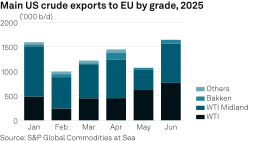
In contrast, Europe could struggle to draw more US crude oil, which is already the main feedstock imported by its refiners.
Since Russia's invasion of Ukraine in 2022, European refiners have already pivoted strongly to US crude to service their operations, and imports grew by almost 800,000 b/d between 2021 and 2023, according to S&P Global Commodities at Sea data.
In 2023 and 2024, US crude shipments to Europe reached 1.9 million b/d, CAS data showed, representing roughly 20% of total imports each year. Northwest Europe is the lead destination for US crude exports, also accounting for around a fifth of shipments.
Global US exports peaked in February 2023, according to historical data from the US Energy Information Administration, when the volume reached a record 5.63 million b/d.
However, the light sweet WTI Midland crude shipped from the US has provided an imperfect substitute to the medium sour Russian Urals grade historically favored by European refiners, contributing to higher yields of products like gasoline and too little diesel and jet fuel.
Implementation challenge
Unlike in other refining hubs such as the Middle East, European lawmakers have little recourse to mandate higher US crude purchases among a mostly private refining sector that is already struggling to stay competitive.
"The EU does not have a centralized procurement mechanism for fossil energy," said Aldo Spanjer. "Actual purchasing decisions are made by private firms or national entities, and in practice, market economics override political pledges," he said.
"Governments could invest and commit to building more strategic reserves, but that has limits. I think it would need to be private sector-led," said Rachel Ziemba, a senior adviser at consultancy Horizon Engage, who called the target "optimistic."
The EU official conceded that details of the deal were still being hashed out, with little clarity over whether the final text would need approval from the European Parliament and Council. "We still do not know the exact legal basis it will have," the official told Platts.
Refining contraction
Even if the US can grow its share of the European crude import market, the sector is quickly shrinking. Already, the continent has been battling a wave of refining closures as oil demand plateaus and low-cost competitors have put pressure on refiners, causing closures to stack up.
According to S&P Global Energy analysts, roughly 900,000 b/d of refining capacity is set to shut down in 2025 across Europe and North America, with more announcements likely in the coming years.
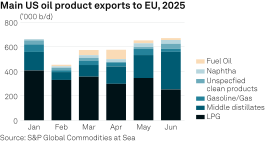
As closures gather pace, Europe will be forced to the import market for more of its fuel, particularly the middle distillates for which it is in short supply. That shortage may only become more pronounced as the bloc implements a new import ban on refined products made from Russian crude in 2026.
However, North America's own refining sector could be ill-poised to plug the deficit. US refiners are typically configured to maximize light-end products like gasoline, which the country has to supplement with its own imports. And like Europe, many facilities are battling closure.
As the agreement is finalized, the US-EU trade deal could provide a welcome macroeconomic indicator that could prop up global oil demand and stave off recessionary risks.
Brent crude oil futures rallied above $70/b July 28, higher than the market close for over two weeks. However, analysts have warned that the economic outlook remains challenged. "The overall US tariff level is the highest in nearly 100 years and the percentage average is almost six-fold the level from late last year," said Tim Moore, Senior Research Analyst at US brokerage Clear Street.

Editor: