Refined Products, Agriculture, Energy Transition, Jet Fuel, Biofuel, Renewables
January 28, 2026
Volatile sustainable aviation fuel prices highlight scaling challenges
By Thomas Washington and Daniel Workman
HIGHLIGHTS
SAF prices show much greater variation than those of jet
Limited supplier pool amplifies market swings in nascent sector
Chinese export quotas can satisfy European demand
Sharp price swings in sustainable aviation fuel highlight the limitations of current production pathways and raise concerns about the sector's ability to expand to meet rising mandates, according to industry professionals.
The volatility in SAF prices is being amplified by the small size of the market and thin pool of suppliers, renewing concerns that today's dominant HEFA pathway will struggle to scale as mandates rise, an official at sustainable fuels developer Aether Fuels told Platts, part of S&P Global Energy.
"The capacity is limited and the number of sellers is limited, and so in those conditions, it also further magnifies the effect of hedging strategies," Aether's CEO Conor Madigan said. Many airlines decided to delay purchases, assuming prices might decline or wanting to postpone balance sheet impacts, he said.
Platts assessed SAF on a CIF basis in Northwest Europe at $2,286.25/metric ton Jan. 27, compared to $741/mt for jet cargoes on an equivalent basis. Platts launched the SAF assessment in September 2023, since when its standard deviation has been $444/mt compared with $95/mt for fossil-based jet, a difference of 365%.
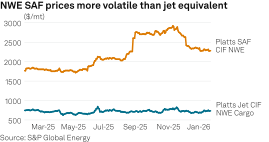
This volatility has highlighted the limitations of current Hydrotreated Esters and Fatty Acids (HEFA) technology, the prevalent SAF production pathway, which faces scalability constraints due to limited feedstock availability.
"The SAF market remains small, early stage, and constrained by limited production capacity," a spokesperson for the International Air Transport Association told Platts. "Under these circumstances, even modest changes in supply or demand can create pronounced imbalances, which in turn drive significant price volatility."
Scaling challenges
"There's enough SAF globally to meet European demand; the problem is the step-wise increase in mandates," said Ina Chirita, head of short-term biofuels analytics at S&P Global Sustainable1. "There is limited appetite from airlines to absorb additional SAF beyond the quotas because it is so expensive; but if you make that increase in mandates more gradual, then you can leave more space for more projects to come online."
Sudden jumps in the EU's mandates for SAF uptake, as opposed to a gradual increase over the years, mean growth is likely to flatline ahead of big deadlines, holding back potential growth in the market, Nicole Loschl, advisor for SAF at OMV, told Platts in May.
She is not the only production-side professional to identify problems in EU policy. The EU will likely have to scale back its ambitious sustainable aviation fuel targets, mirroring its recent retreat from a ban on internal combustion engines, as airlines push back on high costs, TotalEnergies CEO Patrick Pouyanne told the World Economic Forum in Davos, Switzerland, Jan. 21.
To mitigate costs, European refineries are increasingly turning to co-processing biofeedstocks with conventional crude to produce SAF.
Co-processing, which is capped by EU rules at 5% biofeedstock in the mix, is viewed as the fastest and most cost-effective "low capex" method to produce drop-in SAF without requiring massive modifications to existing refinery infrastructure.
Additional price relief for European markets could come from Chinese SAF imports, as the EU currently has no antidumping duties on Chinese sustainable aviation fuel, potentially creating downward pressure on prices as supply increases.
China's SAF export quota is 1.38 million mt/year, which would be enough to cover all of Europe's expected 1.37 million mt of SAF demand in 2026, according to S&P Global Energy CERA forecasts.
Alternative pathways
Different jurisdictions are encouraging production of alternative pathways to HEFA.
"The finite nature of these feedstocks means that continuing a reliance on one specific feedstock and pathway could lead to sustainability impacts and supply chain disruptions or bottlenecks," the UK government said.
It encourages but recognizes the technical and construction risks facing advanced SAF technologies.
The price difference between HEFA-based SAF and synthetic aviation fuel or eSAF is considerable. The European Union Aviation Safety Agency's reference price for SAF in 2024 was Eur2,085/mt ($2,492/mt), compared to Eur7,695/mt for eSAF.
Under the terms of the EU's ReFuel EU Aviation regulation, from the start of last year 2% of aviation fuel supplied in the EU had to be SAF. In 2030, this jumps to 6% and then grows incrementally to 70% SAF in 2050, while eSAF must make up 0.7% of aviation fuel supplied in 2030, rising to 35% in 2050.

Editor: