Agriculture, Energy Transition, Refined Products, Crude Oil, Biofuel, Renewables, Jet Fuel, Gasoline, Vegetable Oils
July 02, 2025
Airlines eye SAF as strategic hedge amid jet fuel price, geopolitic volatility: Asia-Pacific carriers

HIGHLIGHTS
Volatile jet fuel prices driven by geopolitical tensions accelerate SAF adoption
Asia's nascent SAF markets face feedstock constraints, regulatory risks
Panelists see municipal waste as next frontier but economics, logistics unproven
Volatile jet fuel prices driven by geopolitical tensions are accelerating conversations around sustainable aviation fuel as a strategic hedge for energy security, airline and aviation executives told Platts on the sidelines of the MyAERO SAF Symposium in Putrajaya.
Responding to a question from Platts, part of S&P Global Energy, during the panel "Buying SAF -- Lessons from Airlines," on July 1, industry leaders including International Air Transport Association, Malaysia Aviation Group, and Singapore Airlines acknowledged that price shocks like those seen after the recent strikes on Iran's nuclear sites have widened the SAF conversation beyond decarbonization.

Singapore jet fuel/kerosene swaps traded during the Platts Market on Close assessment process jumped 41.67% month over month to 1.7 million barrels in June, data from Platts showed July 2.
Meanwhile, oil products inventories at the UAE's Port of Fujairah climbed for a fourth consecutive week, led by a 33% rise in jet fuel, diesel and other middle distillates, as overall exports slowed for June, according to July 2 port figures and the latest ship-tracking data.
The total rose 0.2% to 19.156 million barrels in the week ended June 30, marking the longest stretch of gains since February 2022, according to Fujairah Oil Industry Zone data shared with Platts since 2017.
Middle distillates, including jet fuel and diesel, rose to 2.722 million barrels, the highest since March 31. Light distillates such as gasoline and naphtha increased 11% to 7.487 million barrels, the highest in two weeks.
"Jet fuel volatility is a given in our world," said Kelvin Lee, head of sustainability and economics at IATA. "We've studied over 100 airports globally to understand why prices surge, and infrastructure constraints are a key culprit. If that's true for ATF [aviation turbine fuel], a well-established market, then SAF, a nascent market, which lacks widespread infrastructure and access, faces even more uncertainty."
Recent IATA research backs those concerns. According to the association's Chart of the Week dated June 27, jet fuel prices rose significantly more than Brent crude after the June 12-19 Middle East conflict, particularly in Europe and Africa.
This divergence underscores the sensitivity of global aviation fuel markets to disruptions along major supply routes like the Strait of Hormuz.
"With over 30% of global seaborne petroleum liquid flowing through the Strait of Hormuz, Europe and Africa saw the largest moves in the price of jet fuel," the report said. "Europe & CIS and Africa are particularly vulnerable to geopolitical instability in the Middle East, as they rely heavily on imports from the East to meet demand."
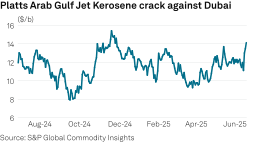
The Asian jet fuel/kerosene complex experienced volatility in June due to the Israel-Iran conflict. Going forward, the market is expected to weaken as the outlook for the East-West arbitrage appears bleak amid a softening European complex.
"Prices have again moderated, but price volatility and even access to fuel can be expected to continue to pose difficulties for airlines given the geopolitical context," the IATA report said. "The role of sustainable aviation fuel in overall energy security must not be overlooked, particularly in the regions that are the most exposed to vulnerabilities in their jet fuel supply."
While Asia may appear less directly exposed, the ripple effects are real. "Flight paths have had to adjust, increasing fuel consumption and costs," said one SAF refiner who spoke off the record. "Even if Asia isn't the epicenter of a conflict, it's not immune to its impact."
Philip See, chief sustainability officer at Malaysia Aviation Group, said the issue is increasingly resonating in Southeast Asia. "In Malaysia, the SAF conversation is no longer just about emissions. Energy security, price volatility -- even economic competitiveness -- are now part of the equation. It's not dominating yet, but you can see it seeping into boardroom discussions."
At the same time, the region's SAF markets remain fragile. Most Asian countries still lack SAF blending mandates, and feedstock availability, especially for used cooking oil, is constrained by informal supply chains and poor traceability.
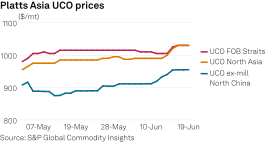
"UCO volumes remain largely opaque," a SAF producer based in Indonesia said. "We don't have consistent data on how much is collected or where it goes. That's a major barrier to scale."
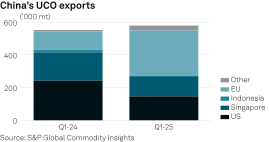
Trade policy is also emerging as a structural risk. With the US tightening eligibility rules for SAF tax credits and countries like China and Indonesia curbing exports of raw feedstocks, stakeholders expect to see a regional pivot toward domestic production and refining.
"The global SAF supply chain is at a tipping point," one speaker from a separate panel said. "If Asia wants to position itself as more than just a feedstock supplier, now is the time to invest in refining capacity, certification systems, and cross-border traceability."
Boris Mak, Singapore Airlines' vice president of sustainability, said book-and-claim mechanisms -- especially domestic schemes -- could help overcome infrastructure bottlenecks and regulatory misalignment. "Once countries get comfortable with SAF tracking domestically, they can scale it bilaterally. That's how regional cooperation can begin."
Still, panelists acknowledged that many governments remain protective of their own feedstock, with a "use domestic first" mentality that may hinder regional integration.
Asked by Platts whether Asia is ready to shift to advanced feedstocks, several panelists agreed the region has abundant agricultural and municipal waste but lacks the infrastructure to convert it at scale. "Municipal waste is the next frontier. It solves both a fuel and an urban waste crisis. But the economics and logistics are not yet proven," one SAF developer said.
Platts assessed Asia SAF-jet fuel spread at $1,109.99/mt on July 2, up 32 cents from July 1.

Editor: