Electric Power
November 24, 2026
Dallas leads North America in low-cost data center building: survey
Editor:
HIGHLIGHTS
Texas legislation threatens tax incentives
Political shift may slow project timelines
A new global survey of data center construction costs indicates the Dallas area has the lowest costs among North American cities. Still, industry observers say that may change, given the role resistance to data center development played in Texas' Nov. 3 election.
Turner & Townsend's latest "Data center construction cost index" report benchmarks cost data "from over 500 live or recent projects across 62 markets" worldwide, with all costs converted to US dollars.
"To supplement our construction cost data, we also conducted an online poll of 400 experts working across the data center industry," the company said.
Among the 13 North American sites, costs in the Dallas area averaged about 12.8% below the average and about 30% less than the high, found in Silicon Valley, California.
Dallas has advantages
"Dallas has the advantage of relatively low-cost land and power, no state income tax, generally lower cost of doing business, reasonable wage and compensation rates, etc.," said Stefanie Williams, associate director for data centers at S&P Global Energy Research, in a Nov. 24 email. "Currently, the state has an incentives program for qualifying data centers that give exemption from the state sales and use tax."
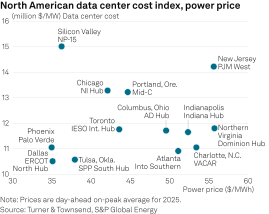
But data centers were a significant factor in the Nov. 3 election, and Texas voters flipped every statewide seat from Republican to Democratic, including the governor, lieutenant governor and attorney general.
Joshua Rhodes, an energy-focused research scientist at The University of Texas at Austin, said, "I expect to see Texas keep building data centers, but with more scrutiny from local communities and no franchise tax relief."
Several bills have been filed before Texas' biennial regular legislative session begins Jan. 12, Williams said, which would "end the legislated tax incentives, impose a two-year moratorium, require local constituents to vote on every proposed project, implement additional frameworks and state-level permits, and require operators to pay an annual stipend to every resident in the county, including children."
"These new rules would apply to data centers over 20 megawatts," Williams said. "If these bills pass, it will likely change the popularity of Texas in general."
Development costs surging
The Turner & Townsend survey costs were based on developing a data center with "a typical 60-MW design."
The Public Utility Commission of Texas set 75 MW as the threshold for a large computational load to be included in ERCOT's large-load interconnection process.
"While many constraints remain, rising costs of data center construction now tend to be driven by the growing scale of the builds, which increasingly require alternative delivery approaches and increased leadership talent to overcome strained capacity and accelerate schedules," the survey states.
Turner & Townsend provides three geographic groupings of data: the Americas, Asia and Europe/Middle East. Globally, the most expensive data center project would cost more than $18 million/MW in Tokyo, about 77% more than in Dallas. The least expensive site would cost less than $6 million/MW in Mumbai, about 45% less than in Dallas.
"In 2026, 52% have experienced cost increases above 6%, with approximately 20% reporting inflation above 15%," the survey states. "Our index suggests that higher inflation is more prevalent in North American and European markets, where average cost-per-Watt has increased by 13% year on year. That's double the global average rate of 6%. In 2027, 28% of survey respondents expect inflation to be between 1-5%, indicating an expected continued softening of cost pressure. 57% expect it to be below 15%."
Data centers may opt elsewhere
ERCOT's latest available summary of the large-load interconnection queue, issued in August, includes projects totaling about 467 gigawatts in cumulative demand by 2031, of which about 90% is data centers. For context, ERCOT's latest record peakload was about 91.2 GW, set July 22.
"There are a few states we're watching now where data center build-outs may face less resistance because of weaker stances taken by the incoming governments, states like Mississippi, Louisiana, Alabama, Arkansas, Oklahoma, Tennessee, and a handful of others," said S&P Global Energy Research Director Dan Thompson in a Nov. 24 email. "I'd be hesitant to say they'll move into a more dominant position, only because the build out in Texas and Virginia is so far ahead of these states, it would take a lot for them to even look competitive on paper. That said, though, given the ramifications of the midterms, we could be looking at a whole new world in January in terms of data center development."
UT's Rhodes said it would not surprise him if a fifth to a third of ERCOT's projects scheduled to come online in 2027 had their energization dates postponed to 2028.
Of the 197.8 GW of projects seeking to interconnect in 2027 in ERCOT's August large-load interconnection queue, 3.7 GW had been approved to energize but were not operational, 42 GW had completed studies and interconnection agreements, and about 152 GW were in various preliminary stages.
