Natural Gas, LNG
November 23, 2026
INTERVIEW: Bulgartransgaz can keep transiting Russian gas outside EU after 2027 ban
By Matt Hoisch
Editor:
HIGHLIGHTS
CEO says ‘no intervention’ from Sofia
Targets Chiren storage expansion by 2029
Expects to source more LNG for operational needs
Bulgaria's natural gas transmission system operator Bulgartransgaz EAD can continue shipping natural gas from Russia to non-EU countries after an EU law banning all such flows to EU member states starts next year, CEO Kiril Ravnachki told Platts.
"For those countries outside the EU, the regulation does not say anything about that," he said in an interview Nov. 18 on the sidelines of the Partnership for Transatlantic Energy Cooperation meeting in Warsaw. "There is no restriction on flowing gas to those types of countries."
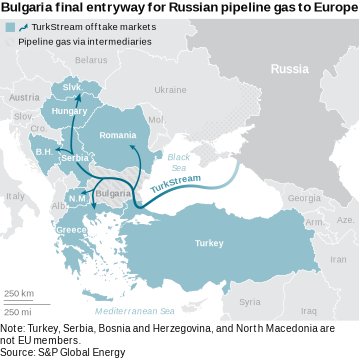
Bulgaria is the only remaining gas gateway for pipeline flows from Russia to Europe, via the TurkStream pipeline. Shipments through other import routes via Ukraine, Germany, and Poland were halted earlier this decade. Several non-EU countries can bring in Russian gas through Bulgaria: Bosnia and Herzegovina, North Macedonia and Serbia.
Sofia has not pushed Bulgartransgaz to end any such flows to non-EU countries once the EU ban takes effect from autumn 2027, according to Ravnachki.
"There is no intervention from the government in any way, including in this regard," he said.
At the same time, non-EU governments in the region are also angling for more options that can allow them to diversify away from Russian fuels
In September, TSOs in both North Macedonia and Serbia signed a memorandum of understanding with other operators to boost cooperation around the so-called Vertical Gas Corridor, an effort to expand non-Russian gas transit routes into Southeast, East and Central Europe, including via regasified LNG imported through Greece and shipped north.
Bulgartransgaz said Nov. 18 it had recently completed projects boosting gas transmission capacity from Bulgaria to Romania by nearly 90% as part of the Vertical Corridor initiative, and it is now offering daily capacity under the new capabilities.
Chiren storage expansion, LNG tendering
While Bulgartransgaz expects to be able to sustain some Russian gas flows beyond the EU, the TSO is also adapting as the broader European gas landscape changes.
Ravnachki, who took over the leadership role from former Bulgartransgaz head Vladimir Malinov in August, said that one of his top priorities is expanding capacity at Bulgaria's only gas storage site, Chrien.
Bulgaria has been working for several years to expand gas storage capacity at the site to as much as 1 billion cubic meters and average daily withdrawal and injection rates to as much as 8 million cubic meters to 10 million cubic meters, according to European Commission documents. The facility's current capacity is some 7 terawatt-hours (662 million cubic meters), per Gas Infrastructure Europe.
"We need this flexibility in the system," Ravnachki said. "With more and more LNG coming into southeastern Europe, demand and LNG deliveries are not always matching in terms of timing."
Ravnachki said the TSO would "hopefully" finish the Chiren expansion by 2029.
Bulgartransgaz is also turning to LNG to meet its own needs. The TSO sourced around 500 gigawatt-hours of the super-chilled fuel from Greece's DEPA Commercial SMSA this summer as part of a tender to support the operation of the Bulgarian gas grid. Ravnachki said further such tenders are in the works.
"We are planning on doing additional auctions for this, and I think pretty soon we will be able to structure more details on how much will be needed," he said. "These are auctions that we need for technological needs and this is something that we will continue using," he said.
The CEO did not offer details on the volumes or frequency of future LNG auctions.
In favor of long-term deals
More broadly, Ravnachki endorsed European players locking in further long-term contracts to secure LNG for the continent. Such deals, he said, are important for TSOs like Bulgartransgaz.
"This guarantees us that we will have the necessary revenue so that we keep the system in good shape and we do the necessary investment whenever it's needed and wherever it's needed," he said.
Market players have abstained from longer-term commitments amid the recent volatility, Ravnachki argued. Still, he pushed for more work to cement longer-term flows.
"This is something that should be looked at, and it should be worked on," he said.
Platts, part of S&P Global Energy, assessed the DES Mediterranean LNG marker at $27.815/million British thermal unit on Nov. 20, up 3.8% day over day.
