Electric Power, Natural Gas, LNG, Energy Transition, Water, Crude Oil, Metals & Mining, Renewables
November 20, 2026
US Senate passes major energy permitting overhaul, sending measure to House
By Zack Hale, Rachel Looker, and Maya Weber
Editor:
HIGHLIGHTS
Bill overhauls permitting rules across energy sectors
House action expected after Thanksgiving break
The US Senate passed a sweeping bipartisan permitting reform package aimed at accelerating energy and infrastructure development, sending the legislation to the House with little time remaining in the lame-duck session.
The Senate on Nov. 19 approved the Bipartisan American Affordability and Jobs Act (BAAJA) of 2026, by a 62-33 vote, marking the furthest a major overhaul of federal permitting laws has advanced in Congress after multiple unsuccessful efforts over the last four years.
The comprehensive package would overhaul environmental reviews and permitting requirements across a broad range of energy infrastructure, including renewable energy, electric transmission, natural gas pipelines and LNG terminals, mining and other projects.
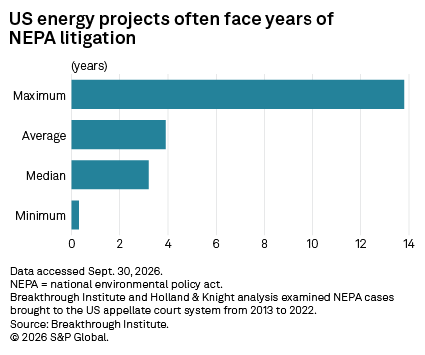
It would also limit legal challenges to federal approvals and generally prohibit agencies from revoking or substantially altering permits once projects have secured all necessary federal authorizations, with only limited exceptions. Cross-cutting provisions include a 150-day deadline for challenges to covered energy and mineral authorizations, limits on agencies' ability to reopen final permits and tighter environmental review procedures with enforceable deadlines.
Bill targets permitting, transmission barriers
BAAJA represents a compromise between Republicans seeking faster approvals for fossil fuel, mining and other infrastructure and Democrats who have pushed for major changes to US electric transmission policy to unlock new generation and help contain rising power costs.
Among its most consequential power-sector provisions, BAAJA would strengthen the Federal Energy Regulatory Commission's authority over interstate transmission siting and require changes to US transmission planning and cost allocation. A Nov. 7 manager's amendment lowered the threshold for projects eligible for federal siting and cost-allocation provisions from 345 kilovolts to 230 kV. It would also direct FERC to revise transmission policies so that large data center customers pay existing transmission charges plus a reasonable share of incremental costs associated with serving them.
Among provisions benefiting gas pipelines, the bill would exclude many expansions of pipelines and transmission lines planned along existing rights-of-way from the National Environmental Policy Act. It would make it harder for states to deny gas pipeline projects based on water quality concerns.
BAAJA also contains several provisions aimed at hard-rock mining and mineral processing, including measures addressing disputes over the use of federal land for mine-support facilities.
It would incorporate the Mining Regulatory Clarity Act, which the House passed in December 2025, and clarify that mining operators may locate multiple 5-acre mill sites for waste disposal and other activities supporting mining operations. Operators would be required to pay a $400 annual fee for each additional mill site to the Abandoned Hardrock Mine Fund for mine reclamation work.
The package would also expand federal leasing eligibility for certain hardrock minerals on public lands and establish a mechanism for hard-rock mining and mineral-processing applicants to seek legal remedies when federal agencies repeatedly deny permits in bad faith or unreasonably delay them.
Package faces key House test
The House is expected to take up BAAJA after lawmakers return from the Thanksgiving break on Nov. 30. One possible pathway would be consideration under suspension of the rules, which would limit floor debate and amendments. Support from two-thirds of voting House members is needed for a rules suspension, meaning significant backing from House Democrats would be required.
The Senate bill has drawn support from a broad coalition of clean energy industries. Ten organizations representing wind, solar, energy storage, geothermal, hydropower and nuclear energy urged congressional leaders Nov. 18 to enact the package this Congress. Environmental groups have remained more divided, with the Sierra Club, Natural Resources Defense Council and Earthjustice arguing that revisions to the package failed to address concerns about weakened environmental safeguards, tribal sovereignty and restrictions on future challenges to federally approved fossil-fuel projects.
Some legal experts have also argued that the changes would make NEPA requirements mostly unenforceable for permitting and authorization decisions affecting private projects.
