Electric Power, Natural Gas, Crude Oil, LNG
November 17, 2026
Large foreign buyers pour billions into US shale gas in pursuit of integration
Editor:
HIGHLIGHTS
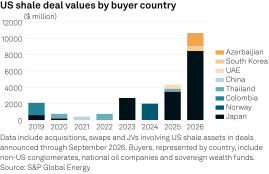
Year-to-date deal values approach $11 billion
Buyers seek to own assets across gas value chain
Japanese buyers with LNG offtake lead in deal volume
Large foreign investors have ramped up spending on US shale in 2026 as companies seek to build increasingly integrated businesses with upstream exposure within the world's largest natural gas market.
Among a suite of conglomerates and national oil companies, dealmaking activity year to date includes repeat buyers and some new entrants, which together have announced US onshore shale transactions totaling about $10.6 billion, according to S&P Global Energy CERA data.
Since 2019, NOCs, conglomerates and sovereign wealth funds have executed nearly $24 billion in US onshore shale transactions, most of which involved gas assets. With the year still unfinished, 2026 makes up 45% of that nearly $24 billion.
The group's most recent transactor, the State Oil Company of the Republic of Azerbaijan, on Nov. 4 advanced its first US upstream deal by signing a definitive agreement to purchase interests in Haynesville Shale producer Comstock Resources Inc.'s upstream and midstream businesses for $1.65 billion in cash.
The US offers one of the world's largest and most competitive gas resource bases and is the leading LNG exporter, making it an attractive investment target, SOCAR said.
"For SOCAR, upstream investment is a natural extension of our strategy to become a globally integrated energy company," a spokesperson told Platts, part of S&P Global Energy.
Around half of SOCAR Trading's LNG volumes already originate from the US. Upstream ownership strengthens the company's position across the gas value chain and supports growing international supply commitments, particularly in Europe, the spokesperson said: "With increasing demand from LNG exports, power generation and AI-driven data centers, we see strong long-term fundamentals."
Focus on integration
Other large non-US buyers have been entering or expanding in US shale plays in recent years, being drawn by the opportunity to match upstream supply with a portfolio of power generation, trading operations and LNG offtake commitments.
After building up a non-operated upstream position in Appalachia that now produces approximately 1.7 billion cubic feet/day, Norway's Equinor ASA on Nov. 3 closed its acquisition of an interest in the Lackawanna Energy Center, a nearly 1.5-gigawatt gas-fired power plant in northeastern Pennsylvania.
The breadth of the US energy market creates opportunities to capture value across the energy value chain, said Equinor spokesperson Ola Morten Aanestad.
"Greater integration across the gas value chain can provide exposure to power markets and spark spreads, while the scale of our position and proximity to major demand centers give us a strong platform to pursue those opportunities," Aanestad said.
The company is open to further investment in US gas assets that complement its existing position in the northern Marcellus Shale, Aanestad said.
Others participating in the market include TotalEnergies SE, which has equity in and LNG offtake from US liquefaction projects. In September 2025, the company announced a deal to acquire a stake in gas-producing assets in the Anadarko Basin owned by Continental Resources Inc., and CEO Patrick Pouyanne said TotalEnergies looks for further opportunities to invest in the upstream because of the value in integration.
More recently, global commodities trader Centalion Group, formerly Gunvor, announced Oct. 5 its purchase of upstream gas assets in East Texas and Louisiana from Silver Hill Energy Partners.
Japanese investment
Japanese companies stand out among large global investors in US shale gas, engineering the most transactions among buyer countries this decade and accounting for 79% of US shale deal value in 2026, S&P Global Energy data showed.
Buyers include Mitsubishi Corp., which acquired Haynesville producer Aethon Energy Management LLC for $7.5 billion, as well as JERA Co Inc. and Tokyo Gas Co. Each has contracted LNG offtake from US export facilities.
For LNG offtakers, owning upstream assets can serve as a hedge against higher LNG feedgas costs, said Prescott Roach, an associate director for S&P Global Energy CERA.
"Most [Japanese buyers] have expressed their ambition to build out integrated gas businesses in the US," Roach wrote in a research note published in October. "While individual company plans differ, this generally involves linking upstream production to midstream infrastructure, LNG markets and domestic gas customers."
| Buyer | Announced deal value ($ million) | Primary seller | Segment | Location/Basin |
| Japan Petroleum Exploration Co Ltd | 1,300 | Verdad Resources LLC | Tight Oil/Shale Oil | Rocky Mountains |
| Mitsubishi Corp | 7,530 | Aethon Energy Management LLC | Tight Gas/Shale Gas | Haynesville Shale |
| Japan Petroleum Exploration Co Ltd | 320 | Fundare Resources Co LLC | Tight Gas/Shale Gas | Rocky Mountains |
| Marubeni Corp | 595 | EagleRidge Energy LLC | Tight Gas/Shale Gas | Barnett Shale |
| POSCO International Corp | 550 | Chord Energy Corp | Tight Gas/Shale Gas | Appalachian Basin |
| State Oil Co of the Azerbaijan Republic | 1,650 | Comstock Resources Inc | Tight Gas/Shale Gas | Haynesville Shale |
| Source: S&P Global Energy | ||||
Haynesville producer TG Natural Resources LLC, the US upstream business of Tokyo Gas Co. subsidiary Tokyo Gas America Ltd, began acquiring assets in the basin in 2015 and has spent around $2 billion over the last 10 years in the Haynesville.
In owning TG Natural Resources, Tokyo Gas has sought to match its long and short positions, TG CEO Craig Jarchow said, explaining that ownership simply thinks differently about running an upstream business than a more traditional US producer.
"Two years ago, if we were owned by, call it, private equity, we would have gone public for sure because we would have been the second Haynesville pure-play, we had scale, the markets were open," Jarchow said Sept. 17 during remarks at the Super DUG gas conference in Houston. "But instead, Tokyo Gas said, 'Well, no, we want to continue to own this thing. We want to completely control it, and we want to continue to grow it and take a value chain approach'."
Nick Woodruff, a global investment banking co-head with RBC Capital Markets, said international counterparties have an advantage when engaging in US upstream dealmaking because they are patient and underwrite their investments over long time horizons.
"We've had some conversations with sovereign wealth funds and IOCs where there is no plan ever to sell the business once it's acquired," Woodruff said Sept. 17 on a conference panel alongside Jarchow. "It is a cash-on-cash yield, and it's a diversification and security of supply. Sometimes it's not even ROI-driven. It's just access to the molecule."
