Electric Power, LNG, Natural Gas
October 27, 2026
Winter weather fuels upside EU LNG demand risk: ACER

By Matt Hoisch
Editor:
HIGHLIGHTS
Added flows likely to come from US
Average gas stocking cost second-highest in a decade
US LNG meets 30% EU gas needs, says war boosted reliance
The EU risks higher LNG demand this winter if weather spurs greater gas needs, European regulatory body ACER said Oct. 27 in a statement on the release of its latest gas monitoring report.
"The actual level of LNG imports needed will ultimately depend on, inter alia, the severity of the winter weather and gas demand," ACER said. "In the current context, additional LNG imports are mainly to come from the USA."
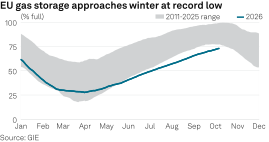
The warning comes as Europe approaches winter with a record-low gas storage fill. EU-wide gas stocks were filled to just 74.9% as of Oct. 25 — the lowest level for this time of year on record going back to 2011, according to figures from Gas Infrastructure Europe.
At the same time, the continent is expected to face international competition for scarcer LNG volumes with Persian Gulf exports still hampered amid the war in the Middle East.
"The EU and Asia will continue to compete for flexible spot LNG cargoes during the heating season, possibly increasing exposure to price pressure and volatility," ACER said.
Although the EU faces a lower storage fill than the past year, it also benefits from a broader decline in gas use, ACER stressed.
"Gas demand is around 20% lower since the 2022 gas crisis, increasing the relative value of current storage levels," it said. "Weather-driven demand will be impacting the gas storage stocks' evolution."
Weather-driven uncertainty was on full display this summer. Hot, dry weather boosted gas-fired power demand in the EU by almost 9% year over year across the gas summer, according to ACER. The trend was particularly stark in August, which saw a 20% annual rise in gas-for-power usage.
Wartime impacts
Those gas volumes that have been stocked have come at a higher cost than in past years due to the war in the Middle East, ACER explained.
"The average cost of injected gas was the second highest in the past decade," it said. The upper bound estimated cost of refilling storage this year is €27 billion, according to the regulatory body. Overall, the EU has spent between €18 billion and €33 billion extra on gas imports due to the war, without any boost in the volumes procured, ACER explained.
Global LNG prices have surged to multiyear highs in recent weeks. Platts, part of S&P Global Energy, assessed the DES Northwest Europe LNG benchmark at $31.16/million British thermal unit on Oct. 26. The index is at its highest point since December 2022.
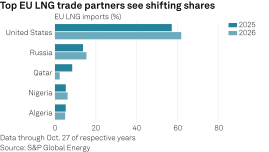
The war has also shifted trade patterns.
The loss of Qatari LNG volumes has boosted EU reliance on other producers, "especially the USA," ACER said. LNG from the world's top exporter accounts for some 30% of the EU's overall natural gas supply, according to ACER.
Russian gas, meanwhile, accounts for about 11% of the EU's gas, it said. Despite recent bans on spot and short-term imports, however, LNG and pipeline flows from the continent's once-dominant supplier are only slightly down year over year. LNG imports from Russia fell 2% year over year this summer, while pipeline imports dipped 3%, ACER said.
The EU is set to ban all Russian LNG imports from the start of 2027 and all Russian pipeline gas imports from autumn 2027.