Natural Gas, LNG, Crude Oil
October 15, 2026
South Texas producers have big plans to develop the region's 'mini Haynesville'

Editor:
HIGHLIGHTS
Producers boast region's low gas breakevens
High value placed on Webb County
Caturus, EOG among those increasing production
Natural gas producers in South Texas see the area as ripe for development and deal activity in the coming years as demand rises along the nearby US Gulf Coast.
The buildout of LNG export capacity in Texas and Louisiana gives producers in the Eagle Ford and Austin Chalk a growing market for supply which they champion to be among the cheapest gas to produce in the US.
"We're seeing a massive build-out of gas demand along the Gulf Coast, with LNG capacity alone projected to grow by roughly 15 Bcf day between now and 2030," KJ Jansen, head of upstream for Caturus Energy LLC, said Sept. 16 during remarks at Hart Energy's Super DUG gas conference in Houston.
"That's once-in-a-generation demand wave. In our view, that demand will reshape US gas markets, and that's exactly why we're building [the] upstream business along the Gulf Coast," Jansen said.
Drilling cheap gas
Caturus, formerly Kimmeridge Texas Gas, recently kicked off a development partnership with Black Stone Minerals LP in the Haynesville Shale but has otherwise concentrated its gas business in South Texas, home of the state's largest gas-producing county, Webb.
In April, the company closed its $950 million purchase of roughly 60,000 net acres and 250 million cubic feet equivalent/day of production in Webb County from SM Energy Co.
Caturus now holds around 280,000 net acres and produces 1 billion cubic feet equivalent/day, up from around 140 MMcfe/d in 2023.
As of mid-September, the company had four drilling rigs operating, including one unit in the asset acquired from SM Energy and another drilling in the dry gas window across La Salle, McMullen and Live Oak counties.
"Historically, most of the Eagle Ford development has been up dip ... in the oil window, but we at Caturus see tremendous potential in the dry gas window reflected in our acreage position here," Jansen said Sept. 16.
Breakevens on the company's wells are extremely competitive because of proximity to markets, availability of takeaway capacity and the highly productive nature of wells, Jansen said.
"Breakeven for us ranges — depends on where we are in the field — but somewhere in that $2.20 [per thousand cubic feet] to upwards of $2.70 on the high end, depending on the asset," he told Platts, part of S&P Global Energy, in an interview on the sidelines of the DUG conference in September. "The $2.70 being more some of these high-pressure, high-temperature areas we're pushing right now, but we do expect cost to come down over time."
EOG Resources Inc., another operator present in South Texas, identified its dry gas "Dorado" position in Webb County as a foundational asset for the company alongside the Delaware Basin and Utica Shale. Executives have said the play produces the cheapest gas in the US, with EOG pegging its breakeven there at $1.40/Mcf.
This year, EOG dialed back its 2026 production growth target in South Texas in the face of low gas prices, but the company has said it will lean on the asset to serve gas sales agreements in years ahead.
Others present in South Texas include the more liquids-focused public Crescent Energy Co. and private Stone Ridge Energy LLC, both of which recently executed transactions in the Eagle Ford.
Crescent announced Oct. 8 that it will acquire Devon Energy Corp.'s Eagle Ford oil-weighted assets at a net purchase price of $3.85 billion. Prior to that, in December 2025 Stone Ridge Energy closed its purchase of Baytex Energy Corp.'s Eagle Ford assets for $2.14 billion.
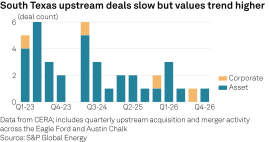
While the volume of Eagle Ford deals has declined versus earlier in the decade, disclosed deal values have trended higher more recently, according to data from S&P Global Energy CERA.
Faye Suter, senior vice president for Stone Ridge's operating partner Flywheel Energy LLC, said the Eagle Ford has a number of remaining assets that are compelling acquisition targets.
"I think that's the other reason we really like the Eagle Ford as a strategic basin for us is that despite its resource density, [it] remains quite unconsolidated, so we see a lot of potential acquisition opportunity," Suter said Sept. 16 during a conference panel alongside Caturus' Jansen.
A 'mini Haynesville'
South Texas contributes a much smaller share to total US gas supply than do the Permian, Appalachia and Haynesville, but the production in region is expected to grow through the end of the decade alongside rising Gulf Coast gas demand.
Between 2020-2025, gas production in the Austin Chalk more than tripled to 1.9 Bcf/d, CERA data showed. Production in the play is projected to grow to nearly 2.4 Bcf/d in 2030.
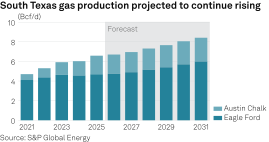
Including the Eagle Ford, South Texas gas production is forecast to climb from around 6.6 Bcf/d in 2025 to more than 8 Bcf/d in 2030, CERA data showed.
Herbie Goldstein, CFO for San Antonio-based midstream company Howard Energy Partners LLC, singled out Webb County, saying the area has matured beyond anyone's upside forecast.
"It's a very low-cost gas producing basin, kind of a mini Haynesville in the western Eagle Ford," Goldstein said Sept. 17 at the DUG conference. "It's low nitrogen. We have great infrastructure buildout there, so I think it's well positioned."
