Energy Transition, LNG, Natural Gas, Crude Oil, Coal, Emissions
October 15, 2026
One-year EU methane law delay unlikely to shift LNG prices: analysts
By Matt Hoisch and Corey Paul
Editor:
HIGHLIGHTS
Anticipate little market effect as LNG prices surge
EC proposes postponing importer requirements to 2028
Spokesperson says move to avoid 'any additional risk'
The European Commission's push to delay importer requirements under a landmark law regulating methane emissions is unlikely to sway LNG prices significantly in the near-term as Europe approaches what is expected to be a challenging winter, market watchers told Platts, part of S&P Global Energy.
The EC released an official proposal Oct. 14 to postpone requirements that importers bringing oil, natural gas, and coal into the EU show that cargoes entering the bloc under newer contracts face the same methane monitoring, reporting, and verification standards as EU producers. The requirements — currently set to begin next year — would only phase in for imports starting in 2028 under the changes, which still require approval from the European Council and Parliament.
The proposal came after calls from several member states, including France and Germany, to postpone the importer obligations amid the ongoing market turmoil.
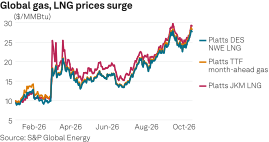
Platts assessed the DES Northwest Europe LNG marker at $27.705/million British thermal unit on Oct. 14. The benchmark is just shy of its highest point since December 2022.
Several analysts, though, are skeptical the delay can offer much breathing room for market players navigating the current high-price environment.
"I wouldn't expect a large [price] impact," Aldo Spanjer, head of commodity strategy at BNP Paribas, said after the EC had signaled it would propose the one-year delay but before the release of the formal text. "I don't believe the market has priced in any potential (small) upside this policy might have on paper, nor any reduction in non-compliant LNG imports, so consequently I would expect little downside from the delay."
Maria Olczak, a senior research fellow with the Oxford Institute for Energy Studies whose work explores the methane regulation, likewise expects a one-year delay to have little effect on markets.
"I don't think that there is any immediate threat [from the regulation]," she said.
Olczak's assessment dovetails with comments from another industry source who said in September that the methane regulation would likely only affect the European LNG market over the longer term.
"I don't expect that Jan. 1 [2027] this [methane regulation] will have an effect on prices," the source said on the sidelines of the Gastech conference in Bangkok. "It will not change the flows of LNG on Jan. 1. But I think it's going to affect the long-term appetite for suppliers to supply into Europe."
'Political insurance'
These assessments push against part of the EC's justification for the delay, which has largely focused on the need to manage near-term pressure. The Commission framed the move as a way to "help save costs" in a statement Oct. 14 announcing the proposal.
"This one-year postponement of the import-related provisions is designed to help avoid additional pressures on the security of supply of imported fossil fuels in the current geopolitical context," it said in the statement.
An EC spokesperson told Platts Oct. 15 there is no evidence the methane regulation has any effect on prices.
"The postponement in itself is not expected to have a particular impact on prices," the spokesperson said. "The postponement is framed on a context of already very elevated prices, and we need to avoid taking any additional risk."
Olczak characterized the proposed delay more as "political insurance" than a market-shifting development.
"Nobody can blame the Commission that they didn't do anything," she said.
Industry stance
Market players have argued that uncertainty around how to comply with the regulation poses a threat to Europe's energy security. But industry groups have decried the one-year delay as insufficient, calling instead for a three-year pause to allow time to develop what they see as workable compliance options.
Charlie Riedl, executive director of the US trade group the Center for Liquefied Natural Gas, said Oct. 15 that a one-year delay could provide some relief for spot-market participants but would do little to resolve uncertainty surrounding long-term contracts, speaking during a panel at the Gulf Coast Energy Forum in New Orleans.
"A year delay helps from their spot market perspective and selling spot, but it doesn't help with any long-term agreements that we're trying to talk about -- securing Europe's long-term gas supply," Riedl said.
