Energy Transition, Crude Oil, LNG, Natural Gas, Renewables
September 24, 2026
INTERVIEW: Oman’s OQT eyes LNG infrastructure support amid trading push
By Matt Hoisch and Claudia Carpenter
Editor:
HIGHLIGHTS
Newly named LNG head flags interest in FSRU co-investment
Says gas has ‘lost a lot of credibility,’ buyers to be discerning
Sees portfolio ‘sweet spot’ of 4 million-5 million mt/ year
Oman's OQ Trading (OQT) may invest in infrastructure to support new LNG and gas demand as the state-owned trading company pushes to expand its LNG efforts, OQT's newly named global head of LNG told Platts in a recent interview.
"For the right opportunities, we might be interested to look at co-investing in downstream facilities — call it FSRUs [floating storage and regasification units] or potentially assets in the system where we can help support the demand creation and supply the demand from our own portfolio," Emmanuël Brasseur said Sept. 22. "In the developing countries entering the LNG market, I believe FSRUs will be the most cost-effective way to link up the LNG to the demand centers in a timely manner, so that is an option."
Brasseur officially starts his new role in November, he said.
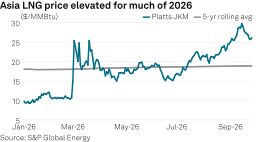
The interest in supporting LNG penetration into new markets comes as the transit disruptions through the Strait of Hormuz due to the war in the Middle East prove headwinds to demand growth. The ongoing conflict has kept LNG prices elevated for much of the year. Platts, part of S&P Global Energy, assessed the JKM benchmark for cargoes delivered into Northeast Asia at $26.114/million British thermal unit on Sept. 24. The index is 134% higher than the same time last year.
"The gas market has lost a lot of credibility," Brasseur said. "Its abundance is there, but its ability to reach the market when it wants has been jeopardized by the closure of the Strait of Hormuz. I believe it opens a door for renewables to penetrate the market quicker than what was initially anticipated."
Moving forward, LNG buyers will grow more discerning, Brasseur said.
"There has been a tendency over the last 20 years to contract the cheapest molecule at all costs without thinking too much about the reliability of that supply," he said. "Buyers will [now] probably be more selective as to where they get their gas from and ensure a higher level of diversification."
Expanding LNG efforts
As he develops OQT's LNG business, Brasseur is eyeing a portfolio that can service an evolving market.
Today, oil activities are OQT's core revenue generator, according to Brasseur. But, he explained, the company is keen to expand efforts around LNG.
"There is a lot experience that has been acquired on the oil business that is transferable to the LNG market, and also the LNG market is commoditizing more and more," Brasseur said.
OQT has been active in LNG for a decade and has built a trading platform, albeit still regionally, as a "relatively modest player," according to Brasseur.
"It's a good basis to now think about the next phase of development where volume matters more," he said.
While Brasseur declined to name a precise portfolio size he'll target, the incoming head described a "sweet spot" around 4-5 million metric tons/year. Diversity and flexibility are also priorities, he said, with cargoes probably sourced from some 3-4 projects.
"We are not going to go for volume," he said. "We will focus on value as opposed to market share or volume."
Sourcing in a growing market
OQT is separate from Oman's state-backed LNG producer, Oman LNG. Nevertheless, it sources from Oman LNG's facility in Qalhat under a four-year, 750,000 mt/ year contract that Brasseur characterized as the "core" around which it will build its portfolio.
"Ideally, OQT will grow its share of Omani offtake in the future, but we are going to be competing with the world for that," Brasseur said. Oman LNG is also eyeing an expansion, which could contribute to that growth, Brasseur added.
"When and if [an expansion] happens, I hope that OQT can play a larger role in helping marketing or monetizing the assets," he said, stressing that his team would also look for growth from other suppliers.
Last year, OQT inked a 15-year LNG sales and purchase agreement for 600,000 mt/ year from the proposed Amigo LNG project in Sonora, Mexico. Deliveries are expected to begin in 2028, according to a 2025 statement — though the facility, which is a joint venture between Epcilon LNG and Singapore-based LNG Alliance, still awaits a final investment decision.
Looking ahead, Brasseur underscored a focus on spot and mid-term exposure. "We remain a trading company," he said. "Our role is where the market can really be hedged out, which is probably up to 5-6 years out."
While Brasseur acknowledged near-term supply distress with the fighting in the Middle East, he sees this as temporary.
Substantial further LNG volumes from a wave of new projects are set to hit the market in the coming years. Analysts with S&P Global Energy CERA forecast global supply reaching some 635 million mt in 2030, up roughly 44% from 2025 levels.
"This is clearly a market that is becoming more and more liquid," Brasseur said.
"Accessing supply is not going to be an issue in the coming years," he said. "I think the key to success in this market will be to establish market share in developing markets where we believe we can add value."
