Natural Gas, Electric Power
September 24, 2026
Affordability looms large over gas ban debate in 2026 midterm elections

Editor:
HIGHLIGHTS
Democrats temper gas ban support amid costs
Colorado puts energy choice to voters in fall
The focus on energy affordability in the 2026 US election cycle is creating opportunities and challenges for both sides of the nationwide gas ban debate, even as November's contests appear to offer few prospects to meaningfully tilt statewide policy on building electrification.
Power is too evenly split in many politically divided states where so-called energy choice bills have stalled, leaving gas ban opponents dependent on clinching trifectas: the governorship and majorities in both legislative chambers.
Meanwhile, GOP efforts to implement a national prohibition on gas bans have made little progress and would be further out of reach if Democrats gain control of one or more chambers of the US Congress.
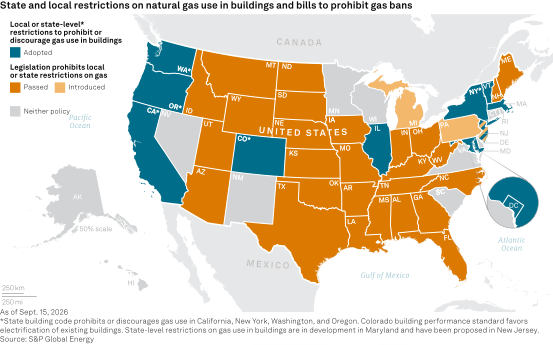
The prospect of expanding policies that prohibit or discourage gas use in buildings is mixed. On the one hand, legal risk to these efforts appears to be lifting after policymakers prevailed in a string of lawsuits over their building decarbonization policies. Those lawsuits were prompted by a landmark 2023 opinion that federal law preempts Berkeley, California's first-in-the-nation gas ban.
But increasing concerns about energy affordability since the 2024 election cycle have caused some Democratic leaders to temper support for ambitious policies developed in the early days of the building electrification movement. Against that backdrop, gas utilities have aggressively promoted the cost advantages of heating with gas over alternatives.
"Any push to ban natural gas would raise costs to consumers, jeopardize environmental progress and deny affordable energy to underserved populations," American Gas Association President and CEO Karen Harbert told Platts, part of S&P Global Energy.
No easy path to gas ban preemption bills
AGA said it would work to preserve consumer energy choice and access to affordable energy. However, as in the 2024 elections, the path through statehouses continues to look daunting in 2026.
Twenty-seven states have passed laws prohibiting gas bans, but the legislation has often stalled when political power is divided, including in Michigan, Pennsylvania, Virginia and Wisconsin. Though the bills draw nearly universal Republican support, they often fail to garner sufficient Democratic backing.
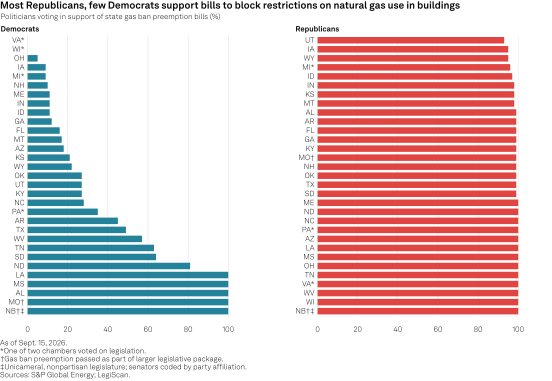
The bills passed in GOP-controlled chambers in Pennsylvania and Michigan in 2025 but have not advanced in Democrat controlled chambers.
Gas ban opponents continue to introduce the bills in states with active building decarbonization campaigns, where they often die in committee. The bills did not come up in a dozen state legislatures and Washington, DC, including some states where they were previously introduced.
But the one state to pass a gas ban preemption bill in 2025, Maine, may prove instructive. Several Democrats joined Republican minorities in both chambers to pass the bill.
Concerns about rising electricity costs played a role in Democratic support, according to a post-mortem on the bill's passage by the Maine Morning Star, a nonprofit newsroom. Governor Janet Mills, who has championed electric heat pumps but also pledged to preserve energy choice during her 2022 reelection bid, became the first Democratic governor to sign a gas ban preemption bill since Kentucky Governor Andy Beshear in 2021.
New approaches to restricting gas use
Meanwhile, even as courts affirm existing gas bans and building decarbonization policies, cities and states have continued to develop new approaches to phasing out gas use in homes and businesses.
In February, Oregon building code officials approved a code update that would require builders to install heat pumps in homes where they plan to include split-system air conditioning. At the local level, some Oregon cities have adopted climate pollution fees for new homes that include fossil fuel appliances.
In California, many local governments repealed or suspended their building electrification requirements following the 2023 Berkeley decision. But in 2025, some of those communities adopted new reach codes that would require residents to install heat pumps when air conditioners burn out.
Additionally, the building decarbonization movement has moved more firmly into the regulatory space, with public utility commissions increasingly questioning long-accepted policies such as line extension allowances and accelerated pipeline replacement programs, according to Malak Nassereddine, director of state mobilization at the Building Decarbonization Coalition.
That trend could accelerate as the affordability crisis increases pressure on governors and commissioners to lower energy bills, Nassereddine said. The Building Decarbonization Coalition recently released a report on the role of infrastructure investment in driving customer bill costs in Pennsylvania, an issue that could attract the attention of Governor Josh Shapiro, in Nassereddine's view.
On the legislative side, Nassereddine saw potential for progressives to capture more seats in the New York Assembly, potentially creating enough support in the chamber to pass a long-stalled overhaul of utility law that would give regulators greater authority to facilitate the gas transition.
Affordability concerns about building decarbonization
More broadly, Nassereddine anticipated a growing emphasis on connecting building decarbonization initiatives to energy affordability.
"I think that's going to be the way to go in this space — just an increased attention to energy affordability and how cleaner alternatives, more sustainable alternatives can get us there," Nassereddine said.
But affordability concerns have also led to backsliding in the building decarbonization movement since the last US midterm elections.
In California, state legislators sharply limited local government's ability to pass new reach codes, and air regulators proposed delaying a pioneering zero-emission standard for appliances. New York put off implementing its all-electric construction rule, while Washington, DC, codes that would prohibit gas use have languished under opposition from Mayor Muriel Bowser.
Vermont Democrats abandoned a clean heat standard for fuels after taking a drubbing in the 2025 elections over the issue. In neighboring Massachusetts, an effort to double the number of local governments allowed to pilot gas bans did not succeed.
Nassereddine saw those developments as evidence that advocates need to deploy a multifaceted approach focused on equity and affordability. That involves adopting utility rates structured to incentivize electrification, putting an emphasis on limiting gas system investment, and pushing forward market transformation initiatives that improve the quality and lower the cost of heat pumps, Nassereddine said.
New strategy for gas ban opponents
As advocates evolve their strategies, so do opponents of gas bans.
A solidly Democratic Colorado legislature has stymied efforts to block restrictions on gas use in buildings for years. In November, conservative advocacy group Advance Colorado will put the issue before voters with Amendment 82, a ballot initiative that seeks to establish a constitutional right to buy and sell gas for use in homes and businesses.
Advance Colorado did not respond to questions about which policies the constitutional amendment could disrupt, but the state, Denver and other jurisdictions have adopted a range of policies to restrict gas use or encourage building electrification.
Conservation Colorado, which opposes the ballot initiative, said Amendment 82 could lead to a flood of legal challenges by utilities and other companies.
"The language in Amendment 82 is incredibly broad and vague with no definitions, limits, or exceptions — so the effects on Coloradans could be widespread," said Thomas Young, vice president of communications and marketing at Conservation Colorado.
The effort is not without precedent. The Colorado ballot initiative has been brewing for many years, and a similar initiative narrowly passed in Washington in 2024. However, a state superior court judge found that Washington's Initiative 2066 was too broad and violated the state constitution. The Washington Supreme Court on Sept. 17 upheld that ruling.
Young cautioned that Amendment 82 is a constitutional measure, whereas I-2066 was a statutory law, making Advance Colorado's initiative much harder to challenge or change if it passes.
