Energy Transition, Electric Power, Agriculture, Natural Gas, Renewables, Biofuels, Grains, Carbon
September 10, 2026
European biomethane players pivot toward compliance markets

Editor:
HIGHLIGHTS
EU market increasingly turns to compliance
France shifts to CPB scheme as rules face criticism
Germany introduces building heating quota
European countries are increasingly turning away from state-funded production support for biomethane and toward demand-side compliance obligations, with recent regulatory changes reshaping expectations for market participation.
This comes as EU's biomethane market growth remains hindered by a fractured policy picture, with counterparties needing to navigate shifting requirements for grid connection and injection, cost allocation, Guarantees of Origin (GO), Proofs of Sustainability (PoS) and certification systems in a rapidly evolving market.
"There is still considerable fragmentation between national markets," Anna Venturini, Policy Director at the European Biogas Association, told Platts, part of S&P Global Energy.
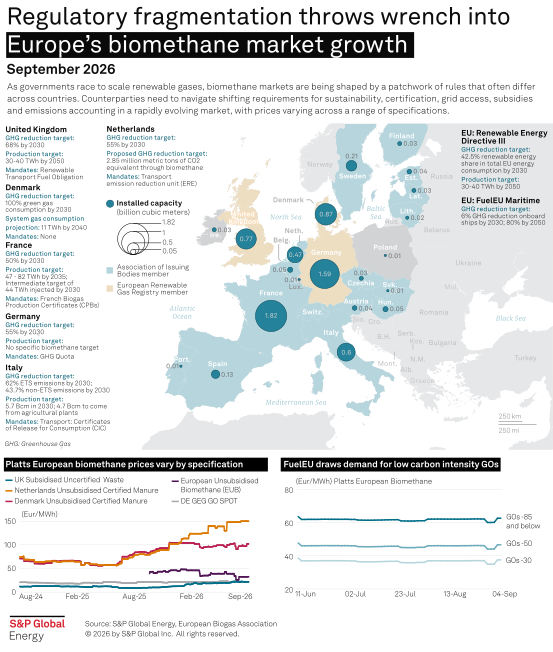
"A more harmonized approach, including interoperable certification and registry systems and a fully operational Union Database, would be important for developing a genuine European market for renewable gases," she added.
Market players and EU member states are divided between two contrasting models, said Alexia Vieira, principal biofuels analyst at S&P Global Energy CERA. On the one hand, a producer-focused, subsidy-driven circular system, and on the other, a buyer-focused, market-driven model.
"The EU regulatory framework allows both to coexist, which creates tensions, uneven implementation, and increased risk for developers and off-takers. Policy is shifting away from stable, production-based subsidies toward consumption-based obligations. This shifts the revenue risk from governments to producers, making project revenue dependent on volatile market conditions and increasing financing uncertainty," said Vieira.
France's CPB
France is Europe's largest producer, with 11.6 terawatt-hours injected into its gas grid in 2024, according to the European Biogas Association. The country boasts more than 829 biomethane plants as of the first quarter of 2026, with generous government subsidies having incentivized rapid production uptake in previous years.
Growth had been driven in part by a 15-year regulated purchase tariff available to eligible injection installations below the applicable annual production threshold.
But an order dated Aug. 10 reduced the eligibility threshold for the regulated purchase tariff from 25 gigawatt-hours to 13 GWh gross calorific value of annual production, while existing purchase contracts are grandfathered and continue under the previous rules.
Specific supported producers will be given an indemnity-free exit route to move toward the Biogas Production Certificates (CPB) mechanism through the end of 2027.
The current tariff framework is now explicitly set to end for new applications, but a complete request submitted before Dec. 31, 2026, can still secure eligibility, even if the buyer has not formally confirmed completeness by that date.
Under the CPB scheme, gas suppliers delivering more than 400 GWh/year to residential and tertiary customers must surrender certificates in proportion to their covered gas sales.
Despite boasting large capacities and generous incentives, France remains a largely insular market as it only allows certificates to be issued for biomethane injected into the French network. This has led the European Commission to issue an infringement notice against France for failing to comply with EU rules on the free movement of goods.
German GHG quotas
As Europe's second-largest biomethane producer, Germany boasts 282 installed plants as of the first quarter of 2026 and injected 10.94 TWh into its grid in 2024, according to EBA data.
Europe's industrial behemoth supports biomethane through a combination of remuneration under the Renewable Energy Sources Act (EEG) for eligible electricity generation and compliance-driven demand in sectors such as transport and, increasingly, building heat.
Special tenders are in place for electricity produced by biomethane-powered combined heat and power (CHP) plants with an installed capacity above 150 kilowatts. A flexibility premium of €100/kW ($116/kW) is available for biomethane CHPs, depending on maize usage limits of 30% in 2025, decreasing to 25% from 2026 onward.
However, tenders have historically been undersubscribed, and the German cabinet has approved amendments to the EEG law that scrap the dedicated biomethane tenders altogether.
"The government is blocking new applications," said a biomethane trader with a utility. "Therefore, EEG might die."
In addition to the biomass and biomethane tenders, a transport greenhouse gas quota is in place, along with a quota for the building sector, which is expected to start in 2029.
| Scheme | Mandate |
| French Biogas Production Certificates | Certificates are generated by eligible biomethane production. Suppliers are required to meet obligations consistent with established coefficients, equivalent to approximately 0.41% in 2026, 1.82% in 2027 and 4.15% in 2028. |
| German Greenhouse Gas Reduction Quota | Fossil fuel distributors must reduce emissions by 12% starting in 2026, increasing gradually to 65% by 2040 through eligible compliance options, including certain conventional and advanced biofuels, renewable electricity, renewable fuels of non-biological origin and biomethane, subject to pathway-specific sustainability, GHG-saving, cap and multiplier rules. |
| German Building Modernization Act | Newly installed fossil-fuel heating systems must use a rising minimum percentage of green gases over time: 10% from 2029; 15% from 2030; 30% from 2035; 60% from 2040 |
| Dutch Green Gas Blending Obligation | The rules require annual reductions in emissions by supplying biomethane into the national gas grid, starting with a 0.63 million metric tons of CO2 chain emission reduction in 2027, before rising to 2.85 MMtCO2 by 2031. |
The GHG reduction quota for transport fuels, known as the THG-Quoten, requires fossil fuel distributors to reduce emissions by a mandated percentage each year through eligible compliance options, including certain conventional and advanced biofuels, renewable electricity, renewable fuels of non-biological origin and biomethane, subject to pathway-specific sustainability, GHG-saving, cap and multiplier rules.
In December 2025, the German Federal Cabinet set an ambitious long-term trajectory to reduce fuel emissions by 12% in 2026, increasing to 59% by 2040, but lawmakers later increased this ambition to 65%, with the obligation coming into effect in April.
Additionally, biomethane plays a significant role in meeting targets for the buildings sector following changes to the Building Energy Act (GEG), which has been replaced by the Building Modernization Act (GMG).
The previous rules required a 65% share of renewable energy in the heat supply for the building sector. The new building-energy framework introduces a staged minimum share of qualifying renewable fuels for certain gas- and liquid-fuel heating systems, with biomethane being one possible compliance fuel.
Dutch blending mandate
The Netherlands, an important player in the European gas market, is also pivoting towards compliance. The country holds significant production capacity, with 92 plants installed as of the first quarter of 2026 and 2.70 TWh injected into the grid in 2024, according to EBA data.
"The Netherlands plans to implement Green Gas Units (GGEs) targeting households, small-scale consumers, and industry by 2027," said Vieira.
This comes after the signing of the Green Gas Blending Obligation Act in May, which outlines the obligations that Dutch suppliers must comply with. The rules require annual reductions in emissions by supplying biomethane into the national gas grid, starting with a 0.63 million metric tons of CO2 chain emission reduction in 2027, before rising to 2.85 MMtCO2 by 2031.
Importantly, the law would allow imports of green gas from other EU member states, which was not possible under previous drafts. This had drawn criticism, with the EU Commission issuing a reasoned opinion in 2024, arguing that the Dutch rules were contrary to Article 34 of the Treaty on the Functioning of the European Union (TFEU), which prohibits quantitative import restrictions and all measures having an equivalent effect to ensure the free movement of goods within the bloc.
The final legislation has not yet been passed, with the next legislative consultation scheduled Sept. 21.
