LNG, Natural Gas
February 24, 2026
FEATURE: Four years on, Russia-Ukraine war drives lasting gas market shifts

By Matt Hoisch
HIGHLIGHTS
EU unlikely to revive Russian gas flows soon: analysts
European price volatility set to last
Russia pivots to China with pipeline, LNG sales
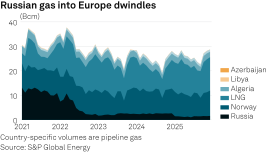
Russia's full-scale invasion of Ukraine reordered the European gas market as the continent deployed infrastructure and shuffled trade to abandon the flows that had been foundational to much of its economy.
Four years later, market watchers widely see this pivot as a lasting rupture rather than a temporary shift, set to endure for the foreseeable future -- even if Russia and Ukraine agree to halt fighting.
Legislation is one of the clearest signals of this durability.
In January, the European Union passed a landmark law phasing out Russian gas and LNG by late 2027. Overturning the ban would require further EU legislation that would need buy-in from a qualified majority of member states. While not impossible, it's a hefty hurdle, according to S&P Global Energy CERA analysts.
"It is implausible that there could be wide consensus across the EU, including within the Commission and Parliament, on restoring Russian gas supply," the analysts said.
It's a change from a year ago, when European market players were still gaming out the possibility of a return to Russian gas amid peace talks.
"European governments and energy markets have moved decisively away from reliance on Russian gas, and there is little evidence that this shift will be reversed even in the event of a ceasefire," said Chris Young, head of KPMG's Global Gas Network.
Durable LNG pivot
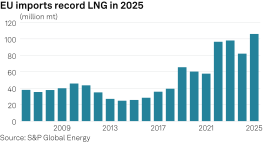
The EU's durable rejection of Russian gas also means a durable embrace of LNG.
The array of import infrastructure member states mobilized to weather the war's first years now seems a bedrock of the continent's energy system.
"It was built in a hurry under very strong pressure, but now it's not just a temporary wartime adjustment," said Tatiana Mitrova, a fellow at Columbia University's Center on Global Energy Policy. "It is a redesign of the whole system."
EU LNG imports have jumped to record levels since the outbreak of the war, from about 57.7 million mt in 2021 to roughly 105.8 million mt in 2025, CERA data showed.
"Europe has re-engineered its gas system around LNG," KPMG's Young said.
As LNG has increased, its role in Europe has also changed.
While the fuel was once a complementary part of the European gas landscape that buyers could tap when prices were favorable, now it's essential for baseload needs.
Consequently, European gas prices are increasingly entwined with the volatile global LNG market, where outages that cut supply or harsh weather that boosts demand can sway prices halfway around the world.
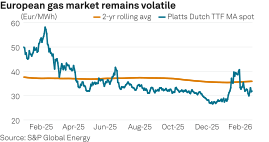
Though this winter, the Platts Dutch TTF month-ahead gas price has held well below last year's high of nearly Eur60/MWh, the benchmark remains volatile. In early February, it dropped 18% in one day as traders repriced for warmer weather expectations and lower prospects of a US-Iran conflict.
Such dramatic movements seem set to persist.
"Much higher volatility than experienced in the last year should be expected going forward," the CERA analysts said.
Navigating these newer dynamics demands a different approach compared to Europe's more placid pre-war gas market.
"It requires more sophisticated contracts, more sophisticated hedging," Mitrova said.
Still, challenges are less existential than in 2022. Rather than a supply risk of having no gas at all, Europe faces a financial risk of having to pay higher prices in a more globalized market.
"It is manageable," Mitrova said.
Changes extend beyond the EU
The war has also driven lasting gas market changes beyond the EU.
Ukraine has faced some of the most visceral impacts, especially in recent months amid a relentless campaign of Russian strikes. Attacks have hindered domestic gas production, prompting the country to boost imports.
The CERA analysts anticipate that this need will endure.
"Expectations are that Ukraine will import about 5-6 Bcm annually in the next years, requiring continued financial support from European institutions and companies," they said.
Russia, meanwhile, has seemingly accepted Europe is largely a lost market and pivoted eastward.
"Russia has redirected strategy toward Asian pipelines and expanded LNG capacity, signaling that a return to the pre-war energy relationship is unlikely from either side," Young said.
China is a particular focus. In 2025, gas deliveries from Russia via the Power of Siberia pipeline totaled some 38.8 Bcm, surpassing the route's design capacity of 38 Bcm, according to Gazprom CEO Alexei Miller.
"While expanding pipeline exports to China were never originally conceived as a direct replacement for European sales, they have effectively assumed this role," the CERA analysts said.
Buyers in China have also been testing Western sanctions against Russia's LNG industry. Since August 2025, tankers have delivered blacklisted cargoes to the port of Beihai in southern China, deepening ties between Beijing and Moscow.
More generally, the Russia-Ukraine war has "significantly" accelerated growth in a global acceptance of LNG over pipeline gas, despite the higher prices it entails, Mitrova argued.
"It is a much more difficult world," she said. "In this world, you prefer to have this flexibility and not to go into the pipeline business. That's a big outcome for the gas industry."
Four years on, a war that has stretched on longer than most expected seems set to change global gas markets in ways that will linger long into the future.

Editor: