Metals & Mining, Non-Ferrous
November 18, 2026
US rare-earth buildout faces commercial reality test
Editor:
HIGHLIGHTS
US rare-earth projects face scale-up hurdles
China controls 90% of magnet production market
Developers target 2028-2030 commercial output
The US has no shortage of planned rare-earth projects, but converting them into reliable commercial production will be a far harder test, industry experts told Platts, part of S&P Global Energy.
Backed by billions of dollars in public and private investment, US developers plan to build a network of rare-earth separation, metal and magnet manufacturing plants by 2030. Platts identified 11 projects targeting commercial separation of rare earth oxides, also known as refined rare earths, although they vary widely in their stage of development.
Critics say the compressed timelines leave insufficient room for commissioning, process optimization and customer qualification, all of which are needed to reach reliable commercial production.
Washington is backing developers in a race to reduce China's dominance of rare-earth supply chains. Beijing controlled 91% of global processing capacity in 2024, according to the US Energy Information Administration, and has used export restrictions as geopolitical leverage. But critics fear developers are overpromising.
"Rare earths are not primarily a mining problem," Robert Friedland, founder and executive co-chairman of Ivanhoe Mines, told Platts. "They are a chemical, processing, separation, metallurgy and manufacturing problem. The West can mine rare-earth-bearing rock. What is extraordinarily difficult is turning that rock into 15-17 individually purified elements."
The challenge has become more urgent as China retains the ability to restrict materials and processing technologies on which Western manufacturers depend. Beijing's suspension of additional rare-earth export controls expires Jan. 10, 2027, raising the prospect of renewed restrictions without a lasting trade agreement.
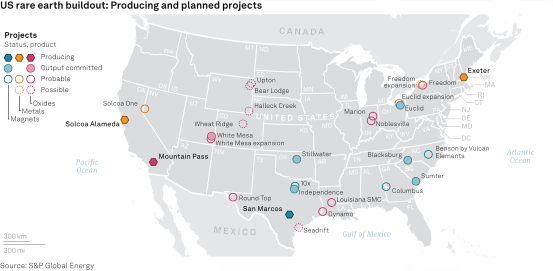
The US imported roughly 71% of refined rare earths, including oxides and metals, from China between 2021 and 2024, according to the US Geological Survey. While domestic demand is projected to rise from 27,000 mt in 2025 to 32,800 mt in 2030, committed US projects are expected to supply only 17,000 mt by then, leaving a 15,800-mt shortfall, according to data from S&P Global Energy Horizons.
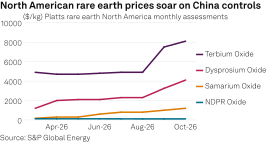
California-based MP Materials and Australia's Lynas are the only rare-earth producers operating at scale outside China, and both are expanding into high-value heavy rare earths such as terbium and dysprosium, which trade at far higher prices thanChinese material.
The industrial challenge beyond mining
The US and its allies have been aggressively scaling up mining. The Department of Defense backed USA Rare Earth's acquisition of Serra Verde in Brazil and struck a multibillion-dollar partnership with MP Materials that includes equity, loans, a 10-year NdPr price floor and a magnet offtake commitment. In Australia, the US government has committed up to $400 million to Sunrise Energy Metals' Syerston scandium project to develop a mine-to-metal supply chain outside China.
But greater mine supply addresses only the first stage of the value chain, in which China's deeper advantage lies in processing, technical expertise, and manufacturing.
"High technology and developing technologies utilize hundreds or even thousands of different compounds, alloys and chemicals containing different forms of these particular metals, each of which requires unique purification and processing pathways," Friedland told Platts. "China has invested many decades of research and development in these thinly traded markets."
China now accounts for roughly 91% of refined magnet rare-earth production and almost 95% of permanent magnet output, nearly double its share two decades ago, according to the International Energy Agency.
"The main challenge outside China is not simply demonstrating that separation is possible but operating reliably at commercial scale and at costs that support a viable business in a volatile market," Sangita Kannan, an economist at the US Department of Energy's Argonne National Laboratory, told Platts.
Testing a different model
Emerging developers argue that aggressive timelines are achievable when projects simplify the scale-up challenge rather than try to solve every part of the rare-earth supply chain at once.
Chile-based Aclara Resources has developed a model that controls both ends of the separation process. Its planned Project Dynamo facility in Louisiana is designed specifically to process high-purity mixed carbonate from the company's ionic-clay deposits in Chile and Brazil, giving it greater control over feedstock chemistry and supply.
Unreliable feedstock, rather than the underlying solvent-extraction chemistry, has been the principal obstacle to developing US separation capacity, Ramón Barúa, CEO of Aclara Resources, told Platts.
The company plans to begin commercial oxide separation by the end of 2028. Its mines are expected to produce mixed rare-earth carbonate of about 99% purity, reducing the impurities entering the plant and potentially simplifying separation.
"Aclara can have this ambitious timeline because we have been investing in these projects during the past eight years," Barúa said, adding that the company had invested more than $300 million in its assets.
While Aclara Resources aims to reduce risk by designing a plant around a controlled feedstock, Ucore Rare Metals is betting on a modular system that can process different feeds and expand in stages.
Ucore Rare Metals is developing its Louisiana separation plant in modular steps rather than commissioning a large conventional circuit at once. Its RapidSX process could accommodate different feedstocks and allow capacity to be added gradually. That flexibility may itself help determine which emerging projects endure.
The strongest prospects are facilities that can adjust which rare-earth elements they recover as market conditions change, said Peter Cook, a geologist and analyst at the Breakthrough Institute.
"This allows a facility to capture more total market value without risking wasted upfront investment in separation capacity dedicated to rare-earth elements with low prices," Cook said.
Such projects must still demonstrate that their technology works at full scale, Cook said, but their ability to adapt production to changing prices and demand gives them "the best prospects for sustained production."
However, Friedland doubts these companies, or their earlier-stage brethren, will reach these goals, calling promises to master those industrial processes within three years "snake oil."
