Metals & Mining, Crude Oil, Natural Gas, Non-Ferrous
November 18, 2026
INFOGRAPHIC: Middle East export disruption highlights sulfur as key industrial feedstock
Editor:
HIGHLIGHTS
Fertilizer makers face rising input costs
Supply shock shows sulfur's critical role
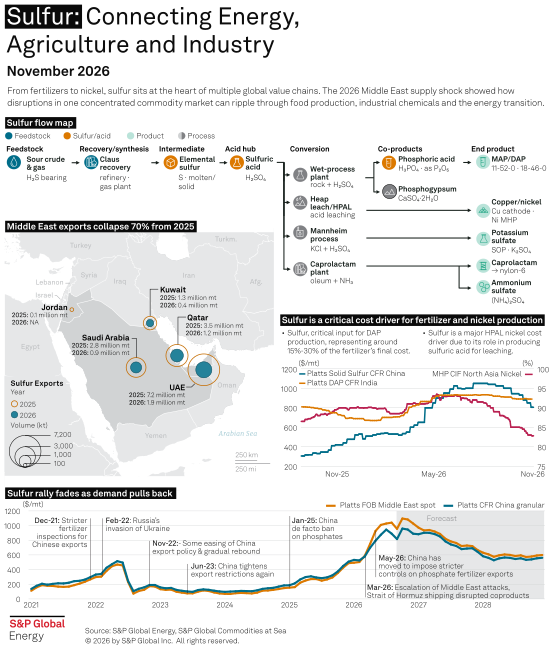
Sulfur is a key raw material for a wide range of industries, linking energy production, fertilizers and industrial manufacturing. Sulfur is converted into sulfuric acid, which is used in a wide range of industries, including phosphate fertilizer production, nickel processing and other chemical industries.
As sulfur is recovered primarily from oil refining and natural gas processing, the Middle East is the world's largest sulfur-exporting region, with producers in Saudi Arabia, the UAE, Qatar and Kuwait acting as key suppliers to consumers worldwide. In 2026, sulfur exports from the region plunged following supply disruptions amid the closure of the Strait of Hormuz.
The decline in exports from the Middle East caused international sulfur prices to rally, pushing up costs for downstream industries. Phosphate fertilizer producers, which account for the majority of sulfur consumption, grappled with higher raw material costs, while nickel processors also came under pressure as sulfuric acid is a key reagent in high pressure acid leaching (HPAL) operations.
The supply shock from the Middle East export disruption highlighted the importance and irreplaceability of sulfur as a feedstock for industries that underpin food production and the energy transition.