Metals & Mining, Non-Ferrous
November 17, 2026
Rare earth buyers seek supply deals stretching beyond five years: Critica CEO
By Anthony Barich and Gaurang Dholakia
Editor:
HIGHLIGHTS
Offtakers demand contracts exceeding 5 years
Critica produces rare earth carbonate in Australia
Jupiter holds 1.7 bil mt resource with scandium
Rare earth mine offtakers' requirements have shifted from seeking supply in the next one to two years to at least five years out and more as Chinese export curbs bite, Jacob Deysel, CEO of Critica Ltd., told Platts, part of S&P Global Energy.
Deysel was part of an Australian critical minerals delegation to the US that returned Nov. 10, where meetings with government agencies and supply chain players revealed a new urgency to secure offtake amid Chinese export controls, the executive said.
Critica has produced commercial-quality mixed rare earth carbonate (MREC) from its Jupiter project in Western Australia at a government facility in Sydney, and is now dispatching product to offtakers as it seeks strategic financing and grant funding, Deysel said.
"A year ago, offtakers were really focused on which projects can fill the gap in the next two to three years, and they were less worried about longer term. The conversation this year has been about how 'how do we fill [demand requirements] five years and beyond,' " Deysel said.
"So that conversation has shifted, and as a result we're having a lot of engagement at the moment."
Prior to the US trip, Deysel was in Seoul, South Korea for the International Rare Earths Conference in October, where "there was enormous attention from offtakers and processers to supply long-term feedstock," Deysel said.
"There's a significant demand that's opening up, and there's not a lot of mines coming online either — certainly not ones that can give you that long, stable, secure supply," the CEO said.
Deysel's conversations with a number of original equipment manufacturers over the course of his US trip also revealed that "what's more important for them at the moment is security of supply outside of China, and pricing is less of a concern at the moment."
Scandium and gallium upside
Critica's Jupiter deposit is one of six rare earth discoveries within Critca's Brothers project in Western Australia, and represents less than 3% of the broader project landholding, according to an Oct. 20 scoping study which outlined A$1.99 billion after-tax net present value, discounted at 8%.
Jupiter's scoping study considered the production of MREC containing about 9,300 metric tons/year of total rare earth oxides at nominal processing capacity, with a base case assuming a life-of-mine average of roughly 8,300 mt/year of contained total rare earth oxides in MREC. Magnet rare earths, including neodymium, praseodymium, dysprosium and terbium, would comprise about 23% of the total rare earth oxides.
The scoping study's base case has first MREC production and sales commencing in 2032.
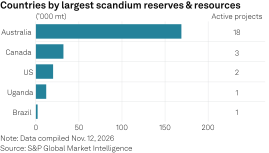
However, Brothers also has the world's largest scandium reserves and resources, according to S&P Global Market Intelligence data. Australia, where the project is located, has by far the most scandium reserves and resources and projects.
On Oct. 12, Critica also revealed Jupiter's updated mineral resource estimate of 1.7 billion mt grading 1,700 ppm total rare earth oxides, including its first indicated mineral resource of 160 million mt. That indicated resource contains about 6,400 mt gallium oxide and about 7,200 mt scandium oxide, while the 1.5 billion mt inferred resource contains roughly 60,000 mt gallium oxide and about 54,000 mt of scandium oxide, based on reported rounded tonnages and grades.
Critica announced Nov. 9 that it is advancing potential value streams for the potential recovery of gallium and scandium as by-products that were not included in Jupiter's scoping study base case.
"The same process that we use to produce our mixed rare earth carbonate allows us to extract the gallium and the scandium. The next step for us is to recover those as individual metals," Deysel said.
Metallurgical test work from Jupiter achieved up to 91.9% gallium and 84.7% scandium extraction, thus "materially advancing the potential recovery pathway for both strategic metals," Critica said in a Nov. 9 statement.
The gallium extraction was materially improved from about 63%, which had previously been reported.
Gallium is a key input into gallium arsenide and gallium nitride semiconductors used in high-performance electronics, telecommunications, power electronics, LEDs, solar technologies and defense applications, and China accounts for over 90% of global refined gallium supply, Critica said Nov. 9.
China is also a leading producer of scandium, whose production remains small and concentrated, and is primarily used in high-performance aluminum-scandium alloys and solid oxide fuel cells, with potential applications across aerospace, defense and advanced energy technologies, according to Critica