Metals & Mining
November 10, 2026
US turns to minerals diplomacy to spur investment, diversify supply
Editor:
HIGHLIGHTS
US signs 40+ mineral pacts in Trump's second term
Investments hit $3.2 billion record in Q2 2026
Agreements lack binding legal force
The US has rapidly expanded its web of critical minerals agreements as it works to loosen China's grip on mineral supply chains, but experts said the strategy's ultimate success will depend on whether diplomatic partnerships can mobilize investment and bring new projects online.
The US has signed more than 40 bilateral and multilateral critical minerals agreements since President Donald Trump began his second term, comprising frameworks, memorandums of understanding, initiatives and action plans. This is more than double the 16 agreements reached over the previous nine years, according to an analysis by Platts, part of S&P Global Energy.
The agreements, most of which are not legally binding, have paved the way for US government financing and private investment, but do not directly deploy capital. The longer-term impact depends on whether the agreements translate into economically viable mines, processing facilities and other projects that expand supply, according to industry experts.
"The government agreement is just creating an enabling environment to deploy public and private capital to bring mineral supply online that supplies the United States. It's setting the table for the deal," Gracelin Baskaran, director of the critical minerals security program at the Center for Strategic and International Studies, told Platts.
Mineral diplomacy expands
Critical minerals agreements have become a central part of the Trump administration's foreign policy as Washington combines diplomacy, trade and development financing to reduce reliance on foreign sources for materials.
The network of agreements may expand as the US Trade Representative develops a plurilateral Agreement on Trade in Critical Minerals, following Trump's January 2026 directive to negotiate with trading partners after a national security investigation into processed critical minerals.
Similar partnerships preceded Trump's second term. Former US President Joe Biden launched the Minerals Security Partnership in June 2022 to accelerate the development of diverse critical mineral supply chains. In February, the Trump administration launched the Forum on Resource Geostrategic Engagement, or FORGE, building on the partnership's work.
The use of critical minerals agreements has become a strategic and central part of US foreign policy as government-to-government relationships enable allied investments to build processing capability, Baskaran said.
"We've taken a page out of China's playbook, and what that means is we are integrating foreign policy and domestic industrial strategy," Baskaran said.
Money follows some agreements
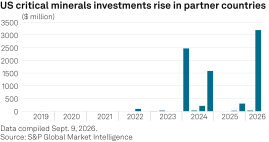
US critical minerals investments in partner countries have increased since 2019, reaching an all-time high of $3.19 billion in the second quarter of 2026, according to S&P Global Market Intelligence data.
While those investments are not directly attributable to the agreements, several country-to-country partnerships have been followed by backing from the US Export-Import Bank, US International Development Finance Corporation or private investors.
The US signed a critical minerals and rare earths framework with Australia in October 2025. Six months later, Australia said the countries were committing more than $5 billion for critical minerals projects under the framework. The US Department of Defense also recently announced a $174 million equity financing investment for a new gallium production facility at an alumina refinery in Australia.
The US signed a similar framework with Argentina in February. In September, the Ex-Im Bank signed a separate framework with Argentina that could mobilize up to $7 billion through 2027 for several priority sectors, including critical minerals development and processing.
"There is a clear recognition with all of this activity that minerals matter, but we're also seeing a concerted effort to use diplomacy, trade policy, development finance, export credit, stockpiling, alliances with other countries around all of that and treating access to minerals and processing capacity really is a form of strategic power," Brent Greenfield, director of government affairs at the American Critical Minerals Association, told Platts.
Still, questions remain over how to turn growing government involvement into competitive, economically viable projects, according to Greta Peisch, an international trade partner at Wiley Law and former general counsel for the USTR.
"What is the strategy to move those work streams forward? It isn't clear from the outside," Peisch told Platts.
Congress could bolster durability
Broad bipartisan support for critical minerals diversification could help uphold the agreements through political changes, experts said, though greater involvement from Congress could make international partnerships more durable.
"Based on the clear bipartisan support that we've seen in recent years and the unified nature of the push across both sides of the aisle to make sure that we have critical minerals resiliency ... the general tenor and direction of what we've seen is highly likely to continue," Greenfield said.
The House passed the Developing Overseas Mineral Investments and New Allied Networks for Critical Energies, or DOMINANCE, Act in June to formalize US participation in FORGE and establish a mechanism to support mineral investments abroad.
However, individual agreements could face greater scrutiny following the midterm elections if Democrats take the majority, Sahar Hafeez, an international trade attorney at Pillsbury Law, told Platts. Senate Democrats have sought records from Trump administration agencies over alleged potential conflicts of interest involving federal support for critical minerals companies.
"We might see some scrutiny of certain deals announced in the past year and a half, but I don't think this bilateral and plurilateral cooperation piece is going to change much," Hafeez said. "However, congressional authorization is going to be important to advance durability and impact of MOUs, plurilateral agreements and other arrangements."
