Metals & Mining, Ferrous
November 10, 2026
Russia shifts steel exports to Baltic ports from Black Sea in 2026
By Andrejs Vorobjovs and Panos Achilleos
Editor:
HIGHLIGHTS
Baltic ports gain 71% of Russian steel flows
Black Sea billet prices climb to $480/mt FOB
Turkish mills switch to scrap amid supply gaps
Russian semifinished steel export flows have increasingly shifted away from the Black Sea toward Baltic ports in 2026, as disruptions to traditional southern export routes reshape shipment patterns and tighten the availability of Black Sea-origin material.
There were no Black Sea steel loadings in either September or October, compared with 468,070 metric tons and 370,994 mt, respectively, loaded from Baltic ports. The Black Sea region had already seen a sharp decline in August, when loadings fell to 94,939 mt across three voyages, while Baltic ports handled 341,399 mt across 10 voyages, S&P Global Commodities at Sea data showed.
The shift marks a significant departure from historical trade patterns. In 2025, Black Sea ports handled 5.687 million mt compared with 6.516 million mt through the Baltic, giving the Baltic a 53.4% share of combined volumes. In the available 2026 data, Black Sea loadings total 1.754 million mt compared with 4.335 million mt through Baltic ports, raising the Baltic share to 71.2%, according to S&P Global Market Intelligence's Global Trade Analytics Suite data.
The divergence became particularly pronounced from the second quarter. Black Sea shipments fell from 346,109 mt in March to 188,291 mt in April and 96,879 mt in May. Following a partial recovery to 219,286 mt in July, volumes dropped back to 94,939 mt in August before falling to zero in September and October. By contrast, Baltic ports maintained shipments of 468,070 mt in September and 370,994 mt in October, the GTAS data showed.
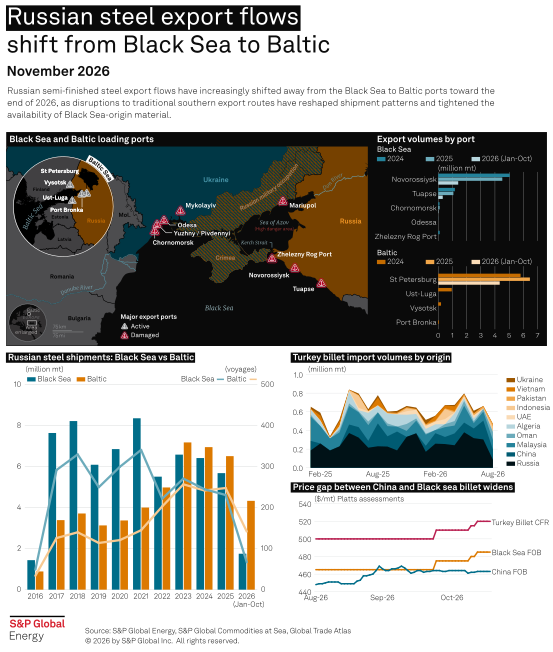
The changing logistics have coincided with firmer Black Sea billet pricing. The Platts Black Sea FOB billet assessment stood at $465/metric ton through much of August and the first part of September, before rising to $475/mt Sept. 24, $480/mt Oct. 9 and $485/mt by Oct. 13. Over the same period, Turkey CFR billet rose from $500/mt to $520/mt, data from Platts, part of S&P Global Energy, showed.
Platts assessed CIS export billet at $480/mt FOB Black Sea Nov. 6, stable from the previous day.
Platts assessed Turkish import billet at $515/mt CFR Turkey Nov. 6, stable from Nov. 5.
"We are planning 100,000-120,000 mt for seaborne exports to Turkey/Egypt through Baltic Sea ports [of billets], to be produced in November for December delivery. This is in line with the average monthly volumes before the Black Sea closure," a Russian mill source said.
Russia nevertheless remained the largest source of Turkey's semifinished steel imports in January-August, mainly driven by the war in the Middle East and lack of Asia-origin material, with volumes of 2.01 million mt, marginally above 2.001 million mt in the corresponding period of 2025, the GTAS data showed.
In response to the lack of cheap Russian billets, some Turkish mills have turned to using scrap instead, however, this option isn't available to everyone. HMS 80:20 scrap prices have strengthened amid reduced availability of competitively priced Russian billet, as disruptions to Black Sea shipments have limited an alternative feedstock for Turkish mills.
With fewer cheap billet cargoes available, Turkish producers have increasingly turned to scrap-based production, providing additional support to imported scrap prices, market sources said.
Platts assessed Turkish imports of premium heavy melting scrap 1/2 (80:20) at $407/mt CFR Nov. 6, unchanged day over day.
