Metals & Mining, Non-Ferrous, Ferrous
October 22, 2026
Nickel Industries expects Dec rains to provide operational relief in Indonesia
Editor:
HIGHLIGHTS
Drought cuts nickel output to 75% capacity
Falling sulfur costs reduce battery plant expenses
Indonesia's upcoming rainy season in December could provide operational relief for Nickel Industries Ltd., which has cut output due to El Niño-driven drought conditions, Justin Werner, the company's managing director, said during an Oct. 22 analyst call.
Water supply issues forced Nickel Industries to cut production at its rotary kiln electric furnace (RKEF) operations to about 75% of nameplate capacity in October, the company said in a release Oct. 22. The company's Hengjaya, Ranger, and Oracle RKEF operations are located at the Indonesia Morowali Industrial Park, where producers are expected to coordinate output reductions amid a water shortage, Werner said.
The Australia-listed miner said its Hengjaya mine only received 7 millimeters of rain from the start of August to Oct. 21, down from the 10-year average of 474 mm over August-October. But Werner remains optimistic about the company's operational outlook, citing expectations of more rainfall in December.
"December marks [as] sort of the start of the wet season," Werner said. "We're hopeful of starting to see some meaningful rainfall sometime in the next couple of weeks."
RKEF plants, which produce nickel pig iron (NPI) for stainless-steel production, use water to cool components and power plant systems. The park previously flagged output cuts at the site, although the drought has not yet led to shutdowns. Platts, part of S&P Global Energy, assessed Indonesian NPI with 10% nickel content at $129/metric ton FOB Indonesia Oct. 21, flat day over day and down $3/mt from the previous week, amid oversupply concerns.
The Indonesia Weda Bay Industrial Park, which hosts Nickel Industries' Angel RKEF operation, remains unaffected by water shortages, according to Werner.
Easing sulfur prices
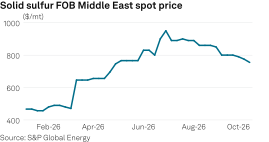
Meanwhile, Werner expects the recent decline in sulfur prices to lower operating costs for Nickel Industries' high-pressure acid leaching (HPAL) facilities. HPAL plants use sulfur to produce sulfuric acid, which then extracts nickel and cobalt from ore to produce a mixed hydroxide precipitate, a key battery material.
Platts assessed the solid sulfur spot price at $755-$790 FOB Middle East Oct. 15, down from a recent high of $950-$1,000/mt July 2.
"Sulfur at this point is not as critical as perhaps it was sort of one to two months ago," Werner said. "There does appear to be quite a bit of movement through the Strait of Hormuz, and that's obviously being reflected in the pricing."
Nickel Industries is currently ramping up production at the Excelsior HPAL project, which recently secured a $245 million facility to support operations. The company expects the operation to achieve full production in December, as drought-related conditions have slowed the ramp-up.
Nickel Industries produced its first mixed hydroxide precipitate from the project in July, followed by its first nickel cathode output in August. Nickel Industries owns 46% of Excelsior, while Hong Kong-registered Decent Resource holds 44% and South Korea's Sphere Corp. holds 10%. Decent Resource is an affiliate of Shanghai Decent.
The company's RKEF nickel pig iron production reached 239,959 mt in the third quarter, down 2% from the second quarter.
Nickel Industries reported nickel ore production of 6.1 million wet metric tons in the third quarter, up from 5.9 million wmt a year earlier. HPAL attributable sales increased 7% to 1,900 mt of nickel in the third quarter from 1,782 mt of nickel in the second quarter.
