Metals & Mining, Ferrous, Non-Ferrous
October 22, 2026
LME Week: Supply surplus clouds European nickel premium outlook
By Shivam Prakash and Merin Jacob
Editor:
HIGHLIGHTS
CERA sees 79,000 mt surplus in 2026, deficit only by 2029
European nickel premiums face downward pressure
Indonesia's policies drive price volatility
As industry leaders gather in London for one of the world's largest metals events, S&P Global Energy Platts presents the LME Week thought leadership series, examining the forces redefining global metals markets and shaping the outlook for 2027 and beyond.
This feature examines why elevated inventories and subdued demand continue to weigh on nickel markets, despite ongoing uncertainty surrounding Indonesian supply.
European nickel traders are heading into the final weeks of 2026 with little to cheer about as oversupply, weak demand, and muted concerns over Indonesian supply risks continue to dominate a physical market and have failed to generate any urgency on the buy side.
LME nickel cash prices remain barely above 2026 lows while Rotterdam physical premiums face renewed downward pressure, prompting market participants to focus on the extent of potential decline ahead of year-end rather than prospects for recovery.
The longer view offers a more nuanced picture. Indonesia's role as the top global nickel producer continues to inject uncertainty into supply dynamics, with Jakarta's decisions on ore mining quotas and export policy fueling sharp price volatility in 2026 and further shifts potentially tightening a market inching toward equilibrium.
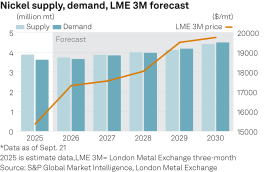
S&P Global Energy CERA lowered its forecast for the average LME three-month nickel price in 2026 to $17,311/metric ton from $17,548/mt after the Weda Bay restart announcement. CERA's latest outlook projected a 2026 primary supply of 3.733 million mt, and demand of 3.654 million mt, leaving a 79,000 mt surplus.
CERA forecasts the surplus narrowing to 30,000 mt in 2027 and 26,000 mt in 2028, before the market moves into deficit in 2029.
Exchange stocks remain elevated
The scale of the inventory challenge is visible in the exchange data. LME nickel cash stood at $15,383.74/mt on Oct. 13, only $23.87 above its 2026 low of $15,359.87/mt on Oct. 8. It was down more than 20% from the year's high of $19,448.31/mt on May 5, latest exchange data showed.
LME warehouse stocks totaled 282,504 mt on Oct. 12, the latest date available, compared with the 2026 high of 289,506 mt on Feb. 25 and the year's low of 255,282 mt on Jan. 1.
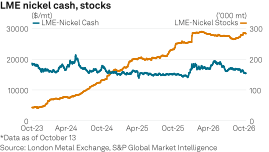
The figures point to a substantial inventory overhang accumulated during recent years of oversupply, Greg Miller, senior analyst for nickel markets at Wood Mackenzie, told Platts, part of S&P Global Energy.
The stock buildup also reflects weaker-than-expected demand from the battery sector. Nickel units previously intended for nickel sulfate production are instead being converted into Class 1 metal and delivered onto exchanges, Miller said. He noted that additional Indonesian HPAL capacity set for late 2026 and 2027 could boost Class 1 nickel supply, with most output likely aimed at Class 1 production and potentially increasing exchange inflows in 2027.
Indonesian variable
Indonesia remained a central and unpredictable force in nickel markets through 2026. Decisions to restrict nickel ore mining quotas, known as RKABs, helped push prices higher early in the year, while changes to the HPM pricing formula and proposed royalty and export tax hikes all fueled price volatility in the first half of the year, Miller said. Prices subsequently retreated toward $15,000/mt despite Indonesian policies helping to move the market closer to balance.
Production cuts at several Indonesian HPAL operations, driven by limited sulfur supplies and elevated sulfur prices amid Middle East tensions, have yet to trigger a lasting price reaction. Miller attributed the muted response to inventory overhang, diminished investor confidence from Jakarta's policy shifts, and weak demand for stainless steel and lithium-ion batteries.
"We expect nickel prices to be largely shaped by Indonesia's supply policies in the near-term," Joenelle Donato, analyst at CERA, said.
"Nickel price is an Indonesian quota story in waiting," Nicholas Savidge, an Italy-based trader, said. "Until Jakarta speaks, it stays in a broad, boring range between $15,000-$17,000."
Indonesian supply continues to pose upside price risk, with ongoing sulfur shortages threatening to postpone new HPAL projects and Jakarta's future RKAB allocation decisions set to influence production and prices into 2027.
"Given that European nickel contracts are typically priced against the LME benchmark, a sustained rise in LME prices driven by supply-side risks would eventually translate into higher contract prices and raw material costs for European stainless steel and battery producers," Donato said.
Those prospective risks have not yet tightened the European physical market, where subdued spot demand, ample availability and intense competition among sellers continue to outweigh concerns about possible Indonesian supply disruptions.
European premiums under pressure
In Europe, producers and trading houses vie for scarce orders as well-supplied buyers benefit from a wide array of offers. Five to seven sellers could be pursuing the same customer, forcing companies to match or undercut competing bids, a Europe-based trader told Platts.
"There is not enough demand in the market for all the trading houses and producers," the trader said. "Everybody has more than enough material in stock. There is no story to increase premiums, so people have to get rid of units."
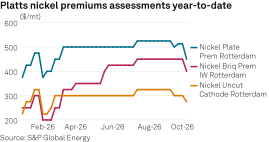
Platts assessed the nickel plating-grade premium at $400-$500/mt in-warehouse Rotterdam on Oct. 16. The uncut cathode premium was assessed at $250-$300/mt, while the briquette premium was assessed at $350-$450/mt, on the same basis.
The trader expected premiums to fall by a further $50-$100/mt by year-end. Stainless steel demand had been particularly quiet and was likely to remain subdued over the rest of 2026, the trader said.
A second trader offered a slightly firmer assessment, noting that nickel demand had picked up slightly and that alloy-sector demand had been more stable, though volumes remained insufficient to materially reduce stocks held by producers and trading houses.
Ample availability is also allowing consumers to delay purchases. With no immediate shortage expected, buyers have little incentive to commit to additional volumes, increasing pressure on sellers to clear inventories.
"There is LME inventories, SHFE inventories, Chinese production that's not allowed to be exported and all the big shadow stocks of the big trading houses all over the world," the first trader said. "There's no reason for a shortage. This is why we see further price declines."
The first trader said even a 10% reduction in Indonesian output would not necessarily create a shortage under current conditions.
For European premiums, prompt availability outweighs concerns over future supply disruptions, as lackluster stainless steel demand and stable inventories drive sellers to compete fiercely for scarce spot transactions.
