Metals & Mining, Electric Power, Ferrous
October 09, 2026
Turkey’s steelmakers face EU quota cuts as CBAM verification becomes critical
By Panos Achilleos and Cenk Can
Editor:
HIGHLIGHTS
EU slashes Turkey's steel quotas by 47%
Verification capacity shortage threatens mills
Exports shift to UK, US as EU sales drop 22%
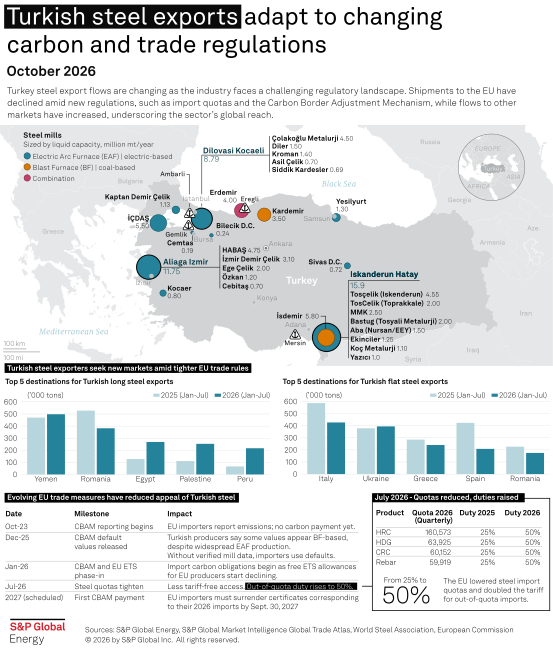
Turkey's steel exporters face two tightening constraints in their largest export market: the EU's Carbon Border Adjustment Mechanism and sharply reduced duty-free import quotas. Shipments to the bloc were already falling before the revised quota regime took effect on July 1, leaving mills to seek other outlets for their production.
Turkey's steel exports to the EU fell 22% year over year to 2.8 million metric tons in the first seven months of 2026. Industry participants cite CBAM as a significant factor, although that period also captures the first month of the revised safeguard quotas.
Under the new EU quota regime, duty-free import volumes across steel categories were cut 47% to about 18.3 million mt/year, while the tariff on volumes exceeding quotas doubled to 50%. Turkey's country-specific hot-rolled coil quota fell 59%, from 1.6 million mt to 642,294 mt on an annualized basis under the new allocation. Turkish exporters may also draw on a 483,682 mt shared pool with Egypt, India, Korea and Ukraine, but access to it is not guaranteed. If Turkey secured the entire shared pool, its HRC access would reach 1.13 million mt. Its allocation across all steel categories stands at approximately 2.86 million mt.
Turkish industry groups expect a substantial loss of EU sales. Ugur Dalbeler, chairman of the Turkish Steel Exporters' Union, has said the quota reductions could cost the sector could cost the sector as much as 3.5 million mt of exports to the EU. Increasing quotas would help sustain the Turkish steel industry's decarbonization investment, however, according to the Turkish Steel Producers' Association.
"A moderate increase in export quotas would contribute to ensuring that investments aimed at decarbonization and adaptation to the green transformation can continue without losing momentum," the group said in a statement to Platts, part of S&P Global Energy.
Verification poses a CBAM hurdle
For Turkish steel producers, CBAM's immediate challenge may be verifying emissions rather than reducing them.
Demand for accredited verification is expected to exceed available capacity as thousands of production assets seek installation-level assessments, according to Nick Ogilvie, CBAM lead at CarbonChain.
"If you are a mill and you have not gone through pre-verification with a verification entity that wants to become a CBAM-accredited verifier, it is unlikely that you will have verified emissions next year," Ogilvie told Platts. He added that much of next year's verification capacity is rapidly being booked.
Where installation-level emissions data are unavailable, EU importers must rely on default emissions values. Those values may not reflect actual performance and could prevent lower-emission producers from demonstrating a competitive advantage. The resulting CBAM charge depends on the applicable calculation methodology and product benchmark.
The issue is particularly relevant for Turkey, where electric arc furnaces account for roughly 70% of steel production. Industry participants said direct EAF emissions, excluding electricity consumption, typically range from 0.02 mtCO₂ to 0.07 mtCO₂ per mt of steel, broadly in line with or below the relevant benchmark. Producers able to verify those emissions levels could face little or no liability for direct-emissions CBAM costs.
Ogilvie estimated that Turkey's CBAM costs could remain relatively low, at €10-€50/mt of steel, if actual emissions values are verified across the supply chain. Without verification, however, importers may be required to use default values that result in higher charges and fail to reflect producers' emissions performance.
The challenge is more acute for steel rerollers and downstream manufacturers. Verified emissions data from upstream suppliers is required in addition to complete verification of their own operations. Delays at either stage could result in the use of default values.
They need to complete verification of their own operations and submit emissions data from their upstream feedstock suppliers. Delays at either stage could result in the use of default values.
Ogilvie said verifiers outside the EU must obtain domestic accreditation as well as accreditation from an EU national accreditation authority, a process that could constrain verification capacity ahead of full CBAM implementation.
Turkish domestic carbon market
Turkey's emissions trading system took legal effect on Aug. 27 and covers sectors targeted by CBAM. Its planned pilot phase and the phaseout of free allowances from 2028 could give Turkish producers a domestic carbon cost to account for alongside their EU obligations.
Eligible carbon costs paid in Turkey may be deducted from CBAM charges, subject to the applicable rules. Rather than eliminating total carbon costs for producers, the mechanism could shift a portion of carbon-related revenue from the EU to Turkey. "The goal is to capture the revenue domestically rather than have it go to the EU," Ogilvie said.
The EU has proposed extending CBAM to approximately 200 downstream products from 2028, including machinery, vehicles, electrical goods, tools and furniture with significant steel content. Turkey accounted for 13.8% of EU imports of downstream steel products in 2024, second to China's 49.7%. The proposal could therefore broaden the range of Turkish exporters exposed to carbon-reporting and cost requirements.
Turkish mills are already increasing shipments to other markets. According to Turkish Steel Producers' Association data, exports to the UK rose 90% year over year to 700,000 mt in January-July. Shipments to the US climbed 17.2% to 340,000 mt, while exports to Egypt increased 29.4% to 406,000 mt. Within the EU, Romania remained Turkey's largest single destination at 962,000 mt, despite a 13.2% decline.
Whether Turkish mills can find enough alternative buyers while securing verified emissions data will determine how well they can withstand reduced access to the EU market.