Metals & Mining, Non-Ferrous, Ferrous
October 09, 2026
EU selects 46 new critical raw materials strategic projects

By Euan Sadden
Editor:
HIGHLIGHTS
Projects span lithium, nickel, cobalt and rare earths
Full portfolio could meet key CRMA extraction benchmarks
Lithium prices flat at $18,000/mt amid weak demand
The EU has selected 46 new strategic projects aimed at strengthening the bloc's security of supply of critical raw materials, adding to the 47 EU-based projects announced in March 2025 and 13 overseas projects adopted in June 2025.
In an Oct. 9 statement, the European Commission said the projects would contribute to the benchmarks established under the Critical Raw Materials Act. By 2030, the act seeks to ensure that EU capacity accounts for at least 10% of the bloc's annual consumption of strategic raw materials through extraction, 40% through processing and 25% through recycling. The targets are intended to improve competitiveness, build supply-chain resilience and reduce dependence on any single supplier.
The newly selected projects are located in Belgium, Bulgaria, Estonia, Finland, France, Germany, Greece, Italy, Lithuania, the Netherlands, Poland, Portugal, Romania, Slovakia, Spain and Sweden. They were chosen from 102 applications submitted during a call that concluded earlier this year, the Commission said.
The projects cover lithium, nickel, cobalt, manganese, graphite, magnesium, tungsten and rare earth elements. By value-chain stage, eight projects focus on extraction, 11 on processing and 19 on recycling. A further eight are integrated projects: three combine extraction and processing, while five combine processing and recycling. Collectively, the projects cover 15 of the 17 strategic raw materials identified under the act.
The Commission said the full portfolio of 106 strategic projects could meet the CRMA's extraction benchmarks for lithium, nickel, rare earth elements, magnesium and tungsten. The projects could also fully meet the processing benchmarks for lithium and rare earth elements, while covering 89% of the benchmark for cobalt, 57% for tungsten and 51% for magnesium.
The portfolio could fully meet the recycling benchmarks for lithium, cobalt and rare earth elements, according to the Commission.
Notable projects include the EU APT tungsten plant in Spain, HyProMag's rare earth recycling plant in Germany, the CoNiKo cobalt and nickel refining project in Finland, the Zinnwald lithium project in Germany and the Viscaria copper project in Sweden.
The Commission said 25 projects from the initial group of strategic projects announced in March 2025 had completed environmental impact assessments and 17 had obtained construction permits. Since the launch of the RESourceEU initiative in October 2025, the EU has mobilized more than €2 billion in financial support through the Innovation Fund, state aid and the European Investment Bank, it added.
Strategic projects designated under the CRMA benefit from streamlined permitting procedures, with maximum timelines of 27 months for extraction projects and 15 months for processing and recycling projects. They also receive enhanced access to financing through a dedicated financing subgroup that connects project developers with major investors and institutions, including the European Investment Bank.
Despite this support, European project developers and industry observers have repeatedly called for concrete financial support from the EU to help new extraction, processing and recycling projects overcome weak market prices and elevated input costs.
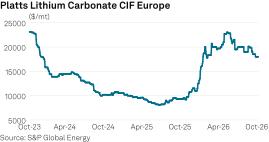
As with other critical minerals, the recent weakness in lithium prices is attributed to a combination of factors, including an unexpected upward revision to China's inventory data and weakening demand expectations. Platts, part of S&P Global Energy, assessed CIF Europe battery-grade lithium carbonate at $18,000/mt on Oct. 8, unchanged both day over day and week over week. Lithium hydroxide was assessed at $17,750/mt, unchanged day over day and week over week.
The EU announcement comes as developed economies seek to diversify critical-mineral supply chains away from China through measures including alternative sources of supply, stronger international cooperation, and investment in domestic production and recycling. Concerns over supply-chain vulnerability have intensified following China's implementation of export controls covering graphite, germanium, gallium, bismuth, tungsten, tellurium, indium, molybdenum and rare earth elements — materials in which China holds near monopolies.
