Metals & Mining, Non-Ferrous
October 05, 2026
Japan's critical minerals push could hinge on expanding JOGMEC: experts

Editor:
HIGHLIGHTS
JOGMEC could gain authority to invest independently
Agency faces capacity concerns
China cuts rare earth exports to Japan
Japan's plan to expand the investment mandate of Japan Organization for Metals and Energy Security could boost the nation's critical minerals strategy, but the state-owned company may struggle to meet rising demand for strategic materials, industry experts told Platts.
Established in 2004, Japan Organization for Metals and Energy Security (JOGMEC) leads the country's public-private partnerships for critical minerals investments. Under the framework, JOGMEC invests jointly with Japanese companies through loans, equity capital and liability guarantees to derisk mining projects. Its metals portfolio comprises several mining developments worldwide, covering rare earths, copper, lithium, niobium and other minerals.
But volatile prices and long investment payback periods have made private capital difficult to mobilize, Japan's Ministry of Economy, Trade and Industry told Platts. The ministry said these issues prompted its proposal to amend JOGMEC's strategy, seeking to allow the agency to directly own stakes in projects without waiting for a Japanese partner.
The government of Japanese Prime Minister Sanae Takaichi is seeking to change JOGMEC's approach as Japan — along with the US, EU and others — scrambles for alternative sources of critical minerals amid China's export restrictions. While the plan could accelerate Japan's search for new supplies, JOGMEC is already managing several projects, and it could struggle with an expected increase in activity. Experts also questioned how effectively JOGMEC would manage projects.
"JOGMEC has some fantastic people, they are really some of the best experts in the field," Yuriy Humber, president of the Tokyo-based Yuri Group consulting firm, told Platts, part of S&P Global Energy. "But [it does not have] the same level of staffing or ... expertise [that] a commercial company in this area [would have]."
Too many to handle
Under the current framework, JOGMEC can already acquire project interests independently, with a pledge to later transfer those rights to private companies, according to Yoshiaki Otsuki, special counsel at the Anderson Mori & Tomotsune law firm in Tokyo. The proposed framework could provide JOGMEC with more operational flexibility, as it would enable the agency to participate in a project at an earlier stage before a private Japanese partner is ready to commit.
This is essential in early-stage projects that may still be too risky for private investors, Otsuki said.
"The timing of a private company's investment decision does not necessarily coincide with the timing at which a project becomes strategically important from a supply-security perspective," Otsuki told Platts.
But JOGMEC could be overwhelmed by the proposed expansion of its mandate, as the agency is already handling several responsibilities for Japan's national energy security, according to Andrew DeWit, an economics professor at the Rikkyo University in Tokyo.
JOGMEC also operates in oil and natural gas, carbon capture and storage, hydrogen, coal, geothermal and offshore wind power, according to its corporate profile. Apart from providing financial assistance, JOGMEC is also involved in geological surveys, research and technology development, mine pollution control, stockpiling, research and analysis, and resource diplomacy.
"JOGMEC doesn't have infinite human resources and does have a big plateful of responsibilities," DeWit told Platts.
An expansion of JOGMEC's role should involve the addition of manpower from the private sector, as this would provide the agency with a commercial perspective of the critical minerals space, according to Humber. He noted that JOGMEC was established as a quasi-government institution with a different operating model compared to mining companies.
"If we change the role of JOGMEC, then we need to add more people, add more budget, and start saying, 'JOGMEC is not just the institution in between,'" Humber said.
Investment risks
DeWit also flagged potential risks JOGMEC could face if it is given more investment freedom. JOGMEC's chosen project could fail to meet production expectations, or the agency could face difficulties in handing off the asset, he said.
The Japanese government has not explained how it would retain oversight of JOGMEC under a new setup, according to Kotaro Shimizu, principal analyst at the Tokyo-based Mitsubishi UFJ Research and Consulting Co. Ltd. think tank.
"A possible challenge is that JOGMEC's investment may not be accountable to the Japanese [national legislature] if the project ... does not satisfy the needs of Japanese consumers of critical minerals," Shimizu told Platts.
Japan's Ministry of Economy, Trade and Industry attempted to allay concerns about JOGMEC under the proposed operating model.
"We believe that JOGMEC has the necessary capabilities and organizational framework to appropriately manage multiple projects," the ministry said in an emailed statement to Platts. "We are also confident that JOGMEC is capable of successfully implementing individual projects and facilitating the smooth transfer of project outcomes and assets to private-sector companies."
JOGMEC Chairman and CEO Ichiro Takahara declined Platts' request for comment on the proposed changes to the agency's strategy.
Despite the potential downsides of expanding JOGMEC's role, some industry players have expressed optimism about the plan. Providing JOGMEC with more investment flexibility is expected to expand the pool of investors for junior miners in Australia, according to Tomohito Tanase, associate director at the North Asia office of Investment New South Wales, an investment and trade agency backed by the government of Australia's New South Wales state.
"Japanese companies have good capabilities in processing and also [offer] opportunities for offtake," Tanase said in a recent forum in Tokyo.
Supply squeeze
JOGMEC is searching for alternative sources of rare earths, a group of 17 elements used in permanent magnets that are critical to electric vehicles, wind turbines and other high-tech applications. China dominates the global supply chain of rare earths, and it has restricted shipments of the material to Japan since Japanese Prime Minister Sanae Takaichi made remarks in November 2025 regarding possible Chinese military actions in Taiwan.
Japan recorded zero imports of terbium, a rare earth metal, from China for January to August, compared to 20 metric tons in year-ago period, according to Humber. Chinese exports of dysprosium-iron alloy, an additive for permanent magnets, and yttrium oxide, a rare earth element, also dropped 82% and 74% year over year, respectively, in the first half, Humber added.
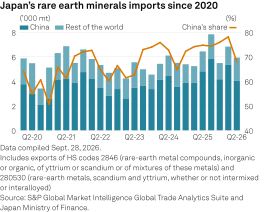
In the second quarter, China's rare earths exports to Japan fell 16.2% year over year and sank 24.5% quarter over quarter to 4,027 metric tons, according to S&P Global Market Intelligence data. But even before the recent diplomatic rift between China and Japan, Humber said China's share of Japan's total rare earth imports already declined to 58% in 2020 from 85% in 2009.
JOGMEC's investment in Australia-based Lynas Rare Earths Ltd. helped the diversification, Humber said. JOGMEC has been supporting Lynas for over 15 years through its Japan Australia Rare Earths BV joint venture with Japanese trading company Sojitz Corp. The joint venture owns a 3.1% stake in Lynas, according to S&P Global Market Intelligence data.
