Metals & Mining, Non-Ferrous, Ferrous
September 28, 2026
China leads race for Latin America's mining sector as US pushes back

Editor:
HIGHLIGHTS
China invests $10B in Latin American mining
US accelerates critical mineral investments
China is the dominant foreign investor in Latin America's mining sector, outpacing the US in the race to secure resources essential to the energy transition.
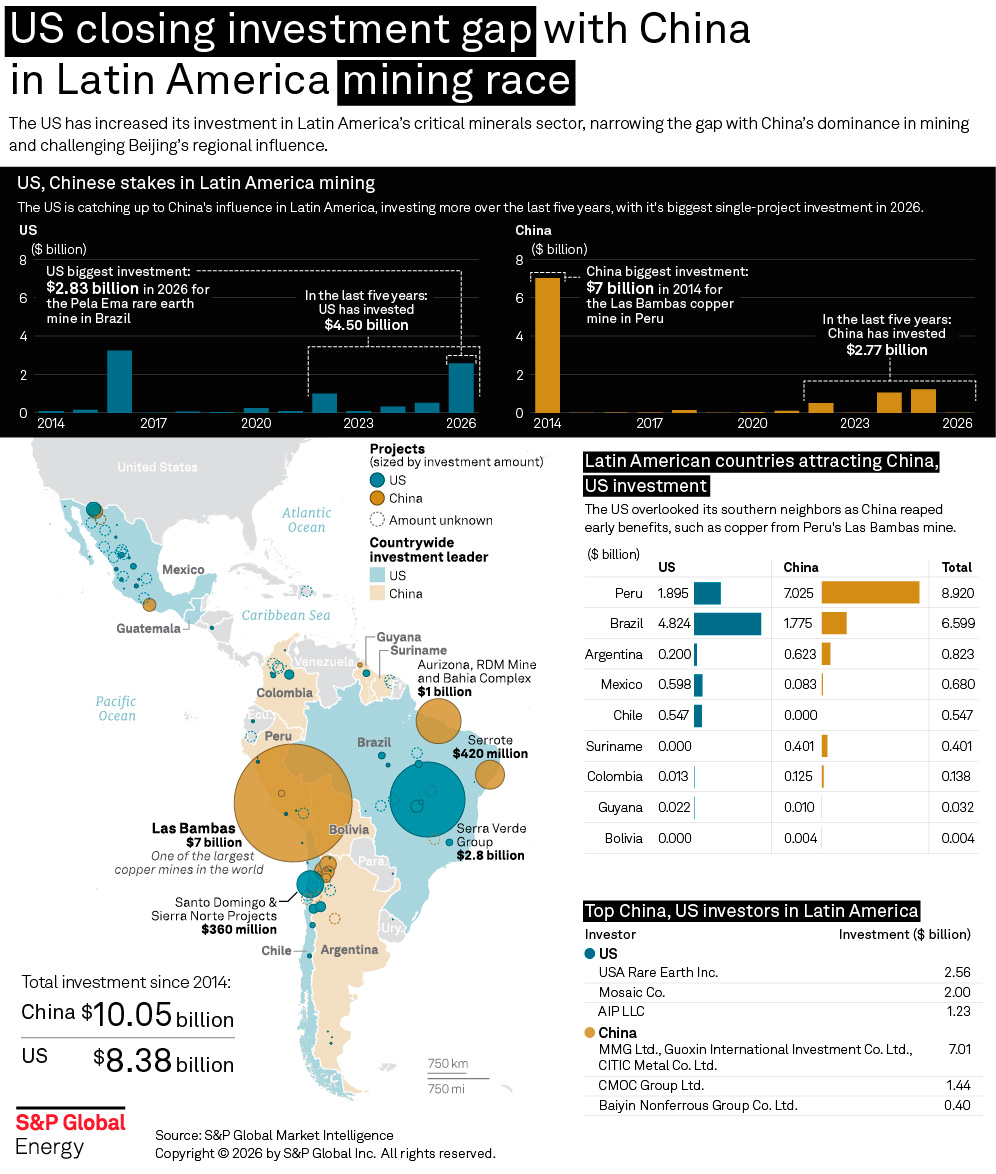
The US has long claimed Central and South America as a kind of regional protectorate, dating back at least to the 1823 Monroe doctrine. But when it comes to mining, China has been the biggest influence in Latin America, pumping $10.05 billion into the region from 2014 through September of this year, compared to the $8.38 billion invested by the US over the same period, according to data from S&P Global Market Intelligence, though China took much of its lead early on, while the US has worked to catch up in recent years.
The US didn't pay close attention to the mining potential of its southern neighbors until US President Joe Biden in 2022 launched his "friendshoring" initiative to stimulate production of critical minerals like lithium and copper among close trade partners of the US. US President Donald Trump accelerated that effort after taking office in 2025, with the result that, since 2022, US investment outpaced China's, $4.50 billion to $2.77 billion.
But the US may have overlooked the resource potential of its southern neighbors for too long.
"China has become the most dynamic player in terms of inward foreign direct investment flows into Latin America in the 21st century," Enrique Dussel, director of the Center for China-Mexico Studies (Cechimex) at the National Autonomous University of Mexico, said in an interview with Platts. Platts is part of S&P Global Energy.
Latin America's vast reserves of lithium, copper and other critical minerals have made the region a magnet for foreign investment. Between 2005 and 2024, companies announced 1,152 minerals and metals projects in Latin America and the Caribbean totaling $230.07 billion. Critical minerals accounted for 23.5% of projects and 41.6% of the total value, underscoring their greater strategic and financial weight, according to the Economic Commission for Latin America and the Caribbean.
China gets in early
China's first investment wave in the region was initially concentrated in minerals and later in infrastructure, as commodity price growth lagged. The country invested $7 billion in 2014 largely to develop the Las Bambas copper mine in Peru. China, through state-owned companies, holds a controlling 62.5% interest in Las Bambas, one of the largest copper-producing mines in the world, as copper prices rise and analysts forecast long-term deficits.
"Now we are thinking about critical minerals," Rebecca Ray, a senior academic researcher at the Boston University Global Development Policy Center, told Platts. "And here we are looking at the participation of private Chinese companies."
Argentina produced 8.4%, or 138,116 mt, of the world's lithium in 2025, according to Market Intelligence. In the same year, Chile accounted for 23.1%, or 5.4 million mt, of global copper production, followed by Peru with 11.6%, or 2.7 million mt, and Mexico with 2.9%, or 703,038 mt.
Over 80% of Chinese state-owned companies' investment in Latin America and the Caribbean between 2000 and 2023 was concentrated in the mining and energy sectors. By contrast, the mining and energy sectors represented less than 40% of investment by Chinese non-state enterprises, according to the Academic Network of Latin America and the Caribbean on China in Mexico.
More than 20 Latin American and Caribbean countries have signed cooperation agreements under China's Belt and Road Initiative, launched by Chinese President Xi Jinping in 2013, making the region an increasingly important component of Beijing's global infrastructure, trade and investment strategy.
Chinese companies have also ramped up investments in Brazil, with CMOC Group Ltd., Baiyin Nonferrous Group Co. Ltd. and China Nonferrous Trade Co. Ltd. investing a total of $1.8 billion in copper, gold and tin projects.
Chinese state-owned companies have historically had a different risk profile from many Western investors, Ray said.
"State-owned companies, by definition, do not have quarterly profit objectives or earnings targets; they have five-year plans in China," Ray said. "So there is greater risk tolerance for short-term ups and downs that may come from political changes, changes in economic governance or even changes in commodity prices."
China's focus has shifted away from large investments, and it now acts as a major buyer. Within Mercosur — Argentina, Brazil, Paraguay and Uruguay — China has come to occupy a central position as a destination for critical minerals, especially lithium.
"In 2023, trade between China and Mercosur reached $190 billion, 18 times as much as in 2003," according to the European Parliamentary Research Service's Feb. 2025 report.
In 2025, Mercosur exported $480.2 million of lithium carbonate to China, compared with $5.91 million to the US and $119,377 to the European Union, according to data from Mercosur's Foreign Trade Statistics Technical Unit.
US policy turns toward countering China
China's growing presence across Latin America's lithium, copper and rare earth sectors has raised alarms in Washington.
In 2018, during his first term, Trump signed the Better Utilization of Investments Leading to Development Act, aimed specifically at countering China's Belt and Road Initiative by restructuring US foreign development assistance and allocating more development funds to the region.
Biden led an aggressive policy of friendshoring, spurred by incentives built into the 2022 Inflation Reduction Act. His administration's National Security Strategy described China as a strategic competitor, stating that because the Western Hemisphere impacts the US more than any other region, the US "vows to help protect Latin America and the Caribbean from external interference or coercion, including from China," a Congressional report said in 2023.
Soon after taking office in April 2025, Trump issued an executive order seeking to "counter China's influence" in critical minerals. And as his administration began investing in Latin America, he later reasserted the view of the US as the only major power in the hemisphere.
Congress repealed most of the Inflation Reduction Act incentives in 2025 after Trump took office, but Trump continued Biden's policy of striking international agreements to bring more critical minerals to the US and counter China's dominance in key metals.
US-based companies have also begun to ramp up investments in Latin America. Among notable investments are USA Rare Earth Inc.'s $2.56 billion acquisition of Serra Verde Group in Brazil, which was the largest investment in the region's mining sector to date, and AIP LLC's $1.23 billion full acquisition of Moly-Cop Adesur SA. in Peru.
Denver-headquartered Newmont Corp. made a $400 million minority investment in Minera Yanacocha SRL for gold, and Freeport Minerals Corp. spent $340 million in a minority deal with Sociedad Minera Cerro Verde SAA for copper. Orion Resource Partners LP meanwhile announced a $340 million asset acquisition in Chile centered on steel.
While China has become a major player in Latin America, US policy still carry weight across the region. Mexico, for example, imposed new tariffs of up to 50% on imports from countries without active free trade agreements, a move that mainly affects Asian exporters, including China — an effort to placate the US during negotiations over a free trade pact.
"The Monroe Doctrine is alive and well," Trump said in December 2025, "and American leadership is coming roaring back stronger than ever before."
