Metals & Mining, Electric Power, Non-Ferrous, Ferrous
September 24, 2026
Trump and Xi to discuss China's rare earth export controls

By Euan Sadden
Editor:
HIGHLIGHTS
China has imposed export controls targeting dual-use rare earths
Trump to seek easing of export restrictions
Second wave of export controls due to take effect Nov. 10
China's export restrictions on certain rare earth elements and critical minerals are expected to be a key agenda item at a summit between US President Donald Trump and Chinese President Xi Jinping at the White House on Sept. 24.
The US is expected to seek an agreement to ease Beijing's April 2025 restrictions on rare earth elements, while securing a further extension of the suspension of a second wave of export controls set to expire on Nov. 10.
The meeting underscores China's leverage across rare earth and critical mineral supply chains. Although the Trump administration has committed funding to support new mining projects, expand rare earth recycling and build strategic stockpiles, the US remains heavily reliant on Chinese supply chains.
Beginning in July 2023, China's Ministry of Commerce began implementing export restrictions on "dual-use items," defined as products, technologies or services that can be used for both civilian and military purposes. The controls cover a range of critical minerals and related products, including selected rare earths: scandium, yttrium, samarium, terbium, dysprosium and lutetium.
The International Energy Agency estimates that China accounted for 61% of global mined rare earth supply and 91% of global refining and processing capacity for major rare earths in 2024. China also dominates the processing of other critical minerals, including lithium, copper, cobalt and graphite.
China's 'dual-use' export controls
China has introduced export controls on specific critical minerals as part of wider restrictions targeting "dual-use items," defined as products, technologies or services that can be used for both civilian and military purposes. The first wave targeted gallium and germanium in July 2023, followed by controls on certain graphite products in October 2023, on antimony in August 2024, and on five critical minerals — tungsten, tellurium, bismuth, molybdenum and indium — in February 2025.
In April 2025, in response to the US's April 2, 2025, tariff announcement covering a broad range of Chinese products, Beijing announced export controls on seven rare earth elements: samarium, gadolinium, terbium, dysprosium, lutetium, scandium and yttrium. The controls covered the associated metals, oxides, alloys, compounds, targets and magnet materials.
In October 2025, China announced additional export controls on holmium, erbium, thulium, europium and ytterbium, along with related products, equipment and technologies. Beijing also announced a total ban on exports of gallium, germanium and antimony to the US.
A subsequent summit between Trump and Xi resulted in a trade truce that included Chinese pledges to restore critical mineral flows to pre-dispute levels. As part of the agreement, Beijing agreed to suspend the export controls scheduled to take effect on Nov. 7, 2025. The suspension is set to expire Nov. 10.
Trade flows
China's controls have significantly disrupted exports of rare earths and other critical minerals, with US and European buyers reporting delays and additional paperwork. US magnet manufacturer Arnold Magnetics said in January that the process had become "slow, opaque and highly discretionary," with many applications remaining pending for 60-120 days or longer without clear decisions.
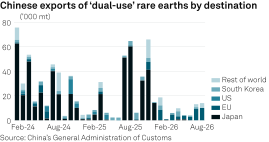
Chinese customs data indicate that exports of yttrium, terbium, scandium and dysprosium to the US effectively halted after April 2025. Shipments to Japan also collapsed in 2026 amid an ongoing diplomatic dispute between Beijing and Tokyo.
Affected industries
Aerospace and defense are among the most exposed sectors because of their reliance on highly specialized, difficult-to-substitute critical minerals in high-performance applications. Rare earths, for example, support the permanent magnets used in guidance systems, radar and satellites, including high-temperature samarium-cobalt magnets. Tungsten is used in dense, heat-resistant munitions and components, while molybdenum supports high-temperature alloys and propulsion systems.
The semiconductor and electronics industries face similar risks. Gallium is used in radio-frequency technologies and power electronics; germanium supports fiber-optic and infrared applications; and indium is used in indium tin oxide coatings for displays and touchscreens. Rare earths are also used in polishing, lasers, sensors and other optical components.
In automotive supply chains, exposure runs through both batteries and magnet systems. Graphite is a critical anode material in lithium-ion batteries, supporting high-energy density, fast charging, long cycle life and stable performance. Rare earth magnets containing terbium and dysprosium are used in traction motors, steering and braking systems, pumps and sensors, including high-temperature applications.
Renewable energy and grid equipment depend on critical minerals across wind turbines, solar PV, energy storage and power electronics. Rare earth magnets are widely used in wind generators, graphite underpins battery storage, and indium and tellurium are important for solar technologies. Gallium supports more efficient power-conversion equipment.
Industrial equipment is exposed primarily through second-order dependencies. Permanent magnets are used in motors, servo systems and automation equipment, while tungsten is critical for cemented-carbide tools, and molybdenum supports heat- and corrosion-resistant alloys.
Prices
North American rare earth oxide prices have risen significantly in recent months as China's tight export controls on medium and heavy rare earths have remained in place. Platts, part of S&P Global Energy, assessed dysprosium oxide CIF North America at $2,300/kg on Aug. 31, unchanged month over month but sharply above the launch price of $1,200/kg published March 31.
Platts CIF North America prices for samarium have recorded similar gains since launch, rising to $800/kg on Aug. 31 from $175/kg on March 31. In contrast, the Platts terbium oxide CIF North America price was assessed at $4,900/kg on Aug. 31, unchanged from the March 31 launch assessment.
Prices for neodymium-praseodymium oxide, which is not covered by China's export controls, have declined steadily since the March 31 launch. Platts assessed CIF North America neodymium-praseodymium oxide at $110/kg on Aug. 31, down $5/kg from the previous month and below the March 31 launch price of $125/kg.
Launched June 30, Platts dysprosium and terbium oxide prices in China have traded close to parity with US prices. Platts assessed dysprosium oxide FOB China at $230/kg on Aug. 31, up from the launch price of $220/kg. Terbium oxide FOB China was assessed at $1,005/kg on Aug. 31, up from its launch price of $1,000/kg.

