Metals & Mining, Non-Ferrous
September 21, 2026
China lithium carbonate futures rebound on import surge data

Editor:
HIGHLIGHTS
Spodumene imports hit record 906,566 mt
Lithium carbonate production falls 2.5% MOM
China's lithium carbonate futures snapped a three-week losing streak on Sept. 21, buoyed by customs data showing record spodumene imports and resilient downstream demand, though a looming supply build threatens to cap any sustained price recovery.
The most actively traded lithium carbonate futures contract on the Guangzhou Futures Exchange closed at 132,500 yuan per metric ton ($19,788/mt) Sept. 21, up 3.1% from the previous session, exchange data showed.
Despite the rebound, the contract remained 17.7% below its Aug. 31 level and hit a low of 125,820 yuan/mt on Sept. 16, according to GFEX data.
Platts, part of S&P Global Energy, assessed battery-grade lithium carbonate at 133,000 yuan/mt DDP China on Sept. 21, up 3.9 % day over day but 0.8% lower week over week.
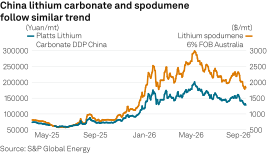
While the GFEX contract recovered on Sept. 21, sentiment in the spot market remained cautious, with buyers largely taking a wait-and-see stance, according to China-based market participants.
"From a market perspective, I think prices are broadly stable overall. No one is willing to sell on the way down, while buyers tend to stay on the sidelines when prices rise," an international miner said.
Meanwhile, market participants generally described downstream demand as relatively robust despite recent price weakness.
The prospect of further supply increases in the coming months is expected to weigh on China's lithium carbonate market, while market participants are closely watching demand during the seasonal September-October consumption peak.
China's spodumene, lithium imports
China's spodumene imports reached a record 906,566 mt in August, rising 22.6% month over month and 46% year over year, according to China's customs data released Sept. 20. The volume was the highest recorded since the dataset was first published in January 2025.
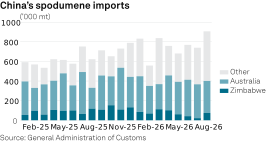
The increase was largely in line with market expectations and was driven by rising shipments from African countries, which more than offset lower imports from Australia and Brazil.
| China's key sources of spodumene imports in August | |||
| Country | Volume | MOM change% | Share in China's total |
| Australia | 326411 | -5.4% | 36.0% |
| South Africa | 222916 | 104.6% | 24.6% |
| Nigeria | 135465 | 29.4% | 14.9% |
| Zimbabwe | 74575 | 245.0% | 8.2% |
| Mali | 64692 | 69.0% | 7.1% |
| Brazil | 62006 | -46.6% | 6.8% |
| Source: General Administration of Customs | Unit: mt | |||
China's imports of spodumene from Zimbabwe might continue to increase in the coming months, market participants said.
China's lithium carbonate imports climbed to 30,391 mt in August, up 13.6% from July and 39.1% from a year earlier. Looking ahead, market participants expect its total imports of lithium carbonate and lithium sulfate to remain elevated, supported by strong export flows from Chile.
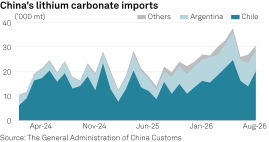
Chile exported 16,338 mt of lithium sulfate to China in August, more than doubling from the previous month, while lithium carbonate exports to China declined 5.3% month over month to 14,261 mt, Chilean customs data showed.
China remained a net importer of lithium hydroxide in August. Imports stood at 5,115 mt, up 317.8% year over year but down 38.5% from the previous month, while exports dropped to 4,789 mt, decreasing 25.4% year over year and 15.6% month over month, China customs data showed.
Lithium carbonate output
China's lithium carbonate production totaled about 96,000 mt in August, down 2.5% month over month, according to the Lithium Branch of the China Nonferrous Metals Industry Association.
The decline was mainly attributed to maintenance-related shutdowns at some production lines amid weaker-than-expected inflows of lithium ore from Zimbabwe in recent months.
However, production is expected to pick up in September as spodumene arrivals from Zimbabwe continue to rise, according to domestic market sources.
