Metals & Mining, Energy Transition, Electric Power, Ferrous, Carbon
September 16, 2026
INTERVIEW: SteelAsia plans to nearly double crude steelmaking by 2029
By Jia Hui Tan and Chenxu Zhao
Editor:
HIGHLIGHTS
Expansion targets 4.8 million mt/year by 2029
Aims to reduce Philippines' dependence on imported billets
Goal to strengthen domestic long-steel value chain
SteelAsia, the Philippines' largest steel producer, is embarking on a capacity expansion that will nearly double its crude steelmaking output to 4.8 million metric tons per year, with a phased buildout of new mills targeting structural sections, wire rods, and low-carbon steel production through 2029 — a move that could significantly reshape the country's steel value chain.
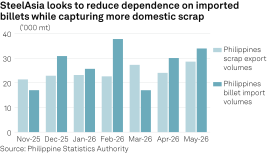
The expansion, described by Vicky Mathur, Vice President–Global Supply Chain & Commercial at SteelAsia in an interview with S&P Global Energy, as a structural transformation of the Philippine steel value chain, is designed to progressively reduce the country's dependence on imported billets while capturing more domestic scrap that is currently being exported to overseas buyers.
The company currently operates 2.5 million mt/year of crude steelmaking capacity across five rolling mills but has only one electric arc furnace, or EAF. As new EAFs come online alongside each new mill, SteelAsia aims to convert more domestically sourced scrap into low-carbon billets, reducing exposure to imported billet prices, freight volatility, foreign exchange swings, and geopolitical disruption.
Expansion plans implemented in phases
The buildout is in three distinct phases. Lemery Works, the first sections mill in the Philippines to produce steel beams and similar products for construction, transportation and infrastructure applications, with a 500,000 mt/year capacity, is the most imminent, with its rolling mill scheduled for commissioning in Q1 2027 and its 500,000 mt/year EAF to follow in Q4 2027.
The second phase, Candelaria Works, planned at 1 million mt/year for larger structural sections, is targeted for 2028, also supported with its own EAF. The two mills together are intended to form a complete structural steel portfolio for the Philippine market.
The final phase, the Concepcion mill with a planned capacity of 1 million mt/year for green steel wire rod with an integrated EAF, is targeted for 2029.
SteelAsia's expansion into structural sections, and in the future wire rods, is framed as import substitution, by allowing more products that are currently imported to be produced locally, Mathur said.
"At present, SteelAsia has no plans to enter flat steel. Our focus remains on completing and strengthening the Philippine long steel industry, with our immediate focus to build a strong, competitive long steel ecosystem," he added.
Long steel demand and procurement strategies
Mathur described the Philippine long steel outlook over the next 6-12 months as structurally positive, citing private construction, industrial development, government support, and energy-related investment as key support pillars.
However, he cautioned that the pace of project execution, financing conditions, interest rates, and broader economic conditions remain key variables to watch.
SteelAsia maintains a diversified procurement base spanning China, Japan, Vietnam, Indonesia, and Malaysia, with the mix varying according to price, availability and freight.
Additionally, Mathur pointed out that regional billet pricing, particularly Chinese export offers, remains an important reference point for Philippine steel economics, with import parity continuing to influence domestic price expectations even as domestic demand conditions affect how much room producers have to move independently.
Mathur said the company evaluates billet purchases on a total delivered cost basis rather than FOB price alone; incorporating freight, transit risk, voyage uncertainty, payment terms, and geopolitical exposure.
On the export side, Mathur acknowledged Europe as a potentially interesting market given the growing relevance of low-carbon steel under the EU Carbon Border Adjustment Mechanism, or CBAM. However, any export strategy toward that region would need to be evaluated against applicable trade measures, quotas, certification requirements, freight costs, and compliance costs.
He noted that within the Philippines, domestic buyers remain highly price sensitive, although some major construction customers and projects are increasingly specifying sustainability or lower-carbon steel requirements.
Domestic scrap availability
Currently, the Philippines exports a portion of its ferrous scrap, which Mathur said reflects both the availability and internationally accepted quality of domestic scrap.
The Philippines saw ferrous scrap export volumes of 154,275 mt over January-June 2026, a 19.3% rise year-over-year for the same period, according to data from the Philippine Statistics Authority.
The new EAF capacity is intended to increase domestic demand for that scrap, improving cash flow cycles for local scrap suppliers and reducing their exposure to foreign exchange and international ocean freight risks.
The expansion is designed to progressively reduce the country's dependence on imported billets while capturing more domestic scrap that is currently being exported to overseas buyers.
By focusing on import substitution and building a complete long steel value chain, SteelAsia aims to create a more resilient Philippine long-steel industry, said Mathur.
Green steel momentum
SteelAsia's green steel credentials are central to its commercial positioning, particularly as the company eyes export opportunities in certification-sensitive markets.
Mathur said SteelAsia's steel billets have a DNV-verified carbon footprint of 0.28 t CO₂ per tonne of steel, reflecting its EAF-based production route combined with scrap utilization, energy efficiency, and process optimization.
"Green steel should ultimately be measured in terms of tons of CO2 per ton of steel, not by the color of the marketing," Mathur said.
The Concepcion wire rod mill is specifically designed around green steel production, leveraging the Philippines' geothermal power advantage. SteelAsia has also signed an agreement with Buskowitz Energy Inc. for a solar project, beginning with its Compostela Works in Cebu, which Mathur described as set to become the largest single-roof rooftop solar installation in Philippine heavy industry. The project is 8 MWp and is expected to supply approximately 25% of the plant's electricity requirements.
