Metals & Mining, Maritime & Shipping, Non-Ferrous, Ferrous, Containers
September 03, 2026
Canada targets US metals in looming retaliatory tariffs

By Kip Keen
Editor:
HIGHLIGHTS
Canada targets C$13.59B in US metal intensive goods
Steel products largely face the highest 50% tariff rate
Trade negotiations remain stalled
Metal products account for almost half the value of US goods hit by Canadian retaliatory tariffs set to take effect Sept. 8 amid a deepening trade war, according to a Platts analysis of recent trade data on items facing new duties.
The US and Canada have been locked in tariff disputes almost from the moment US President Donald Trump took office in January 2025, eroding decades of free trade between the neighbors. The latest effort to de-escalate fell apart Aug. 21, 2026, ahead of 50% US tariffs against Canada. After failed talks, Canada's Prime Minister Mark Carney vowed on Aug. 22 to impose the new metals-focused tariffs on US products, which are set to take effect Sept. 8, 2026.
The Canadian move prompted Trump to threaten new 50% tariffs on Canadian vehicles, vehicle parts and steel as of Jan.1, 2027.
"We couldn't accept what they'd offered," Carney said Sept. 3, speaking at the launch of a rail passenger car funding announcement in Thunder Bay, Ontario. "We wouldn't give what they'd asked. As a result, the US has imposed new tariffs designed to hurt and divide us. That's a miscalculation. Because Canadians will always take care of each other. And it's a miscalculation because we have everything we need to build the country we want."
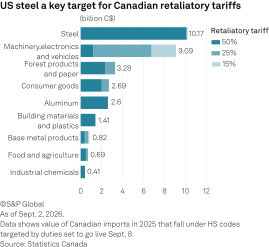
The Canadian retaliatory tariffs heavily target steel, aluminum and base-metal goods, covering C$13.59 billion, or 43.6% of the total C$31.15 billion of 2025 imports targeted by the measures, based on data provided by Statistics Canada.
The analysis gives a detailed look into how Canada is targeting the US, as Canada responds to new US 50% duties on its exports.
Metals focus
Canada plans to ratchet up most of its highest duties on metals, ramping some up to 50%, though others will face 15% or 25% rates. Metals account for C$13.02 billion, or 95.8%, of the total 2025 imported value of targeted products that are subject to the 50% tariff rate, according to the analysis.
Steel is by far the largest metal category. The measures cover C$10.17 billion of steel imports in 2025, including C$4.57 billion of basic and semi-finished products and C$5.59 billion of downstream iron and steel articles.
The planned steel duties reach across the supply chain. Basic steel and semi-finished products make up the largest individual segment at C$4.57 billion, or 45% of the steel total. This category includes primary and semi-finished steel, flat-rolled sheet, and plate, bars, rod, wire, stainless steel and alloy steel products. All are subject to the 50% rate.
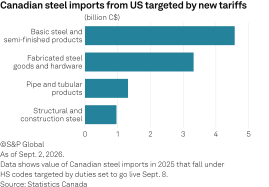
The new tariffs, targetingC$5.59 billion of downstream steel products, show that Canada is aiming duties at value-added industry in the US for things like pipes, structural products, fasteners, hardware and other manufactured steel goods used by construction, energy and industrial buyers.
The single largest downstream group is fabricated steel goods and hardware. At C$3.32 billion in 2025, these items cover about one-third of the steel total. This includes tanks, reservoirs, containers, chains, springs, wire products, castings and other manufactured steel articles.
Flat-rolled products lead aluminum exposure, and the new tariffs cover plate, sheet, strip and foil that accounted for C$1.39 billion, or 53.7% of targeted aluminum trade using the 2025 trade figures.
The balance is spread across downstream and semi-fabricated products. Tubes, pipe and construction products account for C$373.6 million, followed by extrusions, bars, rod and wire at C$329.8 million. Primary aluminum and alloys represent C$253.5 million, while fabricated aluminum articles account for C$246.6 million.
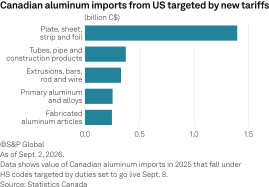
The composition is heavily weighted towards processed aluminum rather than unwrought metal. Primary aluminum -- a key industry in Canada -- accounts for less than one-tenth of the total, while flat-rolled, extruded, tubular, construction and fabricated products together account for over 90%.
In base metals, the new tariffs would cover C$828.1 million of 2025 importsdivided among copper products, base-metal tools and cutlery, and miscellaneous items.
The analysis uses data at the 10-digit HS code level provided by Statistics Canada. In pulling the data, Statistics Canada told Platts its tally may differ from figures cited by the Department of Finance Canada, which has said it is targeting C$27.6 billion in US goods through the Sept. 8 tariffs.
Platts is a part of S&P Global Energy.
Trade talks
While Canada could still decide against imposing the metals-intensive tariffs, there are no clear signs the US and Canada are about to return to negotiations.
US Trade Representative Jamieson Greer said as recently as Sept. 1 that no talks are taking place, while Trump has reiterated his stance the US needs nothing from Canada.
"I don't want Canadian cars, I don't want Canadian parts, I don't want Canadian anything," Trump said Aug. 30, in a social media post. "They've been ripping us off for decades, and it's going to stop."
Some trade groups have voiced concerns over the trade war, flagging higher costs for inputs and a shrinking customer pool.
The Aluminum Association, a trade group of US aluminum producers, said it is looking at the impact of the Canadian tariffs.
"These measures will negatively impact segments of the industry by limiting opportunities for US producers to compete in Canada at a time when America should be well-positioned to meet growing aluminum demand," the group said in an emailed statement, expressing hope the US and Canada would resume trade talks.
In announcing the more than C$4.7 billion plan to build 313 rail passenger cars for Via Rail, Carney underscored Canada's renewed focus on bolstering the domestic industry amid the trade war.
"Those cars will be produced and assembled and maintained in our country," Carney said Sept. 3. "Cars that used to be built in the United States will be built right here in Thunder Bay."
The White House and the Prime Minister's office did not respond to requests for comment.
