Agriculture, Metals & Mining, Dairy, Ferrous, Non-Ferrous
August 26, 2026
Metal industry flags cost, market concerns over Canada-US trade war

By Kip Keen
Editor:
HIGHLIGHTS
Trade war drives up metals costs for both nations
US risks losing key Canadian aluminum customers
Canada lacks alternatives to pricier US supplies
US exporters stand to lose Canadian customers, while Canadian manufacturers may have little choice but to continue buying higher-priced US imports amid a spiraling US-Canada trade war, metal and mining industry trade groups told Platts.
Canadaannounced details on 15% to 50% tariffs that, starting Sept. 8, target a swath of US imports worth about $20 billion. The trade countermeasures, outlined Aug. 25, came after US-Canada talks over US 50% tariffs, which went live Aug. 22, failed to produce a deal, with both sides blaming the other for the outcome.
Canada's decision to walk away and hit the US back with countermeasures has fueled fierce pushback from the administration of President Donald Trump, while driving the two countries deeper into a trade war that is set to drive up costs on many products, including in the steel and aluminum sectors.
For Canadian manufacturers the cost will be higher prices, without ready alternative supply, Dennis Darby, president and CEO of the Canadian Manufacturers & Exporters (CME), a trade group, said in an emailed statement.
"Canada and the United States have deeply integrated supply chains, and many steel, aluminum and other industrial products are sourced from specific suppliers because they meet precise technical, quality, certification and delivery requirements," Darby said. "In some cases, alternatives may not be available domestically or at a competitive price."
Canadian miners are also bracing for the potential impact of higher-cost inputs.
"Members are assessing the anticipated impacts, but doubtless the primary concern will be the increase in costs of mine supplies/inputs," Pierre Gratton, president and CEO of the Mining Association of Canada, told Platts. "None of this is good for business or our two countries."
Meanwhile, US aluminum exporters could lose customers.
"Canada is a significant trading partner for US aluminum firms," Charles Johnson, president and CEO, of the US Aluminum Association, said in an emailed statement. "These measures will negatively impact segments of the industry by limiting opportunities for US producers to compete in Canada at a time when America should be well-positioned to meet growing aluminum demand."
Matching US tariffs
The Canadian Sept. 8 duties target metals in particular, with higher 50% tariff rates, boosting some existing Canadian tariffs on steel from 25%. The Canadian tariffs are designed to match 50% tariffs the US has imposed on many steel and aluminum products imposed under Section 232 of the Trade Expansion Act of 1962.
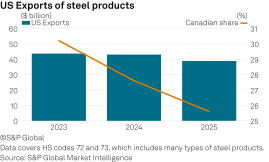
Canada remains a significant market for the US steel and aluminum industries, though US exports have slipped in recent years amid the US turn to protectionist trade policies.
The US has been the top Canadian source of steel products under HS Codes 72 and 73 -- which captures a wide array of steel goods -- for years. In the first half of 2026, the US accounted for 42.9%, or $3.86 billion, of Canadian steel and iron imports in those categories, according to S&P Global Market Intelligence data. Likewise, the US accounted for 47.2% of Canadian aluminum imports, or $1.41 billion, over the same period.
The Canadian move to tax more US imports in response to US tariffs has widened a rift between Trump and Canadian Prime Minister Mark Carney.
"Canada has been ripping off the United States for decades and President Donald J. Trump is done letting them get away with it," the White House said Aug. 25.
The White House listed grievances with Canada, including the country's tariffs on dairy and provincial bans on US alcohol sales.
Carney, in launching fresh tariffs, has said the US sought last-minute changes to a potential deal over American tariffs that were unacceptable to Canada.
Calls for more talks
Now, Canadian and US industries face the potential consequence of looming tariffs.
In response to the Canadian countermeasures, Trump said Aug. 24 in a social media post that the US would increase tariffs on Canada to 50% tariffs for all cars and trucks, vehicle parts and steel starting Jan. 1, 2027.
Some industry groups have called on the US and Canada to resume talks, though there are no clear signs either country is set to do so.
"When the Americans go to the negotiation table first with the right attitude toward our industries -- and a true partnership -- of course, we'll come to the negotiating table," Carney said, speaking at the Aug. 24 launch of an C$11 billion ice-breaker construction plan in Quebec aimed at bolstering domestic industry.
The US Aluminum Association's Johnson told Platts the trade group is hopeful Canadian and US officials will resume talks "to pursue a fair and reasonable agreement."
The CME, along with some other Canadian trade groups, have expressed support for Carney's move to walk away from a US offer ahead of American 50% tariffs imposed Aug. 22.
In a bid to blunt the impact of tariffs, Carney announced C$7.5 billion in support for Canadian workers and businesses alongside the new Canadian tariffs on Aug. 25.
Canadian industry groups said the money will be needed for businesses to weather the trade war.
"Government support for investment, productivity and retooling, combined with greater policy certainty, will be critical," the CME's Darby said.
Not only will Canadian importers of US products in sectors like aluminum and steel find it tough to replace US products facing tariffs, but it's unlikely Canadian producers can quickly fill a gap, Darby said.
"A broad shift would require significant capital investment, new equipment, additional workers, customer commitments and time to establish and qualify new production," Darby said. "Manufacturers will be reluctant to make those investments without confidence that demand will remain and trade policy will be stable."
Canadian leaders have also pointed to government spending and procurement as a means to bolster industries like steel.
In announcing the ice-breaker plan, Carney said the ships would rely on Canadian steel. Ontario, Canada's most populous province, now aims to further scrutinize procurement to cut spending on US firms, according to a letter Premier Doug Ford posted to social media Aug. 26.
Among premiers, Ford has been one of Trump's most vocal critics.
In recent days Ford has threatened to use Canadian energy and metals exports to the US as leverage amid the trade dispute.
