Metals & Mining, Non-Ferrous
August 19, 2026
Midstream offers hope amid Australian lithium hydroxide struggles: experts
By Anthony Barich and Gaurang Dholakia
Editor:
HIGHLIGHTS
Midstream processing emerges as viable option
China controls 72% of lithium chemical supply
Australian refineries face high conversion costs
Midstream looks to be the most sustainable spot for Australia's world-leading lithium production amid hydroxide refinery struggles, experts say.
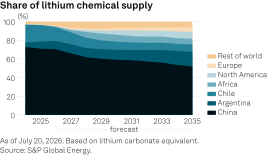
Lithium refining is "where Australia's dominance in the lithium supply chain does end," with China accounting for 72% of lithium chemical supply in 2025, James Chappelow, senior principal analyst, mine economics and emissions at S&P Global Energy, told an Aug. 6 briefing in Perth, Australia.
Between $14,500/metric ton and $18,000/mt is on offer for a "midstream compromise" to produce lithium salts, as opposed to a 2026 spot range of $1,800/mt to $2,100/mt for raw spodumene or between $19,000/mt and $24,569/mt for lithium hydroxide, according to Chappelow's presentation.
Dale Henderson, managing director and CEO of major Australian lithium producer PLS Group Ltd., believes midstream is "a potential sweet spot for doing more onshore processing," whereby the first steps of chemical processing are done at the mine site.
Global cost competitiveness is what attracted PLS to the joint venture with Posco Holdings Inc. in South Korea, where an existing battery hub ecosystem and car making already exist, thus "a lot of the key ingredients come together" to ensure a low-cost operation, Henderson told media at an industry event in Kalgoorlie Aug. 5.
The joint venture's lithium hydroxide facility in Gwangyang opened in December 2023. PLS also opened Australia's first mine site lithium midstream plant at Pilgangoora, Western Australia June 5, using electric flash calcination technology developed by Australian technology company Calix Ltd, according to a company release.
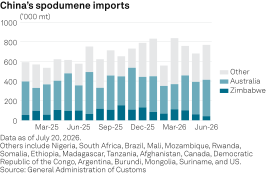
Australia's challenge is that it ships spodumene, which includes about 95% waste overseas, Phil Hodgson, managing director and CEO of Calix, told Platts, part of S&P Global Energy.
If lithium salts can be produced "at a mine site with good quality ore, which our mines [in Western Australia] have, and low energy costs, which we can achieve, then there's absolutely no reason why we can't compete on the world stage," Hodgson said.
Cost challenges
The midstream option is the best compromiseas two of Australia's hydroxide refineries have struggled with costs, which Chappelow said were their "single biggest obstacle."
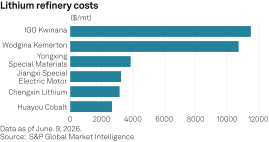
Chappelow's presentation revealed that lithium conversion costs for three Chinese producers were less than half those at two of Western Australia's operating refineries.
Albemarle Corp idled the remaining operating train at the Kemerton lithium hydroxide plant in February, after having paused expansion plans there in 2024, while IGO Ltd. and Tianqi Lithium Corp.'s Kwinana has had long-running cost and technical issues, Platts reported earlier.
The challenges at IGO's Kwinana and Albemarle's Kemerton refineries "were not all bad luck. It really reflects the complexity of a new industrial chemical sector in a high-cost environment. China had 20 years to make these mistakes and learn at a lower cost," Chappelow said.
When contacted by Platts for comment, an IGO spokesperson pointed to the company's June quarter results, in which conversion costs were reported at A$18,379/mt for FY26.
Albemarle did not immediately respond to Platts' request for comment.
A 50,000 mt/year refinery at Kwinana owned by Australia's Wesfarmers Ltd. and Chile's Sociedad Química y Minera de Chile SA produced its first batch of battery-grade lithium hydroxide in July 2025, Platts reported earlier.
"Spodumene conversion is energy intensive, and Western Australia's energy costs are far higher than China's subsidized industrial grid," while Western Australia's refineries also do not compete with China on wages, Chappelow said.
Australia also lacks a local sulfuric acid supply, so every imported ton of reagent adds freight insurance, storage, and domestic transport costs for refining. China is also able to turn some of its waste products, like sodium sulfate waste, into revenue as industrial inputs, whereas it is a cost for Australian producers to dispose of, Chappelow said.
Shifting battery markets
Australia's refinery build-outs in Kwinana, Kemerton, and Mt Holland were designed for hydroxide when it was assumed nickel-manganese cobalt batteries would dominate the market, Chappelow said.
However, the rapid rise of lithium iron phosphate batteries has compressed hydroxide margins and is "driving a price premium for carbonate hydroxide, which is reversing historical price relationships," Chappelow said.
LFP is dominating both plug-in electric vehicles and battery electric storage market share, and "pretty dominant everywhere in terms of battery choice at a carbon and a structural premium," Chappelow said.
Yet NMC demand "isn't really collapsing, it's just that Australia can't really capitalize easily on the LFP boom from our refinery setup. The key question is, does the NMC retain enough premium market to support our hydroxide refinery economics, or is it better to go midstream pivot to take more of the downstream within Australia?" Chappelow said.
Increasing hydroxide tonnage
Wesfarmers announced in July that output from its Mt Holland lithium joint venture project with SQM would double to 760,000 mt/year of spodumene concentrate, which would feed any future refinery expansion at Kwinana.
The company is "very confident in the cost stack of what goes into the refinery," including reagents and labor, Aaron Hood, managing director of Wesfarmers Chemicals, Energy & Fertilisers, told a June 10 strategy briefing.
The number of spodumene units required to deliver a hydroxide unit is the biggest impact on cost, followed by "fractionalizing the cost of getting our tonnages up," Hood said.
"What you're really seeing is the challenges with other players that are in the Australian refining market is you've got to get the tonnage to be competitive," Hood said.