Metals & Mining, Non-Ferrous
August 10, 2026
China black mass market muted on US export restrictions
Editor:
HIGHLIGHTS
US export restrictions take effect Aug. 27
Weak demand pressures domestic prices lower
China's black mass market showed a limited immediate reaction to new US export restrictions on battery scrap, with traders and recyclers focusing on exemption applications and developments in domestic refining capacity that could reshape global supply chains.
The US Department of Commerce's Bureau of Industry and Security on Aug. 6 published a temporary final rule restricting exports of black mass and tungsten waste and scrap without a license, as part of the Trump administration's broader efforts to secure domestic critical mineral supply chains.
The rule, which takes effect Aug. 27 and is scheduled to expire after one year, requires US sellers to account for monthly sales of black mass and tungsten scrap unless an adjustment or exception is granted by BIS. The agency is also seeking public comments through Nov. 4 on whether additional measures are needed to support national defense objectives.
"We heard from our partners in the US that they expect to obtain exemption approvals or export licenses, but the requirements remain unclear," an Asia-based trader said.
Several market participants said they were closely watching the waiver approvals and the pace of US domestic refining capacity development, both of which could determine the restrictions' longer-term impact on international trade.
A China-based recycler said the policy's implementation now appeared certain, although exemptions could provide one avenue for exports to continue.
"Other traders may find alternative solutions, or exports could continue under arrangements where some processed products are returned to the US market," the recycler said.
US exports of black mass totaled 100,667 metric tons in 2025, up 48.7% year over year, according to S&P Global Market Intelligence's Global Trade Analytics Suite.
The restrictions could reshape global black mass supply chains, potentially reducing feedstock availability for China's battery recycling sector while creating opportunities for domestic players with advanced processing capabilities, China-based market sources said.
On one hand, tighter export controls from the US and Europe could reduce overseas black mass supplies available to Chinese refiners. With pricing power in the global black mass market still largely concentrated among upstream suppliers, competition for feedstock could intensify.
On the other hand, China's established hydrometallurgical processing capacity and technological expertise position the country as a potential global hub for black mass refining. Chinese companies have accelerated overseas investments in recent years as part of broader efforts to secure feedstock and expand global recycling networks.
China black mass market under pressure
While the announcement has heightened uncertainty across global battery recycling markets, activity in the domestic black mass market remained sluggish.
Both buyers and sellers were taking a cautious stance, as weak downstream demand and expectations of further declines in battery metals prices continued to weigh on sentiment.
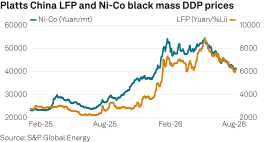
Chinese domestic LFP black mass prices have fallen broadly since July 6, as weaker lithium chemical prices have pressured values.
"Lithium prices have been inching down," a Guangdong-based recycler said, adding that lower lithium carbonate prices continued to weigh on LFP black mass valuations.
Platts, part of S&P Global Energy, assessed Chinese LFP black mass at 6,200 yuan per percent lithium on Aug. 7, up 200 yuan from a week earlier but down 850 yuan from a month earlier.
In the NMC black mass market, payables remained stable even as buying interest weakened. High inventories and expectations of further declines in cobalt and nickel prices discouraged purchases, market participants said.
"Downstream buyers are unwilling to purchase," a Zhejiang-based trader said, adding that domestic procurement activity remained weak as many participants anticipated lower cobalt and nickel prices.
"We have been continuously delivering recycled battery chemicals, but inventory has been difficult to clear recently, so we have slowed our procurement pace and limited our black mass purchases," a Jiangxi-based recycler said.
Platts assessed lithium, cobalt and nickel payables at 74% of the value of battery-grade lithium carbonate, cobalt sulfate and nickel sulfate on Aug. 7, unchanged week over week and month over month.