Metals & Mining, Energy Transition, Chemicals, Non-Ferrous, Renewables
August 04, 2026
Rare earth developers eye industrial residues as new source of US critical minerals

Editor:
HIGHLIGHTS
Firms target waste for rare earth supply
Dysprosium prices surge 91.7% in North America
Skeptics question recovery project economics
Industrial byproducts, once viewed primarily as waste, are attracting renewed investment interest as companies seek alternative sources of rare earths and critical minerals, industry sources told Platts, part of S&P Global Energy.
A growing group of US companies is seeking to recover rare earth elements, gallium, and other strategic materials from industrial residues accumulated over decades of mining and metals processing, betting that higher prices, geopolitical supply concerns, and federal support have finally made long-discussed recovery concepts commercially viable. Still, some skeptics argue that while minerals may be present in vast quantities, extracting them with sufficient purity and at scale remains largely unproven.
The surging interest in critical mineral waste streams, bolstered by intensifying policy support and skyrocketing rare earth prices, comes amid a global race to secure the increasingly crucial materials, used in robots, weapons, and everyday consumer products. Rather than replacing conventional mining, these secondary feedstocks may occupy a middle ground between recycling and primary extraction: lower risk than developing a new mine, but often more technically complex than processing conventional ore.
"The big advantage of using secondary waste material for rare earth production is a faster timeline, easier to permit, lower capital cost, because you're not digging something out of the ground," Chris Young, chief strategy and commercial officer at ElementUSA inc., which seeks to recover metal from mud, told Platts.
For the past two decades, the rare earth market has been plagued by low prices and overcapacity in China, according to experts.
But that equation has shifted dramatically over the past year. Beijing's export licensing restrictions on selected rare earth products have tightened Western supply chains and pushed prices sharply higher outside China. Platts-assessed dysprosium oxide delivered to North America, a key material used in high-temperature permanent magnets for defense and industrial applications, rose to $2,300/kg on July 31, up 91.7% since the assessment launched March 31. The equivalent Chinese market price remains near $215/kg, creating a premium of more than nine times.
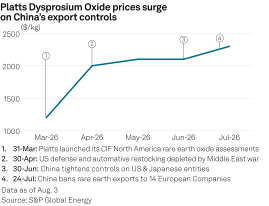
The price surge, combined with hundreds of millions of dollars in federal grants aimed at building US critical-mineral supply chains, has boosted developers. Some of them argue that waste-derived rare-earth projects offer faster timelines, lower capital costs and reduced geological risk compared with traditional mining.
Red mud's second life
ElementUSA, is developing waste-recovery projects in Louisiana, home to the last operating alumina refinery in the US. The facility has accumulated roughly 34 million mt of red mud, a by-product generated during alumina production from bauxite ore.
The start-up, working with the Colorado School of Mines, secured a $67 million award from the US Department of Energy to develop a rare earth processing facility in St. John the Baptist Parish, Louisiana. ElementUSA also received $29.9 million through a Department of Defense-related initiative.
The attraction is straightforward: Unlike a conventional mine, the material has already been mined, transported, processed, and stockpiled, according to Young.
Additionally, the project's economics are based on recovering multiple products rather than relying solely on rare earths.
"The beauty of unconventional resources and the co-production model is that it makes business much more viable from an investment standpoint," Young said. "It stands on multiple materials which help to de-risk the market."
According to ElementUSA, the residue contains roughly 60% iron oxide, creating a potential revenue stream into steelmaking markets while also hosting titanium, gallium, scandium, niobium, vanadium, and rare earth elements. The feedstock originates from Jamaican karst bauxite, which generally contains higher concentrations of critical minerals than more common lateritic bauxite deposits.
That approach is becoming a common theme among companies pursuing secondary feedstocks. Multiple revenue streams can help offset the volatility that has long characterized rare earth markets.
Titanium slurry opportunity
A similar strategy is emerging in titanium dioxide production.
Kunin, based in Chattanooga, Tennessee, is developing processes to recover critical minerals from industrial waste streams, including scandium from titanium pigment slurry, a liquid byproduct generated during titanium dioxide manufacturing.
The company recently received support through a DOE initiative focused on recovering gallium from metal-processing feedstocks and is advancing ion-exchange technologies designed to selectively recover critical minerals from complex waste streams.
Projects attached to existing industrial facilities face a fundamentally different risk profile from that of stand-alone mines.
"The challenge to build a dedicated mine to scandium is that you must build a construction project, put in CAPEX early, and have longer operating cash flows," said founder Daniel Rau. "And you need to go to larger scales and capacities to net IRR payback period."
That challenge is particularly acute in the scandium market, a niche with limited demand and few buyers.
Instead of developing a dedicated mine, Kunin's strategy is to add recovery circuits to operating industrial facilities.
"As a company, we go to these operating mines, smelters, and refineries, and we want to build a co-product circuit for them," Rau said. "Some merits of co-product circuits at operating assets are that they generally have much lower capital intensity, are quicker to build, and in many cases, have much lower unit operating costs."
Rau believes recent geopolitical developments have strengthened the case for domestic supply chains.
"China's openness and globalization provided an unprecedented period of easy access to critical materials on demand," he said. "That ship has sailed."
The widening gap between Chinese and Western rare earth prices, he added, has created market conditions that may support projects previously viewed as uneconomic.
Economic reality check
Not everyone is convinced.
Chris Berry, founder of the consulting firm House Mountain Partners, said enthusiasm for waste-derived critical minerals often overlooks the fundamental challenges of extracting commercial-grade products from low-concentration feedstocks. This can make projects uneconomic, he said.
"Recovery of almost any material from secondary feedstocks is notoriously difficult and sensitive to overall commodity prices," Berry said. "This is why you don't see more of it. The processing costs are too high relative to the commodity price."
Low concentration of target metals is a key issue. Whether the source material is red mud, titanium slurry, or mine tailings, target minerals typically occur in relatively small quantities, according to Berry. Recovering meaningful volumes requires processing vast amounts of material, while achieving high purity.
Purity requirements, he said, often determine whether a project succeeds commercially. It is crucial to users.
"If you're producing off-spec material from waste, it's basically still a waste," he said.
Peter Cook, a senior climate and energy analyst at the nonprofit The Breakthrough Institute, shares some of those reservations but believes certain waste streams warrant closer scrutiny than others.
"Ultimately, feasible waste recovery will vary mineral by mineral, and site by site," Cook said.
Still, Cook sees stronger potential in residues associated with commodities that naturally occur alongside rare earth elements.
Most importantly, Cook said, economics are not static.
"High prices will make lower concentrations feasible," he said. "Mine waste will become feasible on an element-by-element and site-by-site basis, and will likely come into production in waves when prices become exceptionally high."
