Metals & Mining, Ferrous
July 31, 2026
Chinese HRC market faces supply pressure amid falling exports, sluggish demand

Editor:
HIGHLIGHTS
HRC exports down 23% on year in H1
Three new hot-strip mills add 8 million mt/year capacity
Inventories up 8% since end-April on weak demand
China's domestic hot-rolled coil market faces mounting pressure as falling exports, weak demand, and rising inventories weigh on prices, while ongoing HRC capacity expansions fuel concerns about sustained strong supply into the second half of 2026.
Platts, part of S&P Global Energy, assessed Chinese domestic HRC at an average of Yuan 3,325/metric ton ($491/mt) over July 1-30, down 1.9% from the June average and 4% lower than in May, with domestic prices trending lower since mid-May.
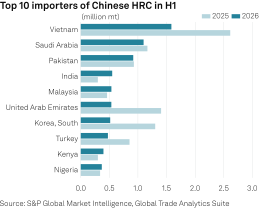
China exported 11.1 million metric tons of HRC in the first half of 2026, down 23.4% year over year and 35% lower than in the same period of 2024, according to data from S&P Global Market Intelligence's Global Trade Analytics Suite.
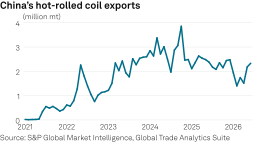
Anti-dumping cases against Chinese HRC have increased steadily since 2025, raising expectations that exports will continue to decline for the remainder of 2026, several trading and mill sources said.
Vietnam, which remained the largest export market for Chinese HRC, imposed antidumping duties, causing China's HRC exports to the country to fall 39% year over year to 1.585 million mt in the first half of 2026.
| Implementation date of import duties | Country | Products | Duties |
| 2026/June | South Korea | Hot-rolled products of carbon steel and other alloy steel | Final AD duties of 28.16%-33.10% |
| 2026/June | Australia | HRC and plate | Preliminary AD duties of 36%-116.9% |
| 2026/April | Vietnam | HRC of 1880-2300mm wide | AD duties of 27.83% |
| 2026/March | Mexico | HRC | Preliminary AD duties of $216/mt-$230.4/mt |
| 2026/March | South Africa | Certain hot-rolled flat steel products of iron, non-alloy steel or other alloy steel | Final AD duties of 6.99%-47.92% |
| 2026/Feb | Egypt | Hot rolled flat steel (HRC/HRFS) | Final safeguard duties from EGP 3,376/mt to EGP 3,673/mt |
| 2026/Jan | Indonesia | HRC from Wuhan Iron & Steel | Preliminary AD duties of 17.55% or $96.02/mt |
| 2025/Dec | India | Flat steel | Final safeguard duties of 11%-12%; CIF minimum prices at $675-964/mt |
| 2025/July | Vietnam | HRC | Final AD duties of 23.10%-27.83% |
One China-based trader said HRC exports to the Middle East have also declined notably so far this year, owing to disruptions to shipping through the Strait of Hormuz.
Capacity expansion
Despite lackluster market performance, China's HRC production capacity continues to expand. Based on company and local government announcements, three new hot-strip mills with a combined annual capacity of 8 million mt were commissioned during January-July.
| Capacity of China's newly commissioned hot strip mills (million mt/year) | Number of China's newly commissioned hot strip mills | |
| 2024 | 21 | 7 |
| 2025 | 15 | 6 |
| 2026 Jan-July | 8 | 3 |
Source: Companies and local governments' announcements, S&P Global Energy
A further 10 projects, totaling about 28 million mt/year of HRC production capacity, are either under construction or in the planning stage, according to announcements from those companies and local governments.
The ongoing expansion of HRC capacity is adding further pressure to the HRC market, already facing challenging demand conditions, with exports encountering growing trade barriers and domestic consumption growth remaining elusive.
Weak domestic demand
On the domestic front, the downturn in the property and infrastructure sectors has continued to weigh on overall steel demand in China.
One mill source said slower construction activity has reduced demand for steel structures, which in turn has weighed on HRC consumption.
"According to my knowledge, the overall domestic end-user demand for HRC through July appears to have been slightly lower than a year earlier, or at least there has been no noticeable growth," he said.
Another mill source said manufacturing-related steel demand remained positive in 2026, but supply in flat steel products, including HRC, has remained "too strong", so that HRC prices and mill margins have struggled to improve.
The source added that manufacturing steel demand is likely to remain firm in the second half of the year, but growth momentum will continue to rely heavily on overseas demand rather than domestic consumption.
"Domestic consumer goods consumption remains weak and is unlikely to provide meaningful support for HRC consumption in the manufacturing sector," he added.
China's domestic HRC apparent consumption reached 27.78 million mt in June, up 5.2% from May, but still 1.2% lower than a year earlier, according to calculations made by S&P Global Energy.
The Chinese domestic HRC consumption equals HRC output minus net HRC exports and increased HRC inventories.
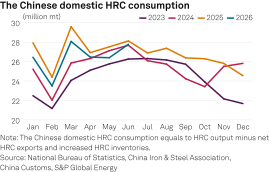
Both mill sources expected a seasonal recovery in steel demand from the construction and manufacturing sectors during late August and September. However, they said the rebound may not be any stronger than that seen in 2025.
Declining exports, weak domestic demand and robust supply have fueled a steady increase in HRC inventories since May.
HRC inventories at major spot markets monitored by the China Iron and Steel Association reached 2.25 million mt as of July 20, up 7.7% from the end of April and 26.4% higher than a year earlier, according to the latest CISA data.
"As of late July, domestic HRC sales among mills have generally fallen into losses of around Yuan 50-100/mt," the second mill source said.
Under pressure from weakening seasonal demand and rising losses, Chinese steelmakers have accelerated HRC production cuts since mid-July. However, the mill sources, as well as three traders and one steel industry analyst, said the output reductions have remained insufficient to offset weakening demand.
One mill source added that current losses remain manageable for most HRC producers, reducing the incentive for deeper production curbs at least for now.
