Metals & Mining, Non-Ferrous
July 27, 2026
DRC mining code reforms risk deterring Western investment

Editor:
HIGHLIGHTS
DRC tightens state control over mining
Reforms risk deterring Western investors
Chinese dominance may deepen in sector
The Democratic Republic of Congo's push to tighten state control over its mining sector could discourage Western investment just as new mine capacity will be needed to meet growing demand for battery metals through the 2030s, industry participants and analysts have told Platts, part of S&P Global Energy.
The government's July 13 announcement that it would revise its 2018 Mining Code to strengthen oversight of the sector and expand state control over strategic minerals will likely leave production of copper, cobalt, lithium, gold, and tantalum unscathed in the short term but poses long-term risks.
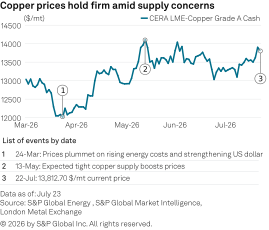
With copper and cobalt prices rising, authorities in the DRC — the world's largest cobalt producer and second-largest copper producer — have stepped up efforts to enforce laws requiring mining companies to cede equity stakes to employees, build national stockpiles, and increase local ownership of strategic resources.
The government also hopes to ease its dependence on China for investment, butindustry participants told Platts that the rushed implementation of new rules could increase sovereign risk and complicate efforts to attract non-Chinese capital.
"The risk is that tighter state control accelerates the very dynamic it may be trying to address: if Western capital is deterred, Chinese operators, who have demonstrated a higher tolerance for sovereign and regulatory risk in the DRC, will continue to dominate, entrenching rather than reducing Kinshasa's dependence on Beijing," Joel Crane, commercial manager at Australian miner and refiner Cobalt Blue Holdings, said.
The policy changes shouldn't have an impact in the short term on operating mines.
"In the short term, the proposed amendments are unlikely to materially affect supply availability or pricing," Crane said. "Existing operations will continue, and the DRC's export quota regime is already the dominant supply-side variable in the cobalt market."
Congo, on Sept. 21, introduced a system of export quotas on cobalt hydroxide, limiting annual exports to 96,600 metric tons for 2026 and 2027, equivalent to 52.0% of the country's 2024 production, according to S&P Global Market Intelligence data.
Investment climate
The Chamber of Mines of the Democratic Republic of Congo,an industry group representing mining companies operating in the country, has voiced similar concerns, warning at a July 20 workshop that uncertainty over the reforms could undermine investor confidence. Chamber President Kassongo Bin Nassor called for the government to delay changes until consultations with industry participants, government agencies, and civil society groups are completed.
The timing has attracted particular attention because Bin Nassor and the Trump administration are negotiating the Washington Accords, a strategic partnership intended to give US-aligned investors greater access to selected mining assets and reduce dependence on Chinese supply chains.
"The market will be watching closely to see whether any changes to the mining code complicate that relationship, and whether Kinshasa can credibly pursue greater state control and greater Western investment at the same time," Crane said.
Regulatory predictability matters more to investors than higher taxes or royalties.
"A well-written code often serves the industry's interest because it provides more security of tenure, requires multiple stakeholder engagement and parliamentary oversight, as opposed to administrative fiats," Kwasi Ampofo, head of metals and mining at BloombergNEF, told Platts.
DRC copper production rose from 1.2 million mt in 2018 to 3.3 million mt in 2025 following the passage of the current Mining Code, while cobalt output doubled over the same period, Ampofo said.
Copper in demand
Global copper demand will grow roughly 30% to 50% by 2040, according to the International Energy Agency, and cobalt demand will compound at a 7% annual growth rate through the early 2030s, said the Cobalt Institute, a trade group.
Future demand growth for both metals is driven heavily by electrification and clean energy. The world will see a 10 million mt copper deficit by 2040, according to a January report by S&P Global.
The proposed reforms would amend more than 40 articles of the code. They include a national stockpiling mechanism, new regulatory agencies overseeing critical mineral exports, and expanded powers to suspend or revoke mining licenses for noncompliance. Financial penalties could reach $1 million, while certain offenses could carry prison terms of up to 20 years.
The government is also seeking a larger share of revenue from strategic minerals. In June, it classified lithium, tantalum, niobium, and uranium as strategic minerals and increased royalties on those commodities to 10% from 3.5%.
Separately, international miners must transfer 5% equity stakes to employees by July 31 under the government's local-content plan. The mines ministry recently reaffirmed the deadline following talks with major operators, including Glencore, CMOC, Ivanhoe and Huayou Cobalt.
Mining remains the backbone of the Congolese economy, with major operators there including CMOC, Zijin Mining, Huayou Cobalt, Glencore and Barrick Gold.
