Metals & Mining, Non-Ferrous
July 24, 2026
China bans rare earth exports to 14 European companies

By Euan Sadden
Editor:
HIGHLIGHTS
Export controls target dual-use materials
China controls 91% of rare earth processing
China has added 14 European entities to its export control list, prohibiting Chinese exporters from supplying them with dual-use items, including rare earths and permanent magnets, without special authorization
In a statement released July 24, the Ministry of Commerce said the affected companies would be denied export permits to safeguard national security and uphold China's international non-proliferation obligations.
China defines dual-use items as products or services that can be used for both military and civilian purposes. In addition to rare earths — including scandium, yttrium, samarium, terbium, dysprosium and lutetium — the designation also covers gallium, germanium, graphite, antimony, tungsten, tellurium, bismuth, indium, molybdenum and their associated products.
The policy underscores China's dominant position in critical minerals supply chains. Developed economies remain heavily dependent on China for rare earths. The International Energy Agency estimates that in 2024 China accounted for 61% of global mined supply and 91% of global refining and processing capacity for major rare earths. China also dominates processing for other critical minerals, including lithium, copper, cobalt, and graphite.
The targeted organizations are based in Germany, Italy, France, Poland, the Netherlands, Czechia, Bulgaria and Lithuania, and operate in industries including defense, aerospace, photonics, and advanced manufacturing.
Notable companies on the list include German defense firm Rheinmetall AG, Czech vehicle manufacturer Tatra Trucks, and German coating materials supplier Sindlhauser Materials, the ministry said.
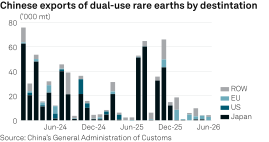
China's export controls on dysprosium, gadolinium, lutetium, scandium, terbium and yttrium, as well as associated metals and magnets, took effect on April 4, 2025, following the introduction of US Liberation Day tariffs. The measures triggered a sharp decline in Chinese exports of rare earths and permanent magnets, which have yet to recover. China also tightened rare earths export curbs on 10 US companies in June, targeting dual-use items.
A second wave of export controls, covering five rare earth elements — holmium, erbium, thulium, europium and ytterbium — as well as related products, equipment and technologies, was initially scheduled to take effect on Nov. 7, 2025, but is now set for Nov. 10, 2026.
Platts, part of S&P Global Energy, assessed dysprosium oxide at $2,100/kg CIF North America on June 30, unchanged month over month. Platts assessed terbium oxide at $4,800/kg CIF North America in June, up from $4,700/kg in May.
