Metals & Mining, Ferrous, Non-Ferrous
July 17, 2026
TRADE REVIEW: Turkish deepsea import scrap likely to face additional downside pressure in Q3
Editor:
HIGHLIGHTS
Weak downstream demand weighs on Turkish scrap market
Indian scrap imports likely to remain subdued through monsoon
Weak downstream demand could continue to weigh on Turkish deepsea import scrap demand in the third quarter of 2026, as prices began to descend towards the end of the second quarter.
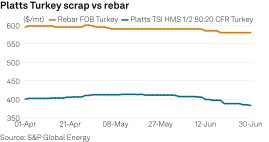
Turkish deepsea import scrap price peaked at $413/metric ton CFR May 13, its highest level since February 2024, and tumbled in the second half of Q2 to $382.50/mt CFR by the end of June, according to data from Platts, part of S&P Global Energy.
Market sentiment was mixed, as muted demand from Turkish mills for deepsea cargoes persisted, with mills reportedly showing a preference for shortsea and domestic scrap.
Market participants will also continue to closely monitor the Strait of Hormuz situation to gauge the near-term sentiment.
"Oil prices are going down and the US-Iran situation is changing every day," one agent source said, adding that this uncertainty was making many participants hesitant to sell.
"I believe the market will rebound in July as few sellers are around and confidence after the peace is mounting, which should trigger more activity moving forward," one trader source said.
Participants also said ocean freight rates remained elevated, preventing further price declines as sellers' margins remained lower.
Platts assessed the monthly average dry bulk Supramax freight rate from New Jersey to Turkey at $34.818/mt in June, up from $30.263/mt in April.
Impact of Middle East conflict
Scrap price spikes in April and May were largely driven by uncertainty surrounding the Middle East war and rising energy and transportation costs, but bearish downstream demand limited buyers' appetite.
The lack of demand was reflected in the import volumes, which saw a slight year-over-year drop.
Ferrous scrap imports in April stood at 1.86 million mt, down from 1.88 million mt during the same year-ago period, under the harmonized HS code 7204, according to data from S&P Global Market Intelligence's Global Trade Analytics. Imports in May this year stood at 1.49 million mt, down from 1.60 million mt in May last year.
"We are heading back to where we started before the US/Iran conflict," one Turkish mill source said.
Platts assessed the Turkish exported rebar monthly average at $584.95/mt FOB Turkey in June, down from $596.50/mt FOB in April.
The outright spread between imported scrap and exported rebar reached its narrowest point at $177/mt on May 12, below the commonly reported breakeven level for Turkish mills at $180-$200/mt, depending on mill size. The spread widened toward the end of Q2 to $197.50/mt on June 30, Platts data showed.
"The rebar situation has been the same for a few months... Finished products sales and rebar sales are dead," a second mill source said. "There will be an aggressive decrease in scrap prices due to low rebar demand."
The narrowing scrap-rebar spread made billets more attractive to buyers. But to add to the woes, the availability of competitively priced Asian billets dwindled, while those available had elevated offer levels and longer lead times.
Turkish mills increasingly favored Russian/CIS-origin billet in the $490-$518/mt CFR Turkey range through much of Q2 and domestic producers like Kardemir over Asian suppliers, participants noted.
Impact of EU safeguards
Turkey's significantly reduced steel export quota, as the recently implemented EU safeguard measures also weighed on market sentiment.
Turkey's export quota to the EU was set at 160,573 mt from July 1, down by almost 60% from the quota of 160,573 mt from April 1-June 30.
"Turkish mills want to wait [to buy] but it is not the scrap price, it's because they cannot sell enough rebar," one agent source said.
Additionally, the Eur/dollar exchange rate also softened during this period, putting further pressure on scrap prices. Platts assessed the monthly average of the Eur/dollar spot exchange rate at $1.15 in June, down from an average of $1.17 in April and May.
Premium deepsea HMS 1/2 (80:20) imports to Turkey and shredded scrap to India, which were negatively correlated in the last three months of 2025, have moved largely in tandem in 2026 as both markets faced similar global macroeconomic factors, such as the conflict in the Middle East and the resultant higher energy and freight costs.
Indian scrap import outlook
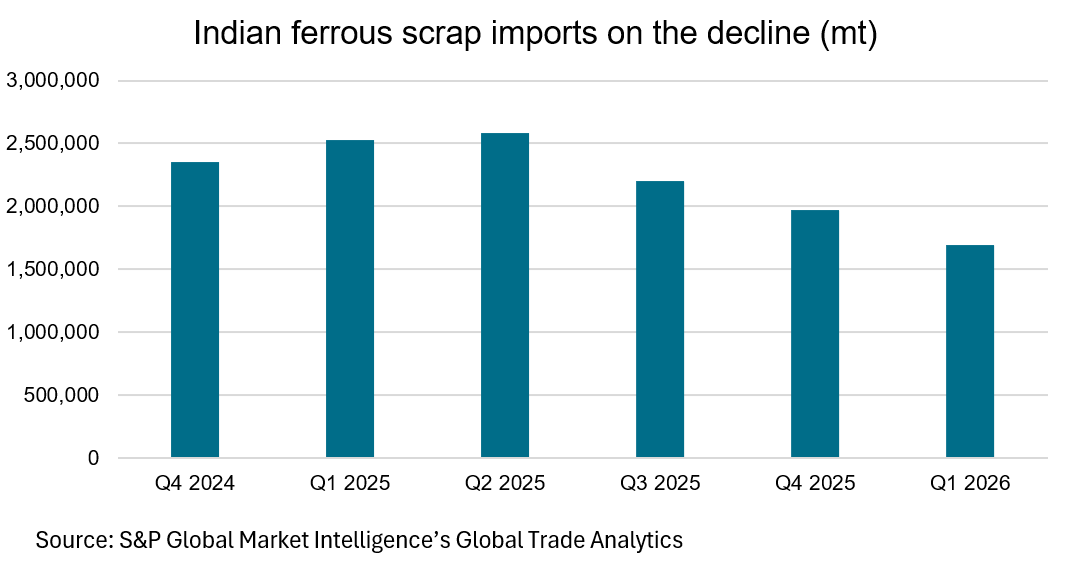
Ferrous scrap import demand from Indian buyers until September is expected to remain subdued, as usual, during the annual rainy season, when construction activities, a major source of finished steel demand, take a backseat.
However, market participants argued that import demand fundamentals have been weak and bearish even before the monsoon. That is a trend that they expect to continue even after the monsoon.
Downstream rebar prices have steadily declined and, in recent weeks, have reached their lowest levels in 2026, while the rupee has languished near record lows against the dollar since May.
Participants said the Middle East war has driven down Indian buyers' risk appetite while also inflating freight costs, making it nearly impossible for sellers to lower their offer levels and leading to a stubborn stalemate between the two.
Under these conditions, Indian steelmakers have largely relied on competitively priced direct‑reduced iron and heavy melting scrap from the domestic market, both of which remain readily available for now.
An India-based trader said the price spread between HMS 1/2 (80:20) to shredded scrap has widened to around $40-$50/mt from $15-$20/mt previously, further disincentivizing shredded scrap imports.
Platts assessed imported containerized shredded scrap at a four-month low of $373/metric ton CFR Nhava Sheva July 16.
Scrap importers in neighboring Pakistan also closely tracked the Middle East conflict, participants said, with any escalation in hostility supporting higher prices due to lower hopes of regaining access to sellers in the region, and vice versa.
Elsewhere, "Bangladesh problems are different; the government has no funds to continue old projects or start new ones, and amidst heavy rains, rebar sales have plummeted," another India-based trader said. "No one is seriously importing scrap, and even larger importers are very quiet."
