Metals & Mining Theme, Ferrous
February 23, 2026
IRON ORE SERIES: Australian magnetite projects insulated from Simandou impact

HIGHLIGHTS
Magnetite serves specialized steelmaking, not bulk market
Green steel demand supports higher-grade feedstock premium
The arrival of Simandou's high-grade iron ore has the potential to alter the landscape of the iron ore markets. This is an overview of a six-part interview series in which Platts News has spoken to magnetite ore producers to discuss their strategy and competitive advantage.
The large Simandou iron ore project in Guinea is not expected to have a material impact on Australian magnetite projects, according to iron ore executives in Australia.
Simandou, which offers 65% Fe high-grade ore, comprises four mining blocks, with interests held by the Guinean government, Rio Tinto and a Chinese-led consortium.
Although some market observers have dubbed it a "Pilbara killer," near-term logistical constraints and limited production capacity challenge that view. Western Australia's Pilbara region remains the primary contributor to Australia's status as the world's largest iron ore exporter.
The ramp-up of Simandou is progressing more slowly than originally expected, according to a Jan. 21 report from S&P Global Energy CERA. The mines are projected to collectively achieve a production capacity of 120 million metric tons/year by 2030.
Reza Azimi, managing director of FI Joint Venture Pty. Ltd., or FIJV, told Platts, part of S&P Global Energy, that "magnetite producers remain structurally insulated" from the market impacts of Simandou.
FIJV aims to produce 5 million mt/y from the Yogi magnetite project in Western Australia by 2030, with plans to increase output to 12.5 million mt/y by 2036.
Magnetite producers will not be "materially impacted" by Simandou as they are "supported by product differentiation, controlled grade and accelerating demand linked to green steel and [direct reduced iron] pathways," Azimi said.
"Simandou supplies bulk hematite, while magnetite projects produce a premium, beneficiated concentrate for specialized steelmaking routes," Azimi said.
Magnetite projects are not attempting to compete with Simandou in terms of volume, but rather "serve a structurally different and growing demand segment," he said.
"Decarbonization policies, particularly in China, are increasing demand for higher-grade, lower-impurity feedstocks, supporting magnetite concentrate consumption," Azimi said.
"In many steelmaking flowsheets, magnetite concentrates and high-grade hematite are complementary rather than substitutable."
Market psychology
The IODEX CFR China benchmark assessed by Platts has declined since December 2025, following the shipment of Simandou's first cargo. However, a Jan. 21 note from CERA analysts attributed the falling prices to slowing demand and ongoing contractual price negotiations, rather than the impact of the Guinean project.
"Over the midterm, the ramp-up of this high-grade project remains the key source of downward pressure on iron ore prices. With the IODEX debased to 61% Fe, this pressure becomes even more pronounced as higher-grade fines supply rises," the Jan. 21 note said.
Azimi said Simandou has "already shifted market psychology" as it increases the availability of premium hematite supply and places a "structural cap on sustained high iron ore prices as ramp-up progresses from 2026 onward."
"The magnitude of this impact will depend on ramp-up execution and broader steel demand, particularly in China," Azimi said.
Winning Consortium Simandou reported Jan. 18 that the first Simandou shipment, a 200,000-mt cargo, had arrived in China.
It will not be long before "we will know a little bit about what is going to be the blending strategies of the various [Chinese steel] plants that get access to the Simandou ore," David Cataford, CEO of Champion Iron Ltd., told Platts.
Price impact
Simandou could impact the premium for high-grade ore relative to the new Platts benchmark index for 61% Fe iron ore fines, "but we will see when those tons come to market," Cataford said.
Most of the world's iron ore is traded to customers at a long-term contractual price above the spot market, as Chinese steel mills require a consistent supply to avoid frequently resetting their furnaces, Cameron McCall, CEO and executive chairman of Macarthur Minerals Ltd., told Platts.
"There is very little iron ore traded at spot price ... so I do not really think that [Simandou] will have a huge impact on the smaller boutique producers [in Australia] and who they sell to," McCall said.
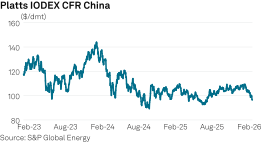
Azimi believes Simandou is likely to exert medium-term downward pressure on hematite iron ore prices, primarily by limiting price increases rather than causing a sudden collapse.
"Its competitive impact is concentrated on lower-grade, higher-cost hematite producers," Azimi said.
John Welborn, executive chairman of Fenix Resources, told Platts: "A few years ago, it was obviously seen as the Pilbara killer and created a lot of uncertainty in the market ... Simandou is now clearly understood and factored in."
Gordon Toll, chairman of Lodestone Mines Ltd., said, "Simandou is pretty much factored in" to the iron ore markets.
Simandou, a bogeyman
While Simandou has been "a bit of a bogeyman" for iron ore markets, Toll said there are challenges with the project's logistics management.
Tom Revy, managing director of Hawsons Iron Ltd., told Platts that Simandou's iron ore is "still fundamentally a blast furnace product."
"It will probably displace some of the lower-grade material that is out there. This is obviously driven by economics because it is better financially to treat higher-grade materials as much as anything else," Revy said.
Although a greater discount may be applied to some lower-grade iron ore globally, as a result of Simandou's high-grade ore hitting the market, "at the end of the day, Africa is Africa, and we have seen a lot of changes there happen at very short notice," Revy said.
