Fertilizers, Chemicals, Energy Transition, Renewables, Carbon, Emissions
December 11, 2025
Low-carbon ammonia markets firm ahead of EU carbon border rules
HIGHLIGHTS
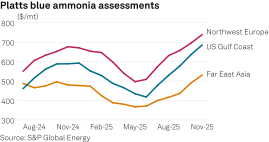
Blue ammonia prices rise 6%-8% in November
EU CBAM implementation in Jan drives import strategy
Green ammonia offers heard at $600-$700/mt in Asia
The global low-carbon ammonia market strengthened significantly from October to November, as conventional ammonia supply constraints tightened the market and supported prices, and exporters started to lineup low-carbon cargoes to Europe ahead of the Carbon Border Adjustment Mechanism implementation.
Carbon capture-enabled blue ammonia prices rose 6%-8% month over month across major regions in November, with values in Northwest Europe -- the highest-priced delivery region -- up $44/metric ton to average $739/mt.
These gains built on October's already elevated levels. Prices on the Gulf Coast narrowed their discount to European assessments, up $50/mt at $686/mt, while Far East Asia rose $41/mt to $531/mt.
Platts blue ammonia price assessments are based on the conventional ammonia market price plus a premium reflecting the costs of carbon capture and storage.
The Platts Ammonia Price Chart illustrates monthly averages of daily assessments for conventional, CCS-enabled and renewable ammonia across a range of geographies and delivery options. Platts is part of S&P Global Energy.
Blue ammonia is made from fossil fuel-derived hydrogen, capturing the associated CO2 emissions, while green ammonia uses hydrogen from renewables-powered water electrolysis. Assessments assume a levelized cost of renewable power input.
Green ammonia cost-of-production assessments remained broadly steady, with variations typically minimal, and cost assumptions reviewed annually.
Platts assessed delivered green ammonia costs in the range of $820-$930/mt in November, with the lowest average cost for delivery to Far East Asia from the Middle East, and the highest delivered from West Coast Canada to the same destination.
The lowest cost renewable ammonia delivered to Northwest Europe was from the Middle East, averaging $838/mt in November.
Conventional ammonia markets
The price momentum stems from persistent supply disruptions in the conventional ammonia market, which continues to drive low-carbon ammonia valuations in the absence of substantial low-carbon trade.
Nutrien's shutdown of nitrogen operations in Trinidad and Tobago late in November exacerbated existing constraints, forcing the producer into spot markets and securing 28,000 mt for December Northwest Europe delivery at $690-$695/mt CFR duty free.
Yara and Mosaic agreed a price of $650/mt CFR Tampa for December deliveries -- a rollover of the price the parties previously agreed for November deliveries -- despite the persisting supply constraints. Sources close to the negotiations attributed the rollover to increasing competition.
It followed five consecutive month-over-month increases in the influential monthly contract price, which reached its highest in almost three years in November.
Several sources said fresh ammonia availability from the new 1.3 million mt/year Gulf Coast Ammonia plant in Texas was sufficient to prevent a further increase in the influential monthly contract price at Tampa.
Meanwhile, production at the 1.089 million mt/year Ma'aden Phosphate Company plant in Saudi Arabia remained on hold through November, after shutting down in August.
In addition, a three-week turnaround was initiated in early December at the 330,000 mt/year Salalah Methanol Company ammonia plant in Oman.
CBAM looms
The conventional ammonia spot market in Northwest Europe was heard at a standstill, with importers drawing heavily on long-term contract volumes, aiming to end the year with high inventories and limit their exposure to CBAM costs from January.
CBAM is due to enter its definitive phase on Jan. 1, 2026, requiring ammonia importers to report embedded emissions and, from 2027, purchase CBAM certificates to cover emissions above a benchmark free allowance.
Platts plans to launch a calculated value for CBAM-associated for ammonia delivered to Northwest Europe.
The weekly differential will reflect the additional cost faced by an EU importer of ammonia with a carbon intensity of 2.20 mtCO2e, a weighted average carbon intensity based on EU import statistics, with current estimates suggesting additional costs of about $64/mt for conventional ammonia imports.
With CBAM on the horizon, a second blue ammonia cargo arrived in Europe from US producer CF Industries, with Bulgarian fertilizer producer Agropolychim receiving 5,000 mt. The 26,000 mt Green Power, which loaded for trader Trafigura from CF Industries at Donaldsonville in Louisiana, discharged the parcel for Agropolychim at Varna Oct. 30-Nov. 4, according to the S&P Global Commodities at Sea data.
CF Industries did not comment on the carbon intensity of the enhanced oil recovery-enabled ammonia.
However, ahead of the implementation of CBAM, low-carbon ammonia continued to trade at parity with the conventional product.
The US Gulf Ammonia Price, a daily market-based assessment of the FOB market for low-carbon ammonia along the US Gulf Coast, mirrored the trajectory of the market for conventional ammonia, firmed to $600/mt FOB in early December from $545/mt at the beginning of November.
Similarly, the Japan Korea Ammonia Price tracked conventional markets, climbing to $530/mt CFR from $470/mt CFR over the period.
Higher indicative values persist for renewable-derived green ammonia, with Chinese offers reported in the low $600s/mt FOB and Indian green ammonia heard in the low $700s/mt FOB.
IMO shock
The International Maritime Organization's decision in October to delay Net-Zero Framework discussions by one year has added uncertainty to the prospects of green marine fuel demand.
Market participants expressed concern that the US-driven delay could impact project development timelines, with one Latin American renewable hydrogen developer noting the postponement "raises questions about the future of green marine fuel projects," including ammonia.
As with the broader green ammonia market, the marine fuels segment has yet to see a meaningful willingness to pay a premium.
"Project developers will continue to be hopeful, mainly reassessing the circumstances," a market participant told Platts. "They remain interested in projects but are also waiting for changes in the political landscape."

Editor: