Energy Transition, Electric Power, Hydrogen, Emissions
October 27, 2026
INTERVIEW: AM Green eyes more deals for 3 mil mt/y renewable ammonia goal
By Ruchira Singh and Takeo Kumagai
Editor:
HIGHLIGHTS
Renewable ammonia output target for 2031-32
Can meet marine fuel specifications under JERA deal
Tuticorin, Kandla projects expected to advance
AM Green Ammonia (India) Pvt. Ltd. is seeking further global offtake deals as it advances a 3 million metric tons/year renewable ammonia production target, CEO Gautam Reddy told Platts, part of S&P Global Energy, following an agreement with JERA Co. Inc. announced Oct. 27.
JERA and AM Green signed a binding heads of agreement under which the Japanese power generator will purchase about 70,000 mt/y of renewable ammonia from AM Green's Kakinada facility in Andhra Pradesh, with commissioning planned for 2028-29.
"AM Green intends to build a 3 million tonnes of green ammonia [production capacity] in our phase one by 2031-32," Reddy said. "... There's a whole pipeline of deals available to us that are in various stages of maturity."
Reddy said the company was in ongoing discussions with prospective global buyers while advancing its other projects in India, including those at Tuticorin and Kandla, and was hopeful that more agreements would soon come to fruition.
AM Green's website currently lists renewable ammonia projects of 2 million mt/y at Kakinada, 1 million mt/y at Tuticorin and 1.5 million mt/y at Kandla, alongside a 100,000 mt/y project at Una.
The developer has secured significant deals with companies, including Uniper (500,000 mt/y renewable ammonia) and Yara, and was selected as the sole winner of the Asian lot in Germany's H2Global auction for renewable fuels of non-biological origin-compliant renewable ammonia, with a minimum value of €585 million, in September.
Marine application
Reddy said the deal with JERA was significant as it marked an early marine application for renewable ammonia, even as key fuel standards for the shipping sector remain under development.
This is "quite an industry-setting kind of deal because we are meeting the maritime requirements where regulations are still not clear," he said, pointing to the International Maritime Organization's impending decarbonization framework.
"Until now, contracts have been signed to meet transportation requirements in Europe or power cofiring in Japan, where regulations have already passed," Reddy said.
However, "there are clients who want maritime decarbonization. There are clients who are willing to encourage it, pay for it."
Seven Japanese companies comprising shipbuilders and owners, and a power generation company agreed to develop an ammonia fuel supply chain in the Chubu region and to build and operate four ammonia-fueled car carriers for the supply chain, the companies said in a joint statement Oct. 27.
Geopolitical impact
Reddy said AM Green's project was impacted as much as the industry's, owing to inflationary pressures and supply chain challenges amid geopolitical conflicts, but development and early trade were advancing nevertheless.
"All those are things that affect everyone ... also, there is a huge demand for power in the Indian power market," Reddy said, highlighting the constraints the hydrogen developers were facing.
"So obviously, our clients are realizing that, and we are positioning the price in an optimal zone where all these considerations are met, and it's a win-win for everyone," he added.
The agreement marks one of AM Green's first delivered-basis supply contracts in the Asian market and a milestone for the company as it pioneers direct delivery of green fuels to Japan, JERA said in its statement.
With the industry moving forward, "I would like to believe that clients are willing to pay a premium for a credible supply," Reddy said.
Adapting to standards
AM Green has offered to supply JERA with RFNBO-compliant renewable ammonia, despite uncertainty over the standards that will ultimately govern ammonia use in the maritime sector.
"Those discussions are still underway. For example, EU maritime has one standard ... but we don't know what standard IMO will come up with," Reddy said. "Japan has its own standard."
Meeting any eventual maritime standard was a requirement for JERA, he said, adding that AM Green had offered to meet the more stringent RFNBO requirements.
"The comfort we are offering JERA is that whatever the IMO, [or] whatever the shipping standards will be, we will make sure we deliver to that," Reddy said. "JERA always wanted us to meet any eventual standard that gets released. So we have offered the RFNBO standard."
Suitably positioned
The location of AM Green's Kakinada project offers both geographical and infrastructure advantages, with the plant situated next to an existing port that has handled ammonia for about 25 years, Reddy said.
The port's experience, expertise and existing clearances for ammonia handling were among the factors behind AM Green's choice of Kakinada, particularly as it seeks to begin deliveries quickly, he said.
"Our renewables, our pumped hydro storage and ammonia plant are all in the same geo zone," he said. "So that also helps us meet the European requirements, which are very stringent."
"All these things come together in why we have chosen Kakinada in the first place," Reddy said. "And it's showing, it's manifesting in the way the clients are trusting us."
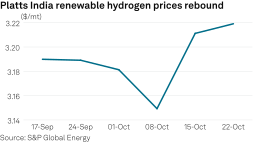
Platts assessed the India renewable hydrogen term contract at $3.22/kg on Oct. 22, up 0.94% month over month.
Meanwhile, Platts assessed Northwest Europe renewable hydrogen at €6.70/kg ($7.47/kg) on Oct. 1, up 1.52% month over month.
