Energy Transition, Coal, Crude Oil, Natural Gas, Electric Power, Emissions, Carbon, Renewables
October 21, 2026
UN report sets out pathway to return to 1.5 C warming by 2100 after overshoot

Editor:
HIGHLIGHTS
18% GHG emissions cut needed by 2030 vs 2025
Coal must fall 75% by 2035, phased out globally by 2040
Solar PV capacity growing 7 times faster than expected
The world must cut greenhouse gas emissions by 18% within four years to limit the worst effects of climate change, and return warming levels to 1.5 C above pre-industrial levels by 2100 after overshooting this century, the UN warned on Oct. 21, with the pace of reductions now required exceeding targets set by the Intergovernmental Panel on Climate Change.
The UN Environment Programme's Emissions Gap Report 2026 finds that global temperatures are now certain to exceed 1.5 C and lays out what it would take to minimize the overshoot and return to that threshold by the end of the century.
The report's findings come as energy markets face mounting pressure from climate policy and the accelerating buildout of renewable power capacity.
"Overshoot is not surrender," UN Secretary-General António Guterres said in a statement. "We can still keep it as small and as short as possible – and bring temperatures back below 1.5 C by the end of the century."
Under the report's "lowest possible" 1.5 C overshoot scenario, peak warming by mid-century would be capped at 1.7-1.8 C, with a roughly 50% chance of returning to 1.5 C by 2100.
Achieving that outcome would require global greenhouse gas emissions to fall 18% by 2030, 45% by 2035 and 69% by 2040, all measured against 2025 levels, the UNEP said.
Analysts at S&P Global Energy said in a recent report that limiting global warming to 1.5 C this century was no longer possible, though a wide range of outcomes was possible under its mapped scenarios.
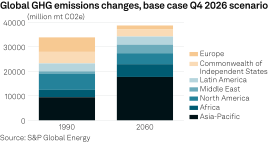
In a base case, global GHG emissions are set to fall to just below 40 billion metric tons of CO2 equivalent by 2060, from around 54 billion mt in 2025. S&P Global's Energy Scenarios project warming of 2.0-3.1 C by 2100.
The cuts needed in the UNEP report imply average annual reduction rates of 5.7% between 2025 and 2035 — steeper than the approximately 5% annual rate called for in the IPCC's Sixth Assessment Report pathways.
By contrast, full implementation of countries' existing Nationally Determined Contributions would reduce emissions by only 5-8% by 2030 and 11-15% by 2035 relative to 2025 levels — a fraction of what the lowest overshoot scenario demands.
New NDCs submitted since last year's report have made a negligible difference to those projections, the UNEP said.
Fossil fuel demand
To stay on the lowest overshoot pathway, the share of coal, oil and gas in total global energy supply would need to fall by at least 55%, 15% and 5% respectively by 2035 relative to 2025 levels, with far steeper reductions required by 2040 — at least 75%, 30% and 35%.
Electricity generation from coal would need to fall by at least 75% by 2035 and be effectively phased out globally by 2040.
Methane emissions, a key concern for the oil and gas sector, would need to be at least 25% lower than 2025 levels by 2035 and at least 40% lower by 2040.
The UNEP warned that without urgent action, current policies would see warming reach 2.8 C this century — worse than last year's projections.
The deterioration is attributed in part to the withdrawal of the US from the Paris Agreement and revised estimates of historical emissions.
Even the most optimistic scenario assessed, in which all countries' NDCs plus additional net-zero targets are fully achieved, would limit warming to only 2.1 C.
Every five years of CO2 emissions at current levels pushes peak warming up by around 0.1 C, the UNEP said.
Carbon removals
The lowest possible overshoot scenario would also require the removal and permanent storage of roughly 320 gigatons of CO2 from the atmosphere over the course of this century — equivalent to approximately eight years of 2024's global CO2 emissions — though the report acknowledged that socioeconomic and technological challenges make achieving this uncertain.
Despite the severity of the gap, the report highlights accelerating momentum in clean energy.
Since the adoption of the Paris Agreement, global renewable electricity capacity has grown three times faster than anticipated, with solar photovoltaic build-out increasing seven times faster than projected.
Total energy supply from coal and oil has grown more slowly than earlier forecasts, and climate policies have cut emissions across multiple sectors and countries.
More than 220 policy evaluations cited in the report show that electricity sector policies reduced emissions by an average of 9%, while carbon pricing instruments achieved reductions of 5-13% across sectors.
Platts, part of S&P Global Energy, assessed nearest December EU ETS carbon allowances at €85.56/mt on Oct. 20.
The UN report calls on nations to use the second global stocktake process to extend quantified climate goals to 2035 and 2040, and to replicate proven policy successes at scale.
For renewable energy, meeting the lowest overshoot pathway would require at least tripling renewable electricity capacity by 2035 relative to 2025 and increasing that to 4.5 times by 2040, alongside reducing the primary energy intensity of GDP by at least 30% by 2035 and 40% by 2040.
"Every additional fraction of a degree and additional year of warming above 1.5 C increases climate impacts and risks, such as the deadly floods, heatwaves and wildfires that have plagued many nations this year," UNEP Executive Director Inger Andersen said in a statement. "So, we must pull out all the stops to minimize peak warming and return to 1.5 C by the end of the century."
