Energy Transition, Natural Gas, Hydrogen
October 13, 2026
ENTSOG slashes 2040 European clean hydrogen demand outlook by a third

Editor:
HIGHLIGHTS
2040 demand 1,296 TWh/year in latest network plan
2030 EU hydrogen demand forecast almost halved
Infrastructure gaps leave 12% demand unmet
Europe's gas grid operator group ENTSOG has dramatically cut its forecasts for European hydrogen demand in its latest Ten-Year Network Development Plan, with projected consumption in 2040 now running nearly one-third below the level assumed just two years ago -- a revision that reflects delayed project investment timelines, sector consolidation and a reality check for the continent's energy transition.
The draft Hydrogen Infrastructure Gaps Identification report for TYNDP 2026, published Oct. 12 for public consultation, assumes EU hydrogen demand of around 335 terawatt-hours/year in 2030 and approximately 1,296 TWh/year in 2040 -- compared with 620 TWh/year and 1,929 TWh/year respectively in the TYNDP 2024 assessment. The 2030 figure represents a 46% reduction and the 2040 figure a 33% cut, according to the draft report.
The downward revisions flow directly through to the report's assessment of infrastructure stress. Curtailed hydrogen demand -- the volume of demand that cannot be satisfied due to insufficient supply or transmission capacity -- falls from 52 TWh/year in the 2024 assessment to 36 TWh/year in 2030, and from 294 TWh/year to just 62 TWh/year in 2040 under the new figures.
ENTSOG said the lower demand assumptions "reduce overall stress on the hydrogen system, leading to lower demand curtailment and better market-clearing price spreads."
Platts, part of S&P Global Energy, last assessed Northwest European long-term renewable hydrogen offtake prices at €6.70/kg ($7.52/kg) on Oct. 1.
German demand hub
ENTSOG said the comparison between the two assessments "confirms several consistent structural findings regarding the future European hydrogen market."
Germany remains the main future hydrogen demand and transit hub, while the Iberian Peninsula, the Nordic corridor and import routes from North Africa and Ukraine remain the primary sources of hydrogen imports to the European network.
Central and South-Eastern Europe, including the Balkans, is again identified as structurally vulnerable to infrastructure constraints in both the 2024 and 2026 assessments.
The report notes that even under the lower demand scenario, 12% of European hydrogen demand remains unmet in 2030, with nine countries experiencing severe curtailment rates ranging from 70% to full supply disruption.
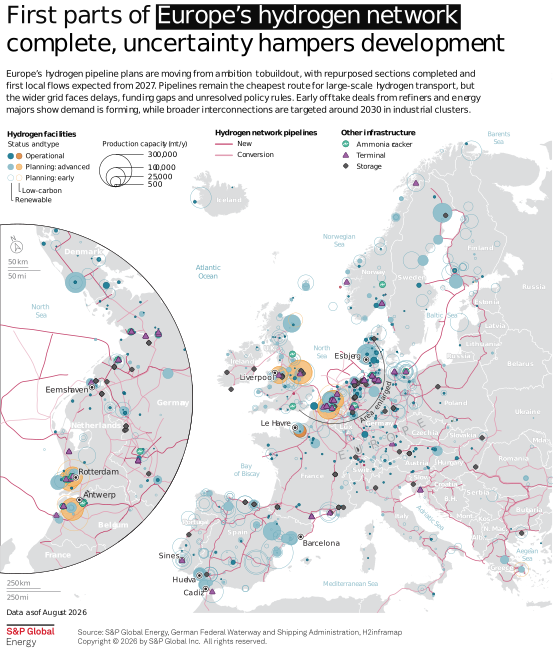
Europe's hydrogen pipeline plans are taking shape, with the first sections of a planned 30,000-kilometer network already completed and primed to start operations.
But developers are facing a reality check in Europe's energy transition, which has stalled infrastructure projects and pushed back development timelines.
Most European countries will rely on domestic production for 2030 clean hydrogen needs, ENTSOG said, while infrastructure developments will expand storage, import and pipeline transport capacity by 2035.
By 2035, infrastructure expansion under the EU's projects of common and mutual interest pipeline reduces unsatisfied demand to 3% at EU level, before rising again to 5% in both 2040 and 2050 as demand growth outpaces infrastructure build-out.
Insufficient transmission capacity
The 2026 assessment also extends the planning horizon to cover 2035 and 2050 -- years not assessed in the 2024 report -- and focuses exclusively on the PCI/PMI infrastructure level of mature hydrogen projects, dropping the "Advanced" infrastructure level assessed in 2024 following a recommendation from the Agency for the Cooperation of Energy Regulators.
The report identifies insufficient transmission capacity and limited market connections as "the primary drivers of hydrogen demand curtailment and market-clearing price spreads across the EU," and concludes that beyond 2040, expansion of cross-border pipeline networks alongside storage and import capacity will be necessary to eliminate remaining infrastructure gaps.
The draft report is open for stakeholder consultation until Oct. 30. Following consultation, the report will be submitted to ACER, the European Commission and EU member states for their formal opinions.