Energy Transition, Chemicals, Metals & Mining, Hydrogen, Renewables, Carbon, Ferrous
September 21, 2026
HCEE India 2026: Renewable hydrogen industry shifts focus to final investment, construction

Editor:
HIGHLIGHTS
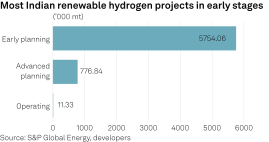
Most India renewable hydrogen projects in early stage
Industries want renewable hydrogen at $1.5-1.75/kg
Methanol bunkering tested; hubs, ports in focus
As India enters the next phase of its clean energy transition, the industry will look for evidence that policy support, production incentives and investment commitments are translating into projects reaching final investment decisions and moving into construction.
Policymakers and industry leaders will deliberate on the next steps for India's clean energy development, targeting a commercial stage by 2028-2030, at S&P Global Energy's Horizons Clean Energy Expansion India Conference 2026, to be held Sept. 24-25 in New Delhi.
India launched a 174.90 billion rupees ($2.10 billion) Strategic Interventions for Green Hydrogen Transition (SIGHT) scheme in 2023 and has since conducted multiple auctions to support the production of renewable hydrogen, electrolyzers and renewable ammonia.
"The support on offer under the SIGHT hydrogen auctions offered some of the lowest subsidy levels of any global hydrogen revenue support scheme," said Matthew Hodgkinson, senior principal analyst for hydrogen at S&P Global Energy.
The industry will be interested in "seeing how long it takes these projects to reach FID and how much state support they require, if any."
The National Green Hydrogen Mission targets producing 5 million metric tons of renewable hydrogen by 2030 and aims to position India as a major participant in global renewable hydrogen trade.
Industry and government sources say the global slowdown and geopolitical issues may delay it.
Trade participants are also expected to discuss the challenges facing project implementation and call for stronger policy support and faster infrastructure development, industry members said.
Renewable ammonia advances
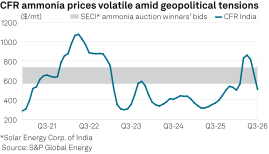
Despite the challenging global environment for clean fuels, Indian developers are eyeing fresh rounds of tenders from Solar Energy Corp. of India amid a push to produce hydrogen derivatives.
"The first round of tenders under the production incentive scheme was more of a price discovery," Sanjay Nagrare, president, Ocior Energy Holding Ltd., a renewable hydrogen developer in India, told Platts, a part of S&P Global Energy.
Following disruptions to conventional fuel supplies, the drive for energy security has prompted traditional sectors to view renewable fuels "in a slightly more serious manner."
According to Nagrare, the market can expand through additional renewable ammonia tenders, the introduction of green urea, and greater use of renewable hydrogen in refineries.
The drive toward energy security has improved India's prospects for adopting renewable ammonia as an import substitution to save foreign exchange.
"India is highly competitive on the international market for exporting renewable ammonia," Hodgkinson said. "However, geopolitical issues in 2026 have pushed energy and supply security to the top of the agenda, increasing the likelihood of domestically produced renewable ammonia being used to displace incumbent gray ammonia imports."
Hard-to-abate sector eyes low-cost H2
India's hard-to-abate industries will be in the spotlight as companies assess the deployment of emissions-reduction technologies and prepare to participate in the country's emerging compliance carbon market.
Industry participants will be closely watching how sectors such as steel, fertilizers and refining are adapting their operations to align with the emerging Carbon Credit Trading Scheme (CCTS), which is expected to lead to carbon credits trading in the compliance market by 2026/2027.
The deliberations are expected to delve into the pricing of renewable hydrogen, which is the key to its adoption in the hard-to-abate sector, they said.
"For green hydrogen to be viable, especially now, the delivered cost of green hydrogen has to fall between $1.5-$1.75/kg," Naveen Ahlawat, president & head – sustainability & decarbonization at Jindal Steel Ltd. told Platts.
"At that cost level, coupled with carbon prices of around $10-$15/mt of CO2 in India and about Eur100/mt in Europe, hard-to-abate sectors would have a strong commercial case to begin transitioning to low-carbon alternatives."
According to Ahlawat, renewable hydrogen could be deployed in India's blast furnaces and DRI units by retrofitting existing technology, with gas-based steel plants potentially blending up to 30% renewable hydrogen.
Platts assessed the India renewable hydrogen term contract at $3.22/kg on Sept. 10, down 0.6% month over month.
Ports, hubs development crucial
Some of the earliest commercial opportunities for renewable fuels are emerging at ports on India's east and west coasts, which are aiming to offer renewable methanol bunkering services and facilitate renewable ammonia exports.
Also, some major binding agreements, including the ACME-IHI, ACME-Mitsubishi Gas Chemical and Reliance-Samsung C&T deals, now require tangible progress on infrastructure and logistics.
Deendayal Port in Gujarat has tested methanol bunkering and V.O. Chidambaranar Port in Tuticorin is pursuing a similar strategy and is now exploring fuel sourcing options.
"The next round is going to be more about building the market," Nagrare said.
Data from S&P Global Energy shows that India has a renewable hydrogen production pipeline capacity of over 6 million mt/year, of which about 112,752 mt has been financed and 11,329 mt is operational.
