Electric Power, Energy Transition, Renewables
September 16, 2026 · Updated September 21, 2026
Unexpected rainfall pressures Brazilian power prices lower

Editor:
HIGHLIGHTS
Unexpected rainfall raises hydro capacity expectations
Power prices drop sharply for October, for March 2027
El Niño predictions point to persistent rainfall
A reversal in weather expectations, with unexpected rainfall across several Brazilian regions, has affected the outlook for hydroelectric availability and pressured power prices in the country.
September has been marked by heavy rainfall and strong winds, especially in Brazil's central-south region, where most of the country's hydro reservoirs are located, the National Meteorological Institute (Inmet) said Sept. 15.
The change in weather, combined with new rain forecasts, has caused a sharp decline in forward power prices, with market participants expecting more availability of cheaper hydroelectric power. Annually, over half of Brazil's electricity generation comes from hydropower plants, according to the Ministry of Mines and Energy.
"In the next six-eight weeks, our models are signaling that intense rain will continue," said Alexandre Nascimento, meteorologist and partner of the São Paulo-based Nottus consultancy firm. "Cold fronts are coming with strength and not remaining restricted to the south, but reaching southeastern and central states as well."
The weather started affecting forward power prices late last week, and continues to pressure them.
Platts' assessment of conventional power in Brazil's southeast-central region, October forward price, was at 146 reais/MWh ($28/MWh) on Sept. 15, down from 217 reais/MWh on Sept. 1. The assessment for March 2027 dropped to 280 reais/MWh ($54/MWh), from 319 reais/MWh on Sept. 1.
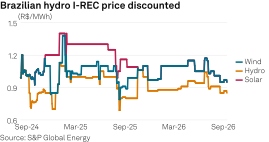
On International Renewable Energy Certificates, hydro prices remained discounted from other technologies, partly due to high supply. Vintage 2026 hydro I-REC was assessed at 0.85 real/MWh (16 cents/MWh) on Sept. 15, compared with 0.95 real/MWh for wind and solar.
"The electricity market was speculative, holding at higher prices, but now reality is sinking in," a trader said.
The uncertainty has been intensified by El Niño, which has been affecting rainfall and temperatures across the country. Recent El Niño alerts from Inmet forecast heavy rainfall in the country's southern region and more intense drought in the northeast. But the predictions were unsure about the central and southeastern regions, where most of the country's hydro reservoirs are located.
"We have been skeptical about most El Niño projections in the market, as our models have been pointing to severe rainfall in the southeastern region," Nascimento said.
Located in Brazil's southeast, São Paulo has recorded the highest rainfall of the month in its records, even with the month far from over, according to Inmet. Besides this city, there was widespread rainfall in recent days in at least seven states, it said on Sept. 15.
"So far, the market has been expecting the rainfall to be concentrated in the south, with increased temperatures in the southeast, and this has not been confirmed," another trader said.
The effect is beginning to be felt in reservoirs. Reservoir capacity remained steady in the week, with central and southeastern reservoirs estimated to reach 55.8% by the end of September, according to the National System Operator (ONS). Northeastern reservoirs are estimated to reach 67.1%, both little changed from the beginning of the month. Reservoir capacity and replenishment are used in ONS's models and directly affect energy prices in the country.
"We are approaching the wet season with reservoirs stable," Nascimento said.
Other effects of El Niño include higher temperatures in many regions, which are already felt in the Brazilian northeast, but it is not yet clear how this will affect electricity demand.
Nottus' meteorological models for early next year are still in conflict due to significant uncertainty in the weather, but Nascimento does not rule out a persistently wet period in summer in some parts of the country.
"The fact that we are facing heavy rainfall right now does not influence forecasts for the summer," he added.
