Energy Transition, Emissions, Carbon
September 16, 2026
INTERVIEW: ACCU developer expects no major Safeguard review changes

Editor:
HIGHLIGHTS
Expects Generic ACCUs to rise toward EP costs
Long-term offtake deals gaining traction
Soil supply expected to scale; SMC premium temporary
Australia's Safeguard Mechanism review is unlikely to produce material changes to baseline decline rates or introduce caps on carbon credit use, with the program working well in its present form, according to Marc Train, CEO of Corporate Carbon, and Julien Gastaldi, CEO of Maki Planet Systems.
Speaking to Platts, part of S&P Global Energy, in an exclusive interview Sept. 10, Train said the scale of industrial decarbonization required and the marginal abatement cost curves mean the ACCU market fills a critical gap that caps on offset use would not address.
The government's 2026-27 Safeguard Mechanism review, whose consultation closed for submissions Sept. 18, sought feedback on post-2030 baseline decline rates and potential limits on ACCU access for compliance.
Corporate Carbon is an Australian multisector developer involved in more than 100 carbon projects under the ACCU program. Maki Planet Systems is a climate technology company working to scale Savanna Fire Management globally.
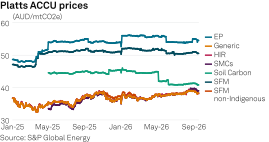
Platts assessed benchmark Generic Australian Carbon Credit Units at A$38.25/metric ton of CO2 equivalent Sept. 16, while Environmental Plantings ACCUs were assessed at A$54.50/mtCO2e and Savanna Fire Management Indigenous ACCUs at A$50.50/mtCO2e.
Safeguard review expectations
Asked about expectations from the Safeguard review, Train said the opening paragraph of the consultation paper stated the mechanism is working well and doing what it's supposed to do.
"We wholeheartedly agree. So we don't expect it to change much," Train said. "From what we saw in the details of the review and the paper, we probably don't expect a whole lot of change."
On whether caps should be imposed on ACCU use for compliance beyond 2030, Train said the scale of industrial decarbonization required represents a significant investment.
"The ACCU market fills that gap really well. We expect the ACCU market to do what it's supposed to be doing, and we don't expect that the caps will come into place," Train said.
Generic to rise, not premiums to fall
Commenting on the Climate Change Authority's recommendation to examine whether 25-year permanence ACCUs remain appropriate for Safeguard compliance, Train said Corporate Carbon is supportive of the 100-year permanence.
"We have existing projects which have 100-year permanence, and when we get the opportunity to transition projects to 100-year, we will," Train said. "It is effectively there to create permanent stores in the land, so we are supportive of it."
Train said he would not expect significant market impact from greater emphasis on 100-year permanence, noting that compliance buyers would probably expect some pricing delta if market dynamics drive that decision.
With Climate Active certification ending in June 2027, Train said the market should expect Generic ACCU prices to rise to meet the cost of production for higher-cost methodologies like Environmental Plantings, rather than premiums compressing.
"What I'd expect is not so much the premium continuing, but rather a rebasing in the price in order to meet and attract pricing associated with higher-cost methodologies like environmental plantings," Train said.
Train noted that the premium market has always traded on smaller volumes compared to Generic purchases, with the voluntary market becoming a smaller percentage as compliance grows.
Gastaldi added that fewer than 5% of Climate Active buyers were actually buying ACCUs, and of those, mostly Indigenous credits.
Offtake deals gaining traction
Train said the appetite for longer tenor offtake deals is more relevant now than ever, with large emitters recognizing supply-demand imbalances.
"We definitely are seeing large emitters who are coming into the sector, recognizing the supply-demand imbalances that are set to come," Train said. "So we are seeing offtakes coming in for five to 10 years and longer, which maybe two years ago weren't as prevalent."
Regarding the permanent exit arrangement for fixed-delivery carbon abatement contracts, Train said Corporate Carbon views CACs as obligations to be managed at the business level to maximize value.
Train said he does not expect CAC exits to materially impact spot supply.
"Given the supply-demand imbalance, and how there's a supply overhang currently, the volume of what we would expect to go through via the CAC mechanism wouldn't impact spot supply today," Train said.
Soil supply, SMC premium
On soil carbon, Train said AgriProve's projects are expected to track in line with expectations, with the proposed 3 metric ton per hectare per year cap aligning with AgriProve's modeling.
Train said the transition to remote sampling via satellite under module 2 will enable soil carbon credits to be generated at scale.
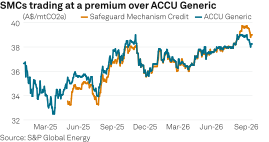
On the Safeguard Mechanism Credit premium over Generic ACCUs, Train said the premium appears to reflect a specific buyer solving a specific need.
"We don't see it as a sustainable trend where a premium would track higher than generics," Train said.
Meanwhile, Gastaldi said the rapid international uptake of Savanna Fire Management methodologies across four major carbon frameworks in less than 12 months reflects recognition of a gap in available climate products.
"It's on the back of the efforts made in Australia in the last few years to improve that method, with a strong track record, especially on integrity," Gastaldi said.
"At a time when the international markets were struggling with relevance and integrity, it's been about showing that we had a community-led, high-integrity, measurement-based method that was directly tackling the issue of a warming climate," Gastaldi said.
Maki is active in Botswana, Zambia and Brazil, with exploration work in Angola and Mozambique, while partners operate in Belize, Mexico, Papua New Guinea and Timor-Leste. The main focus is on sub-Saharan Africa, where the methodology has the most potential, Gastaldi said.
