Energy Transition, Coal, Natural Gas, Electric Power, Maritime & Shipping, Metals & Mining, Emissions, Renewables, Ferrous
September 16, 2026
Global AI data center, air conditioning power demand stalling energy transition: ETC

Editor:
HIGHLIGHTS
New structural demand delays coal phaseout
Clean energy deployment fastest, cheapest ever
Industrial decarbonization lagging, China leads
Surging power demand from AI data centers and air conditioning — with much of this met by coal and gas-fired generation — has stalled the global energy transition despite clean energy deploying faster and more cheaply than anyone predicted, Energy Transitions Commission chair Adair Turner told Platts, part of S&P Global Energy, in an interview Sept. 14.
The rapid renewables deployment was meeting the previously unforeseen demand growth rather than cutting into coal burn in any serious way, Turner said.
And while solar, battery, and EV costs have fallen sharply, with clean electricity growing 2.3 times faster than the overall energy supply in 2025, global emissions have only plateaued rather than fallen.
"If you looked at what has happened to the price of solar photovoltaic, the price of batteries, the rate of increase of electric vehicle sales [...] all of that would make you very optimistic that we can drive a lot of this energy transition to net zero far more rapidly and cheaply than we dared dream just 10 years ago," Turner said.
However, "we're not making progress at anything like the pace to meet the well below 2-degree centigrade commitment [in the UN's Paris climate commitment], let alone the 1.5 °C [target]," he warned. "That's the big story."
The UN Environment Programme warned in a report published at the start of September that the world was set to overshoot 1.5 °C of warming, and that urgent action was needed to contain the climate change risk.
The world remains on a trajectory of roughly 2.5 °C of warming by 2100 under current stated policies, according to the ETC, based on IEA data. Average warming is expected to continue to exceed 1.5 °C through 2030, the ETC noted, citing World Meteorological Organization projections.
Fossil fuel surge
The AI and cooling demand surge has directly delayed the coal and gas phase-out. In the US, data center power consumption is driving up gas burn.
Globally, rising temperatures are structurally increasing air conditioning loads, creating a reinforcing cycle in which climate change itself generates new electricity demand.
China's coal burn is showing signs of falling, and plants are running fewer hours, but India is lagging, Turner said.
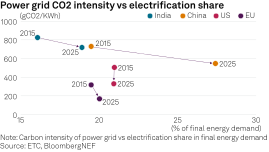
Turner noted that electricity is still only around a fifth of total final energy demand and needs to reach a third within 10 years — a target that is being made harder to hit by overall demand growth.
Critically, Turner said there had been no serious decarbonization beyond the electricity sector. Heat, heavy industry, aviation, and shipping still run overwhelmingly on fossil fuels, keeping emissions stubbornly high.
Turner said that because electricity is more efficient than direct combustion, with fewer conversion losses, final energy demand could still fall in absolute terms even as energy services expand.
Power share
The key to driving down emissions lies in the dual challenge of decarbonizing power grids and electrifying larger parts of energy demand, Turner said.
The electrification of China's road transport fleet, he said, was "absolutely unstoppable," with electric vehicles accounting for large shares of both passenger and road freight fleets.
The pathway would vary from country to country, with some regions having deeply decarbonized electricity systems but lagging in electricity's share of final energy demand.
But there were no easy wins for the grid upgrades needed to meet growing deployment of renewables, Turner said, noting the picture would be different depending on the power mix and demand in each country or region.
Turner said governments have an essential role in setting goals and enabling policies — new grid infrastructure, planning reform, and long-term offtake frameworks — citing the UK's power decarbonization program as a model.
Interest rate pressure
Rising real interest rates since 2019 have compounded the challenge. Green investment was once an easy win in a low-rate environment, Turner said.
Now, AI borrowing for investment is driving interest rates higher still, pushing up capital costs for clean energy projects precisely when deployment needs to accelerate.
Beyond the power sector, industrial decarbonization is lagging.
Only 9% of the 70 near-zero steel plants needed globally by 2030 have reached final investment decision, and the US recorded zero clean industrial investment decisions in 2025, the ETC said.
Turner highlighted one significant exception: a joint project between the ETC and China's iron and steel research institute examining the pathway to net zero for Chinese steelmaking.
China produces 50% of global steel, Turner noted, making its decarbonization trajectory transformational for global emissions.
"It can happen, and it will happen," he said.
