Energy Transition, Natural Gas, Electric Power, Maritime & Shipping, Coal, Emissions, Carbon
September 03, 2026
EU allowances to remain well supported in Q4 but policy risk adds pressure

By Toby Lambert
Editor:
HIGHLIGHTS
EUAs expected to hold firmly above €80/mtCO2e
Potential downside risk from EU ETS review headlines persists
Late compliance deadline buying expected from smaller entities: trader
Nearest December EU allowances are expected to trade in a firm range in the fourth quarter of 2026, with a strong energy complex and the September compliance deadline providing support, though uncertainty over proposed EU Emissions Trading System reforms remains, market participants said.
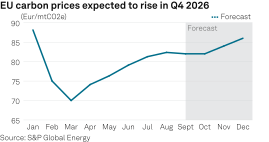
"We see the benchmark holding a €78/mtCO2e to €90/mtCO2e range into the deadline, with the center of gravity in the mid-80s," said Chris Christodoulopoulos, EU allowances trader at environmental services company Global Factor. "The path of least resistance is mildly higher."
Analysts at S&P Global CERA also expect higher ranges in the coming quarter, with their Q4 outlook anchored at €82-86/mtCO2e.
Benchmark nearest-December EUAs were trading at €83.12/metric ton of carbon dioxide equivalent at 12:17 BST on Sept. 3, according to the Intercontinental Exchange. Platts, part of S&P Global Energy, assessed the nearest December contract for EUAs at €84.11/mtCO2e in the previous session.
"The EU ETS review proposal suggests scope for EUA price upside in H2 2026 with the market tightening in 2026 and 2027 left largely untouched," said Sawal Bacha, carbon market analyst at Redshaw Advisors.
The European Commission published its proposal to revise the EU ETS directive on July 17. The proposal included changes that slow the pace of emissions reductions beyond 2030, extend maritime and aviation sector coverage, and establish new funding for decarbonization across covered sectors.
Main drivers
Analysts at S&P Global CERA affirmed a strong energy complex, firm compliance-side demand, and a colder-than-normal Q4 lifting gas-for-power demand as the main potential upside drivers, according to a recent market note.
Christodoulopoulos identified four main drivers currently shaping carbon: "Gas and the geopolitical premium attached to it, which is still the dominant short-term correlation; the end of REPowerEU-related auction supply; investor positioning, which remains structurally long and has been adding on dips; and the political noise around the July ETS revision."
The TTF front-month contract, the benchmark for European natural gas prices, has increased above €70/MWh in recent sessions. Higher natural gas prices can make coal-fired power generation more competitive versus gas, a potentially bullish driver for EUAs.
The most recent Commitment of Traders report, covering the week ended Aug. 28, showed investment funds decreased their net-long positions by 10.85% to 32.5 million allowances. Despite the decline, investment funds remain structurally long.
REPowerEU, an EU initiative designed to support the green transition in light of the Russia-Ukraine war, was partially funded by the auctioning of frontloaded EUAs before achieving the last of its funding targets on July 13, resulting in an auction calendar revision.
The EUA surrender deadline itself is less significant for prices than observers outside the market would assume, Christodoulopoulos added. This is because most compliance entities are often hedged well ahead of the Sept. 30 deadline.
"What we get is a bid at the margin — late-buying from smaller installations, aviation and shipping operators, and the maritime sector is now surrendering against a higher share of verified emissions — but it's worth a couple of euros of support, not ten," Christodoulopoulos said.
Shipping companies must now surrender allowances for 70% of their 2025 verified emissions by Sept. 30, up from the 40% requirement for their 2024 verified emissions.
Bacha broadly agreed with the sentiment, saying "some upward pressure could come from last-minute buying by compliance entities looking to scoop up allowances before the deadline, but it is very difficult to quantify."
In terms of downside risk, Christodoulopoulos said "a credible Ukraine settlement, or the Iran situation cooling, takes the premium out of gas and EUAs follow."
"The second-order risk is positioning: the institutionals are long, and in a market this thin a liquidation doesn't need much of a catalyst," he added.
Average ICE daily traded volumes in August 2026 stood at 19,232 lots, 26.64% lower than the same month in 2025 at 26,217 lots, according to data compiled by Platts.
Policy uncertainty remains
In recent sessions, other market participants have noted the importance of political statements as a driver for the EUA market.
Bacha also said, "bearish policy risks persist with the Commission's ETS reform proposal only at the first step of the legislative journey."
Following the publication of the proposal, the legislative procedure begins, with EU leaders having previously said they sought to finalize the review by the first quarter of 2027.
S&P Global CERA analysts said that the "ongoing ETS reform legislative process — now resuming in earnest with Parliament's Sept. 1 ENVI Committee meeting — also introduces headline risk through year-end," which could impact prices for the nearest-December contract.
"After Sept. 30, this becomes a policy market again, trading the trilogue on the commission's revision, the Market Stability Reserve parameters, and ETS2 timing," said Christodoulopoulos.
A trilogue is an informal negotiation between representatives of the European Parliament, the Council of the EU, and the Commission to reach a provisional agreement on a legislative proposal.
The EU's ETS2 is a new emissions trading system created to cover and address CO2 emissions from fuel combustion in buildings, road transport, and additional sectors.
