Energy Transition, Electric Power, Metals & Mining, Crude Oil, Renewables, Non-Ferrous, Emissions
August 27, 2026 · Updated August 28, 2026
INTERVIEW: ADB highlights rapid clean energy leapfrogging in Asia-Pacific

Editor:
HIGHLIGHTS
ADB pledges $10B for ASEAN Power Grid over 10 years
Pan-Asia Power Grid Initiative targets $50B mobilization
Critical minerals key to Asia-Pacific's fuels-to-materials shift
The Asian Development Bank is scaling up support for regional power grids and critical mineral supply chains across Asia-Pacific, arguing that the region's pursuit of energy security in the wake of the Middle East conflict has strengthened rather than weakened the case for accelerating decarbonization.
Pradeep Tharakan, director, energy transition at ADB's Energy Sector Office, said the region is also witnessing significant "leapfrogging" in clean energy technology, with smaller economies such as Nepal and Pakistan emerging as frontrunners in electric-vehicle penetration and distributed solar generation.
"With the Middle East conflict, what was highlighted or reinforced is something clean energy advocates have argued all along: that energy security and decarbonization are not mutually exclusive factors. They are mutually reinforcing," Tharakan told Platts, part of S&P Global Energy, in an online interview Aug. 25.
"If you are focused on energy security, we need to really invest in renewables, strong grids, connected systems and energy storage. And all of that will lead to decarbonization anyway."
Tharakan said the ongoing Middle East conflict has crystallized an argument long made by clean energy advocates: that energy security and decarbonization are complementary rather than competing priorities for the region's fast-growing economies.
He pointed to a "massive increase" in procurement of solar photovoltaic energy across small and large Asian economies over the past year, along with a shift toward EVs in markets, including smaller ones such as Nepal, as evidence that the link between the two goals has become clearer to policymakers.
"As recently as a year ago, about $3 trillion was invested in the energy space: $2 trillion for clean energy and $1 trillion for fossil fuels," Tharakan said, noting that even during the pandemic-era demand destruction, the world continued investing in clean energy.
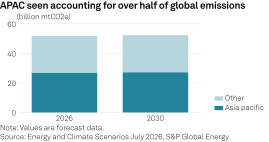
Asia-Pacific emissions are expected to rise from 26.96 billion metric tons of CO2 equivalent in 2026 under a base-case scenario to 27.19 billion mtCO2e by 2030, according to S&P Global Energy.
Grid, minerals-to-manufacturing investment
ADB has pledged about $10 billion over the next 10 years toward investments linked to the ASEAN Power Grid, Tharakan said, as part of efforts to help member countries build more resilient and interconnected energy systems.
Earlier in 2026, at ADB's annual meeting, the bank announced the Pan-Asia Power Grid Initiative, or PAGI, under which it aims to mobilize up to $50 billion over the next decade, Tharakan said.
"For countries to be resilient, they need to be interconnected and benefit from a larger pool of energy resources," Tharakan said.
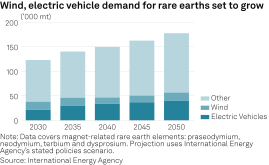
The bank has also turned its attention to the materials underpinning the energy transition, launching a critical minerals-to-manufacturing supply chains initiative, or CMM, in 2025, with an initial focus on battery minerals, copper and rare earth element value chains.
"We realized that if we want to help our countries with the energy transition, the transition requires materials and equipment like electrolyzers, wind turbines and solar PV panels, and those require minerals," Tharakan said.
Some of the supply chains feeding this manufacturing base remain highly concentrated, Tharakan said, adding that diversifying them is crucial for managing and maintaining energy security across the region.
ADB's efforts in this area are coordinated with public- and private-sector partners, blending climate finance from sources such as the Climate Investment Funds and the Green Climate Fund with philanthropic and commercial capital, he said.
Focus on just transition
Tharakan said transition plans are improving across the region as the falling cost of renewables increasingly makes them the default choice for governments and corporates, though more work is needed at the subnational level, where cities face the biggest infrastructure and financing challenges.
"The transition story needs to be just. If you do it in an unplanned way, you create inequitable and negative impacts," Tharakan said, pointing to a widening "energy-transition divide" and noting that roughly 60 million people across Asia-Pacific still lack access to electricity.
As fossil fuel use declines over time, communities and industries built around those sectors in countries such as Indonesia and India will need to find alternative livelihoods, Tharakan said, adding that upskilling and reskilling programs will be necessary to manage the shift.
Asia-Pacific must continue to focus on decarbonization, with energy demand set to climb further on the back of rising cooling needs, artificial intelligence and data center growth, urbanization and industrial electrification, Tharakan said.
"Asia-Pacific has no choice but to decarbonize as it develops," Tharakan said. Regional investment has bounced back to prepandemic levels, he said, citing International Energy Agency investment data.
China remains the world's largest market for clean energy investment, with India close behind, potentially ranking just after the US, Tharakan said.
He highlighted examples of countries emerging as leaders in clean technology adoption across the region. While Norway has the world's highest share of EVs in new car sales, Nepal ranks second, Tharakan said, attributing this to the country's hydropower-based electricity system, which allows drivers to reduce reliance on imported oil.
"We are seeing some very significant leapfrogging," Tharakan said, citing Pakistan's rapid build-out of distributed solar generation capacity over the past three to five years.
