Energy Transition, Electric Power, Renewables
August 27, 2026
Brazil leads Latin America in data center growth on renewable energy

Editor:
HIGHLIGHTS
Brazil reaches 706 MW datacenter capacity
Campinas city emerges as top hub with 316 MW
Fortaleza targets overseas data processing
Brazil has been leading investments in data centers among Latin American countries, due to the country's high renewable generation capacity and local data consumption.
By August, Brazil had a total of 706 megawatts of data center inventory, a record-high increase of 106 MW from December 2025, reaching about half of Latin America's total capacity, according to a recent study from JLL Research. Since 2012, data center capacity in the country has increased more than sixfold, driven by cloud computing and AI, and the current vacancy rate is only 4%.
"The availability of renewable energy is a major appeal and makes Brazil stand out against other countries in its region," Bruno Porto, manager for logistics, industrial and data center real estate at JLL, told Platts on Aug. 26. "If you look at the pipeline, to projects under construction, Brazil is even further ahead among its peers."
Brazilian capacity is expected to continue growing, with a total of 660 MW under construction, of which 56% occupancy is pre-committed, JLL data shows.
The development is expected to drive renewable energy consumption, as most hyperscalers demand renewable sources for their datacenters, securing their supply mainly via power purchase agreements, or PPAs. With an installed capacity of 219 GW, 77% of which is from renewable sources, Brazil has become attractive to this sector.
"All new projects require energy to be 100% renewable," Rafael Garrido, CEO of 247 Data Centers said. "Not using renewable energy is out of the question, and that is one of the reasons Brazil is emerging," he added.
Another competitive advantage for Brazil is its existing submarine cable infrastructure, which has established the country as South America's primary connectivity port.
Major submarine cable systems landing in the Brazilian cities of Fortaleza, Rio de Janeiro and Santos provide direct, high-capacity links to North America, Europe, and Africa, ensuring low-latency connectivity essential for digital services.
But a strong local data consumption also creates a local demand for these structures, most of which are currently located near large urban areas.
"It is estimated that around 60% of the Brazilian data processing occurs outside the country, meaning there is room to increase local processing," Porto said.
Campinas as a new hub
For data centers aimed at supplying local demand, it is critical to be located close to consuming centers, making the regions near the cities of Rio de Janeiro and São Paulo the primary locations for projects.
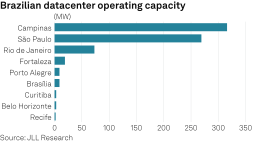
Campinas, a city with a population of 1.2 million and 93 km from São Paulo, has become the country's main hub for data centers, with the fastest inventory and expansion. Capacity has reached 316 MW in August, with a 1% vacancy rate, JLL data shows.
For comparison, São Paulo and its neighboring city, Barueri, have a combined 269 MW, while Rio de Janeiro has 73 MW.
"Campinas, less densely populated than São Paulo, provides cheaper land and easier access to transmission infrastructure," Porto said.
As a result, the city attracted hyperscalers such as Microsoft and Amazon Web Service, both with operations in the city, according to sources. Microsoft has announced it is expanding operations with facilities under construction in Hortolândia and Sumaré, both in Campinas' metropolitan area.
These hyperscalers bring service providers, many of which require their own nearby data centers, creating a cycle, Garrido said.
"AI agents, for one, need to give immediate answers, which requires a low latency rate, so they must be located near users," Garrido said.
Exporting data processing
Brazil's northeastern city of Fortaleza is emerging as a data center hub focused on overseas demand. The city, being near relevant submarine connections, is seen as a privileged place to send data overseas with lower latency.
As of August, the city has 19 MW of datacenter capacity, with a 25% vacancy rate, and a total of 227 MW under construction. Most of the capacity under construction belongs to a single project from the Chinese company ByteDance, owner of TikTok social network, under construction at the Pecém port complex with 200 MW of capacity at launch.
Limited access to energy infrastructure in the region, especially for planned expansions, has been one of the obstacles to additional investments in the region, according to Porto.
But many projects in Brazil are also waiting for regulatory definitions before being implemented. A law establishing a special tax regime for data centers, called Redata, is being discussed in Congress, and many are waiting for the approval to benefit from the proposed tax reductions.
"The Redata law was welcomed by data center companies and can become a catalyst for investments, once approved," Porto said.
Platts is a part of S&P Global Energy.
