Electric Power
November 02, 2026
Meta leads US corporate clean power purchasing, focuses on nuclear capacity

By Nushin Huq
Editor:
HIGHLIGHTS
Meta contracts 32.2 GW clean energy globally
Policy uncertainty challenges investment plans
Meta Platforms Inc. has emerged as the largest corporate purchaser of clean power in the US and the third-largest globally, according to S&P Global Energy data.
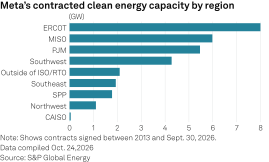
As of Sept. 30, Meta has contracted 32.2 gigawatts of clean energy capacity worldwide, behind Amazon.com Inc. and Microsoft Corp. Nearly 30 GW of that capacity is in the US. In 2026 so far, Meta has contracted for 10.6 GW, according to S&P Global Energy CERA data.
The hyperscaler has matched 100% of its electricity use with clean energy since 2020, Amanda Yang, Meta's head of clean and renewable energy, told Platts, part of S&P Global Energy.
"We prioritize the same grid where we can because that's what helps bolster the electricity grids and the power needs in specific locations," Yang said.
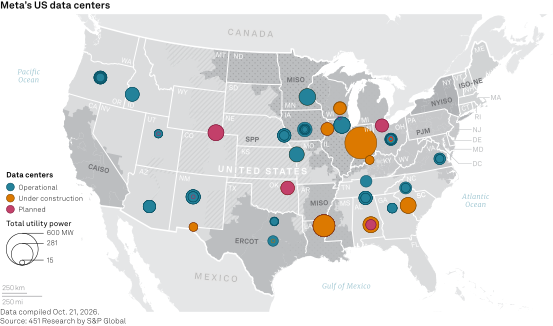
But amid surging power demand driven by the global data center infrastructure build-out, Meta has had to become more "nimble," Yang said, focusing on matching total global yearly power use instead of using a 24/7 carbon-free energy strategy, which other hyperscalers such as Google LLC have adopted.
"We are thinking about our clean energy work from a portfolio basis, but I don't think that the fundamental principle to prioritize local grids has changed really overall," Yang said. "There are some places where we may have had to flex a little bit just because of the speed at which we need to move, but overall that fundamental principle has not changed."
Nuclear deals
While solar capacity still dominates Meta's portfolio, nuclear power is also becoming a cornerstone of the company's strategy. Over the last year and a half, Meta has announced up to 7.7 GW of nuclear commitments in the US, making it one of the largest corporate nuclear purchasers globally.
That strategy supports license extensions and power output uprates at existing facilities, and investments in small modular reactor (SMR) technology through partnerships with developers Oklo Inc. and TerraPower LLC, Yang said.
Meta's agreements supporting existing plants include a 20-year power purchase agreement with Vistra Corp. that will supply more than 2,600 megawatts from the 908-MW Davis-Besse and 1,268-MW Perry plants in Ohio and the 1,872-MW Beaver Valley plant in Pennsylvania. In 2025, Meta signed a 20-year agreement with Constellation Energy Corp. for the 1,121-MW output of its Clinton Power Station in Illinois. The plant has a current operating capacity of 1,060 MW, according to S&P Global Market Intelligence data.
Meta's nuclear capacity deals include "extension of life" provisions for existing nuclear facilities as well as uprates, combining outputs and zero-emission credits, according to Yang.
The US Department of Energy recently awarded conditional loans to Constellation and Vistra to support uprates at nuclear plants. A $5 billion loan to Constellation, announced Oct. 27, would support uprates at as many as eight plants, including Clinton. A loan of up to $4.2 billion to Vistra, announced Oct. 5, would support uprates at the Ohio and Pennsylvania plants, as well as perhaps at Vistra's two-unit Comanche Peak plant in Texas.
Yang declined to comment on exact deployment timelines for the SMR projects, but she said the company is "confident enough in terms of that deployment cycle that we're putting real capital behind advancing all of this advanced nuclear."
"Obviously, this is something that we're realistic about in terms of the timelines associated with new nuclear," Yang said. "There are more extended development timelines around that, and there's some risk around that from a cost perspective."
"All of that is new capacity that will be added to the power generation infrastructure to expand the footprint of those nuclear facilities," she continued.
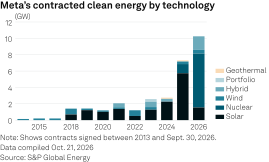
Meta is also considering newer technologies, such as advanced geothermal and long-duration energy storage, and has announced a capacity reservation agreement for nearly 1 GW of space solar, a technology that harnesses near-infrared light in space and brings it to Earth.
"That could really expand the generation profile and potential of existing solar facilities on the ground," Yang said.
Challenges
Still, policy uncertainty remains a challenge for clean energy investment, Yang said.
A key part of overcoming that hurdle is communicating how clean energy agreements can bring benefits to local communities through new jobs, local tax revenue, reduced emissions and overall grid resiliency.
"I think that these are things where corporate interests also dovetail with the overall US interest to make sure that we are building appropriately and setting ourselves up for success," Yang said.
Longer-term, Meta is looking at technology diversification as a risk-management strategy, Yang said.
"That's the reason why we're working on supporting a variety of new technologies and advanced clean energy technologies at the same time that we're pursuing the already-commercialized clean energy technologies," Yang said. "It provides fuel diversification, if we're thinking about fuel exposure and supply chain risk from that perspective, to be able to have access to energy supply that is not exposed to a cyclical commodity."
Allocation frameworks also remain a challenge amid a nationwide focus on electric bill affordability.
"We recognize that this construct may need to be modernized as we think about a very different energy sector today than what we've seen from the last two decades," Yang said. "And so that's also why we support policies that really help ensure that all large energy customers like us, like data centers, manufacturers, are responsible for paying for the costs that they are generating so that other customers aren't bearing those expenses."
